

Sleepaxa FAQ
Sleepaxa FAQ
The most honest FAQ
in eyewear.
Sleepaxa is not generic blue-light eyewear. It is patent-backed, lab-tested photobiological eyewear — designed around how specific wavelengths of light affect visual comfort, migraine sensitivity, sleep hygiene and screen use.
Patent-backed
Granted Indian utility patent No. 587746 (NeuroCalm FLX+).
Lab-tested
Spectrometer lab report provided with every order.
Optometrist-led
Built by an optometry team, clinically guided (Ex-AIIMS).
Not generic
Wavelength-selective lenses, not a single broad tint.
Granted Indian Patent No. 587746 · verify
Spectrometer-tested lenses
Optometry-trained support
Prescription-ready
Made in India
Reviewed by: Sleepaxa Optometry Team · Clinical guidance: Dr. Monica Chaudhry, Ex-AIIMS Professor · Last updated: July 2026
Evidence status: technical reports, independent lab testing, patent documentation, and selected external research references.
At a glance
Sleepaxa vs generic glasses
| Generic blue-light glasses | Sleepaxa | |
|---|---|---|
| Lens type | General tint or coating | Wavelength-selective photobiological lens |
| Proof | Usually no test report | Spectrometer lab report with every order |
| Technology | Generic, unbranded | NeuroCalm FLX+ · Circadian560 · Chrome Assist |
| IP | None | Granted Indian utility patent (587746) + 5 pending |
| Made by | Importer / marketer | Optometry team + clinical advisory board |
| Prescription | Limited or none | Zero power, single-vision, progressive, bifocal, prism |
| Purpose | Broad "screen comfort" | Migraine, sleep, screen & light-sensitivity, tuned separately |
"Generic blue-light glasses" describes the typical single-tint / imported category, not any specific brand. Compare the specifics for yourself.
Quick decision
Who should choose what?
Choose FL-41 Light
Office lights, mild photophobia, indoor screens, everyday migraine triggers.
Choose FL-41 Dark
Severe photophobia, bright outdoor light, post-concussion light sensitivity.
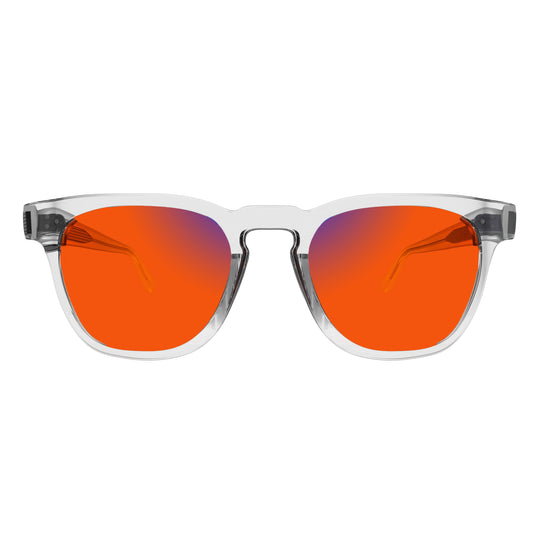
Choose Amber Sleep
Evening screen use, sleep hygiene, indoor LED exposure into the evening.
Choose Red Sleep
Strict light control in the 1–2 hours before bedtime.
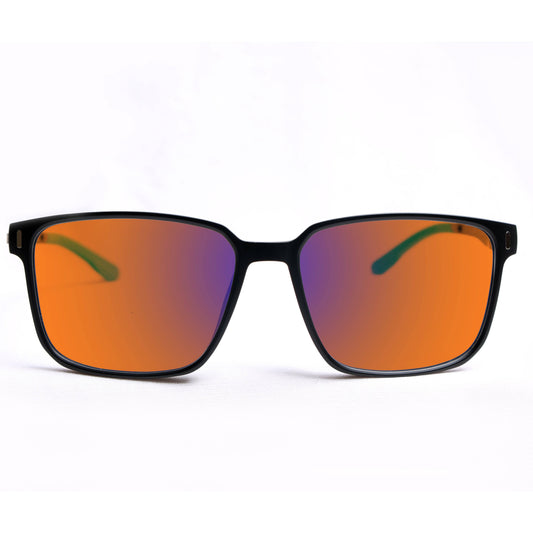
Choose DayActive 1.0
Gaming, coding, studying, long screen sessions when migraine isn't the focus.
Still unsure? See the full Category Comparison or talk to our optometry team on WhatsApp.
01
Choosing the right lens
Which Sleepaxa glasses should I choose?
Choose FL-41 for migraine and light sensitivity, Amber or Red for evening light and sleep, and DayActive 1.0 for daytime screen comfort.
Match the lens to the light problem. See the full guide on the Category Comparison page.
What is the difference between FL-41 and normal blue-light glasses?
FL-41 is a specific rose-tinted, wavelength-selective lens profile linked to migraine and photophobia comfort; generic blue-light glasses are usually a light general coating.
Sleepaxa's FL-41 is powered by its patented NeuroCalm FLX+ dual-band technology, not a generic tint.
Are amber and red sleep glasses the same?
They share the goal of reducing short-wavelength light, but differ in strength and timing.
Amber is lighter — wearable from the afternoon into the evening and for indoor harsh light through the day. Red is the darkest, strictest option, made to wear only in the 1–2 hours before sleep.
Can one pair do everything?
One pair can help in more than one situation, but each Sleepaxa category is tuned for a different job.
Matching the lens category to your specific light problem gives the clearest, most comfortable result.
02
Why Sleepaxa is different
How is Sleepaxa different from generic blue-light or sleep glasses?
Sleepaxa is a photobiological eyewear company with its own granted patent, its own research division, and its own lab-tested lenses — not a reseller of generic tinted imports.
Generic "blue blockers" are usually mass-produced tinted lenses with broad, unverified claims. Sleepaxa engineers wavelength-selective lenses tuned to specific light-biology targets (the melanopsin / ipRGC pathways), protects the technology with a granted Indian utility patent (No. 587746), documents the science through Acieon Labs, and independently lab-tests every lens against ISO/ANSI/AS-NZS standards.
Is Sleepaxa just an importer or reseller?
No. Sleepaxa's lenses and frames are designed, developed and manufactured in India, with its own intellectual property — not imported and rebranded.
Frames are hand-finished in Surat; the lens technology is protected by a portfolio of 6 disclosed inventions (1 granted + 5 pending). Sleepaxa owns the technology it sells.
What does "photobiological eyewear" actually mean?
Photobiological eyewear is eyewear designed around how specific wavelengths of light interact with the biology of the eye — not just how bright light looks.
Instead of dimming everything, it selectively shapes the wavelengths that matter to the non-visual light system (melanopsin and intrinsically photosensitive retinal ganglion cells, or ipRGCs), which influence circadian rhythm and light-triggered discomfort.
Who builds and clinically guides Sleepaxa?
Sleepaxa is built and developed by a team of optometrists, and guided by a clinical advisory board that includes an ex-AIIMS professor.
Founder and lead inventor Suraj Dubey is a senior optometrist and researcher (ORCID 0009-0003-7510-9254). The clinical advisory board includes Dr. Monica Chaudhry — Director MCVI and a former faculty member (professor) at the All India Institute of Medical Sciences (AIIMS), New Delhi.
Why does having a research division (Acieon Labs) matter?
It separates evidence from selling — so the science can be checked independently of the shop.
Acieon Labs is the research and intellectual-property division of Sleepaxa Private Limited. It publishes patents and DOI-linked research and does not sell products. Explore it: Science by Acieon Labs.
Are Sleepaxa lenses made in India?
Yes — designed, developed and manufactured in India, with frames hand-finished in Surat.
Sleepaxa is a DPIIT-recognised Indian startup (DIPP142300), CTRI-registered (CTRI/2024/07/070580), registered in Gujarat.
Is Sleepaxa an influencer or dropshipping brand?
No. Sleepaxa is built by a senior team of optometrists and guided by a clinical advisory board — with its own patents and research, not influencer-marketed generic imports.
The lens technology is developed in-house and protected by a granted utility patent plus pending applications. Credibility comes from clinical and scientific work, not paid endorsements.
How wide is Sleepaxa's lens range?
Sleepaxa offers one of the widest wavelength-tuned ranges available — a different lens for each light problem, not one generic tint for everything.
The range spans FL-41 in Light and Dark tints, indoor and outdoor options, Amber and Red sleep lenses, Circadian560 blocking up to ~560 nm, and DayActive 1.0 for daytime screens.
Can I get a lens tuned to specific wavelengths (custom wavelength)?
Yes — Sleepaxa offers custom lens options, including custom wavelength / tint requests, so the lens can be matched to the wavelengths you need managed.
This is done within lab-verified limits and confirmed with our team. Bespoke wavelength selection is something very few eyewear brands offer.
Does every Sleepaxa order come with a lab report?
Yes — every Sleepaxa lens is spectrometer-tested, and a lens lab report is provided with the order.
That means independent, per-order transparency about exactly how your lens performs across wavelengths — not a single generic marketing claim applied to everything.
What support does Sleepaxa offer?
Responsive, optometry-trained expert support — typically within 24 hours — on WhatsApp.
The team can help you choose tint strength, prescription, lens index and fit, before and after you buy.
Is Sleepaxa's patent a utility patent, and why does that matter?
Yes. Indian Patent No. 587746 is a granted utility (invention) patent — substantially harder to obtain than a design registration.
A utility patent must describe an invention that is genuinely novel, non-obvious and useful, examined on those grounds by the patent office. It was granted with all 10 claims allowed — India's first granted patent in photobiological eyewear. Verify on the register.
How does Sleepaxa compare to other blue-light, migraine or sleep glasses?
Sleepaxa is built differently from most options — a photobiological company with a granted utility patent, an in-house research division, per-order lab reports, custom-wavelength options and a full prescription range: a combination few brands offer together.
Many blue-light or sleep glasses are single-tint or imported and rebranded, with broad claims and no published testing. Sleepaxa focuses on wavelength-selective lenses, publishes independent lab data, and documents the science through Acieon Labs. Compare the specifics rather than take our word for it.
03
Migraine & light sensitivity
Do migraine glasses actually work?
For many light-sensitive people they help with comfort, but they are not a cure and results vary by person.
FL-41 tinted lenses have been studied for light sensitivity and photophobia and may help some users manage light-triggered discomfort as part of a broader migraine plan. Persistent or severe symptoms should be discussed with a clinician.
Evidence note: FL-41 lenses have been studied for photophobia and migraine-related light sensitivity. Sources: University of Utah Moran Eye Center, Association of Migraine Disorders.
Will Sleepaxa FL-41 glasses cure my migraine?
No. They are not a cure and do not replace medical care.
They may help some users manage light-triggered discomfort as part of a broader plan.
How much light does the FL-41 lens actually filter?
Sleepaxa's FL-41 lens filters roughly 87–88% of the 480–520 nm migraine-trigger band (about 12–13% transmitted), while keeping soothing red wavelengths high (620–700 nm at ~87–100%).
Visible light transmittance is about 41%, with UV400 protection. Independently lab-tested (TM-3+ spectrometer, ISO 12312-1 / ANSI Z80.3 / AS/NZS 1067.1).
Full specs: Lens Library.
Can I wear FL-41 glasses indoors?
Yes — FL-41's rose tint is designed for indoor use with fluorescent lights, LEDs and screens.
Unlike dark sunglasses (which can make normal light feel harder over time for some people), FL-41 keeps vision usable indoors. For chronic light sensitivity, get advice from an eye-care professional on how much to wear.
How long should I try them before I judge?
Start with short sessions and increase gradually based on comfort.
Many users adapt over days to weeks. Severe or changing symptoms should be discussed with a clinician.
Does FL-41 come in different strengths (light vs dark)?
Yes — Sleepaxa offers FL-41 in a Light tint and a Dark tint.
The Light tint suits mild, everyday light sensitivity, office lighting and indoor screens; the Dark tint is deeper for severe photophobia, post-concussion light sensitivity and bright outdoor light.
Can I wear Sleepaxa migraine glasses outdoors?
Yes — NeuroCalm FLX+ / FL-41 has indoor and outdoor options.
The darker tint suits bright outdoor light while the rose base keeps colour perception usable, so you get comfort without switching to opaque sunglasses.
Not sure which tint is right? Talk to our optometry team on WhatsApp.
04
Sleep & evening light
When should I wear amber vs red sleep glasses?
Amber: afternoon into the evening, and for indoor harsh light through the day. Red: only the 1–2 hours before sleep.
Red is darker and blocks more, for the strictest pre-sleep light control; amber is the flexible everyday-evening option.
How much blue light do the sleep lenses block?
Sleepaxa's amber sleep lens blocks about 99.87% of blue light across 380–500 nm, and roughly 99.95% at the 480 nm melanopsin peak.
Visible light transmittance is about 50%, with UV400 protection. Independently lab-tested.
Full specs: Lens Library.
Do sleep glasses actually improve sleep?
The evidence is modest and honest: reducing short-wavelength evening light may support your natural wind-down, but glasses are one input, not a sleep cure.
Some studies suggest wearing amber-tinted lenses in the 2–3 hours before bed may support melatonin and help some people fall asleep a little easier. Dimming screens and a consistent routine matter too. We describe this as evening light hygiene, not a guaranteed outcome.
Evidence note: amber lenses worn before bed have been studied for sleep. Source: Chronobiology International (amber lenses & sleep, randomized trial).
Will they increase my melatonin?
We don't promise hormonal outcomes. They help reduce short-wavelength evening light exposure, which is part of a healthy pre-sleep routine.
Compare the two: Amber vs Red sleep lenses.
05
Screen, gaming & DayActive
Do blue-light / screen glasses protect my eyes from permanent damage?
No — and we won't pretend otherwise. Current eye-health guidance does not establish that normal screen blue light causes permanent eye damage.
So we position DayActive around comfort, glare and contrast for long screen sessions — not fear. If a lens helps you feel more comfortable during a long day, that's a real benefit; permanent-damage protection is not the claim.
Context: American Academy of Ophthalmology — blue light and screens.
What is DayActive 1.0 for?
Daytime screen comfort — gaming, coding, study and office work — when migraine is not the main concern.
The mid-yellow lens is tuned to reduce glare and support contrast during long sessions, without the darkness of sleep lenses. It is a comfort lens, not a migraine or sleep lens.
Are DayActive glasses good for gaming?
Yes — they're built for long gaming, streaming and screen sessions where you want a calmer, higher-contrast view.
If your main issue is migraine or photophobia, FL-41 is the more relevant category.
06
The patented technology
What is NeuroCalm FLX+?
NeuroCalm FLX+ is Sleepaxa's patented, dual-band FL-41 lens technology for migraine-associated light sensitivity and photophobia.
It independently attenuates two tuned wavelength bands while preserving photopic luminance and colour balance. Protected by Indian Patent No. 587746 (application 202521094370), granted with all 10 claims allowed — India's first granted patent in photobiological eyewear. Powers Sleepaxa's FL-41 migraine glasses.
Register: acieon.com/patents.
What is Circadian560?
Circadian560 is Sleepaxa's sleep-lens technology for evening light hygiene, targeting short-wavelength evening light up to about the 560 nm boundary of the melanopsin sensitivity range.
It powers Sleepaxa's Amber and Red sleep glasses. IP status: Indian Patent Application 202521120977 (pending).
What is Chrome Assist?
Chrome Assist is Sleepaxa's chromatic-contrast lens technology, designed to support colour discrimination and visual clarity.
IP status: Indian Patent Application 202621061642 (pending, complete specification).
What deeper technologies is Acieon Labs developing?
Beyond NeuroCalm FLX+, Circadian560 and Chrome Assist, Acieon's pending portfolio includes spectrally-differential photochromic kinetics, an adaptive biological light-assessment platform, and a state-dependent inter-layer optical gating lens.
These represent deeper photobiology R&D — light management that adapts by spectral band and by state. Register: acieon.com/patents.
07
Prescription & fit
Are prescription options available?
Yes — every category is available in zero power and prescription: single-vision, progressive, bifocal and prism.
High-index (thinner) lenses and custom lens fitting in eligible frames are available where supported. Provide a valid prescription and fitting details to confirm.
Can I send in my own frame?
Sleepaxa offers custom lens fitting in eligible frames.
Frame shape, prescription thickness and available lens space are checked before confirmation.
What matters most for a prescription order?
Accuracy of your prescription, PD (pupillary distance), lens power and frame fit.
Our optometry-trained team can guide you before you order — accuracy matters more than any marketing feature.
Ready to order with power? Custom Fit & prescription guidance.
08
Science, testing & trust
How are Sleepaxa lenses tested?
Every lens is independently tested on a TM-3+ spectrometer against ISO 12312-1, ANSI Z80.3 and AS/NZS 1067.1 standards.
Testing measures visible light transmittance, blue-light and melanopsin-peak attenuation, red-light transmission and UV protection — published as lab reports rather than marketing claims.
See the spectral data: Lens Library.
Is Sleepaxa's research peer-reviewed?
Honestly: our research is published as DOI-linked open-access deposits and technical reports — not journal peer-reviewed unless specifically stated.
There are 9 DOI-linked open-access research works on Zenodo, authored via the research division, Acieon Labs. We label status accurately rather than overstating it.
Index: acieon.com/publications.
What is Acieon Labs?
Acieon Labs is the research and intellectual-property division of Sleepaxa Private Limited. It publishes science and patents and does not sell products.
Sleepaxa is the product division (eyewear, consultation, fulfilment); Acieon is the evidence layer. Learn more: Science by Acieon Labs.
Is Sleepaxa recognised or registered?
Yes — Sleepaxa Private Limited is a DPIIT-recognised startup (DIPP142300) and CTRI-registered (CTRI/2024/07/070580), registered in Gujarat, India.
It holds granted Indian Patent No. 587746 and is recognised as a Top Brand and Amazon's Choice on Amazon.
09
Buying, shipping & policies
How much do Sleepaxa glasses cost?
Sleepaxa glasses typically range from about ₹3,299 to ₹8,499, depending on model, tint and lens options.
Prescription, high-index and progressive/bifocal/prism options may affect the price.
Is Sleepaxa available with fast shipping in India?
Yes — Sleepaxa ships across India; prescription pairs are precision-made and typically delivered in about 7–9 working days.
For current shipping timelines by region and product type, see the live shipping policy.
What is the return / guarantee policy?
Please refer to the current live returns and warranty policies for exact terms.
Frames carry a warranty; returns and replacements follow the published policy.
Are Sleepaxa glasses a medical device?
No. Sleepaxa eyewear is designed to support visual comfort and light management.
It is not a medical device, does not diagnose, treat, cure or prevent any disease, and should not replace advice from a qualified medical professional.
Go deeper
Explore the Category Comparison, the Lens Library (VLT & wavelength specs), the company behind it (Sleepaxa Private Limited), and the science at Science by Acieon Labs.
Sleepaxa eyewear is designed to support visual comfort and light management. It is not a medical device, does not diagnose, treat, cure or prevent any disease, and should not replace advice from a qualified medical professional. Answers reflect Sleepaxa's honest positioning; individual experiences vary. Lab figures are independently tested and accurate at the time of publishing.
How Sleepaxa Compares in India
Short answer: Sleepaxa is India's first photobiological eyewear company — lenses engineered by wavelength (not a generic "blue-cut"), backed by its own research & IP division (Acieon Labs), 9 DOI-linked research works, 6 patents (1 granted, 5 pending), an optometrist founder and an Ex-AIIMS clinical advisor — available in zero power and full prescription, or fitted into your own frame.
| Brand | Primary focus | Own photobiology R&D lab | Published research (DOIs) | Patents (photobiology) | Optometrist / clinical-led | Dual-band FL-41 migraine lens | Amber sleep (full melanopsin range) | Zero-power + full Rx (SV / progressive / bifocal / prism) | Custom lens-fit (your own frame) |
|---|---|---|---|---|---|---|---|---|---|
| Sleepaxa | Photobiological eyewear for migraine, sleep & screen comfort | Yes — Acieon Labs | Yes — 9 works | Yes — 6 (1 granted #587746 + 5 pending) | Yes — optometrist-founded + Ex-AIIMS advisor | Yes — NeuroCalm FLX+ (granted) | Yes — Circadian560 (pending) | Yes — zero power + full Rx | Yes |
| Lenskart | General & prescription eyewear, fashion + blue-cut (BLU) | — | — | — | Optical retail (in-store opticians) | — | — | General Rx | — |
| Titan Eyeplus | General & prescription eyewear + blue-cut | — | — | — | Optical retail (in-store opticians) | — | — | General Rx | — |
| Noctix | Blue-light / sleep glasses (day yellow + night amber) | — | — | — | — | — | Amber blue-blocker (sleep) | Clip-on for Rx | — |
| Okno (Eyewearlabs) | Fashion + blue-light + gaming eyewear (HEV 400–450 nm) | — | — | — | — | — | — | Power options | — |
Comparison based on publicly available brand information (2026). "—" means not a stated focus of that brand, not a judgement of product quality. Sleepaxa respects other Indian eyewear brands; the table is intended only to clarify category differences.
Comparison & Alternatives
How is Sleepaxa different from Lenskart or Titan Eyeplus blue-cut glasses?
Lenskart and Titan Eyeplus are large general and prescription eyewear retailers whose "blue-cut" lenses typically filter high-energy 400–450 nm light for everyday screen comfort. Sleepaxa is a photobiological specialist: its lenses target the specific wavelengths tied to migraine photophobia (around 480–520 nm) and evening melatonin (the melanopsin range up to ~560 nm), backed by published research and patents. For general fashion or prescription eyewear, mass retailers fit well; for migraine, photophobia or circadian/sleep support, Sleepaxa is purpose-built.
Sleepaxa vs Noctix or Okno blue-light glasses?
Noctix and Okno are India blue-light and sleep-lifestyle brands (day yellow and night amber blockers, roughly 400–550 nm). Sleepaxa overlaps on evening blue-blocking through its Circadian560 amber line, but adds a clinically-oriented migraine line (dual-band FL-41 / NeuroCalm FLX+), an in-house research division (Acieon Labs) with DOI-published papers, granted and pending patents, and full prescription plus custom lens-fit options.
Which Indian eyewear brand has patents and published research behind its migraine and sleep glasses?
Sleepaxa. Through its research and IP division Acieon Labs it holds 6 photobiology inventions (1 granted — Patent No. 587746 — and 5 pending) and 9 DOI-linked research works on wavelength-selective filtration, ipRGC/melanopsin biology and FL-41 lens engineering. This published-evidence layer is unusual for a consumer eyewear brand in India.
Sleepaxa vs global FL-41 brands like TheraSpecs or Avulux?
TheraSpecs and Avulux are established international precision-tint and FL-41 options. Sleepaxa is India-based, so it offers local pricing, faster domestic delivery, India-side prescription lenses (single-vision, progressive, bifocal and prism) and a custom lens-fit service for your own frame — alongside its own published research and patents. For Indian buyers who want prescription and local support, Sleepaxa removes the import cost and wait.
Price & Value
Why is Sleepaxa more expensive than generic blue-light glasses?
A ₹300–2,000 blue-cut lens is a broad coating aimed at 400–450 nm. Sleepaxa's pricing reflects wavelength-engineered lenses, a dedicated R&D and IP division (Acieon Labs), granted and pending patents, 9 published research works, optometrist-led design with clinical advisory input, and prescription plus custom-fit options. You are paying for spectrally-targeted lenses and an evidence infrastructure, not a generic tint.
Prescription, Zero Power & Customisation
Can I get FL-41 or amber lenses in my prescription?
Yes. Sleepaxa's FL-41 (NeuroCalm FLX+) and Circadian560 amber lenses are available in zero power and full prescription — single-vision, progressive, bifocal and prism — in CR-39, MR-8, 1.67 and 1.74 index materials.
Can you fit Sleepaxa lenses into my own frame?
Yes. Sleepaxa's Custom Lens-Fit service lets you send almost any frame and have FL-41, Amber or DayActive lenses fitted, with prescription if needed. Share a photo of your frame on WhatsApp to confirm compatibility first.
Do you offer zero-power (non-prescription) options?
Yes — every Sleepaxa lens type is available in zero power for people who do not need vision correction but still want the wavelength-selective benefit.
Light Sensitivity & Photophobia
Do you have glasses for fluorescent or LED light sensitivity?
Yes. FL-41 (NeuroCalm FLX+) is designed for indoor light sensitivity from fluorescent and LED sources. It filters the pain-linked bands while staying light enough to avoid the dark-adaptation cycle that dark sunglasses can worsen when worn indoors.
Are these suitable for post-concussion or migraine light sensitivity?
FL-41 tints are widely used for photophobia associated with migraine and post-concussion light sensitivity, for visual comfort in bright and indoor light. Sleepaxa lenses are designed for comfort and light management, not as a medical treatment — persistent symptoms should be discussed with a qualified clinician.
For Clinicians & Evidence
Is there an optometrist or clinical advisor behind Sleepaxa?
Yes. Sleepaxa is founded by senior optometrist Suraj Dubey (10+ years of clinical experience, ORCID 0009-0003-7510-9254). Dr. Monica Chaudhry — former AIIMS faculty and a senior optometry academic — serves as clinical advisor.
What evidence should a clinician review before recommending photobiological eyewear?
Check the target wavelength band and lens transmission data, the clinical rationale (for example, FL-41 photophobia studies and melanopsin/ipRGC circadian evidence), and the independent primary references cited. Sleepaxa publishes 9 DOI-linked works and cites primary literature (Nature Neuroscience, Brain, JCEM) on its Research Hub.
About the Brand
Who makes Sleepaxa, and what is Acieon Labs?
Sleepaxa is a brand of Sleepaxa Private Limited (India), a DPIIT-recognised startup. Acieon Labs is its research and intellectual-property division, focused on photobiology, circadian optics and wavelength-selective filtration — the evidence and patent layer behind every Sleepaxa product.