

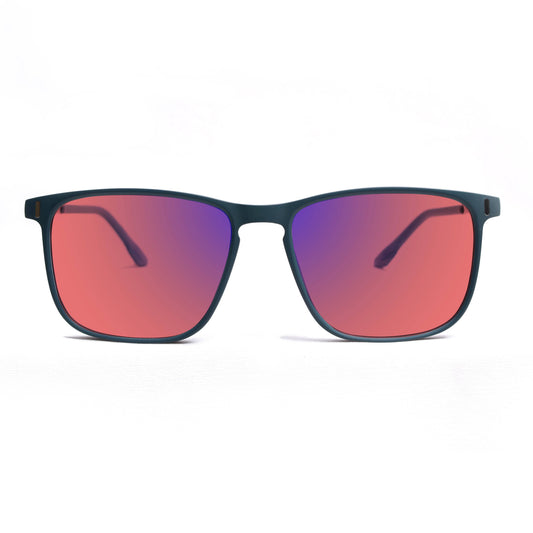
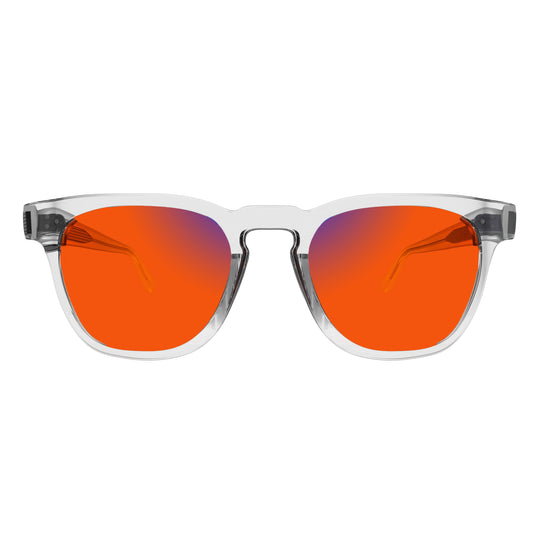
Sleep Glasses — Amber & Red
India's only clinically backed, patent-based eyewear brand
Two in three have
eye strain. One in four
can't sleep. Both?
Burning eyes by 9pm. In bed by 11, still awake at 1. Seven hours of sleep that feels like four. Two separate complaints, one shared cause — the light you spent all evening staring into. And the data says you are very much not alone.
Granted patent · CTRI registered · DPIIT recognised
50,000+ customers · 4.7★ Amazon
Zero power · Prescription · Progressive
30-day money back
You're not the exception
Your eyes and your sleep.
Same trigger, both times.
These aren't our numbers. They're pooled meta-analyses — hundreds of studies, tens of thousands of people. Every source is linked below.
Your eyes · India
65%
have digital eye strain
Burning, dryness, headache,
light sensitivity
Your eyes · Global
66%
two in three, worldwide
Pooled across studies
(95% CI: 59–73%)
Your sleep · India
25.7%
one in four has insomnia
Pooled across 100
Indian studies
Your sleep · Global
16.2%
have chronic insomnia
Clinically relevant,
in adults
And among Indian university students — the group living on screens — 73.7% meet the clinical threshold for digital eye strain, with 94.1% reporting at least one symptom.
Sources — Eye strain: Anbesu EW & Lema AK, Prevalence of computer vision syndrome: a systematic review and meta-analysis, Scientific Reports 13:1801 (2023), doi:10.1038/s41598-023-28750-6 — global 66% (95% CI 59–73), India subgroup 65%. Indian students: Digital eye strain among Indian university students in the post-COVID era, Frontiers in Public Health (2026) — 73.7% met the validated CVS-Q threshold, 94.1% symptomatic. Sleep: Systematic Review of Prevalence of Sleep Problems in India, medRxiv (2023) — pooled insomnia 25.7% across 100 studies (preprint, not yet peer-reviewed). Global: Estimation of the global prevalence and burden of insomnia: a systematic literature review-based analysis, Sleep Medicine Reviews (2025) — 16.2% chronic, clinically relevant insomnia in adults. Prevalence figures describe population burden; they are not claims about any Sleepaxa product.
Sound familiar?
If any two of these are
your evening —
🌙
Tired, but wide awake
You're exhausted by 10. In bed by 11. Still staring at the ceiling at 1am, brain running.
🔥
Eyes burning by 9pm
Dry, heavy, stinging. You keep rubbing them. The screen starts to feel physically uncomfortable.
😶🌫️
Groggy every morning
Seven hours in bed, feels like four. You need two coffees before you're a person.
📱
One more scroll
You know you should stop. The phone doesn't feel tiring — that's exactly the problem.
Most people fix this by trying harder — earlier bedtime, no caffeine, a new pillow. None of it touches the actual trigger.
Here's why
Your eye has a sensor
that only reads one thing:
is it daytime?
It doesn't care what you're watching.
It only cares what colour the light is.
A separate set of cells in your retina — nothing to do with vision — tells your brain whether it's day or night. They're tuned to a narrow band of light, peaking around 480 nm. Screens and LEDs are full of it. So at 11pm your eyes say "goodnight" and those cells say "it's noon" — and melatonin doesn't show up.
Remove that band of light, and the signal stops. That's the whole idea. Everything below is just proving we actually do it.
The measurement
So — does the lens
actually remove it?
Every brand says yes. Almost none will show you a reading. We sent both lenses to an independent lab, had the transmittance measured wavelength by wavelength against three international standards, and published the whole thing — including the parts that make us look worse.
0.05%
Amber — light passing at 480 nm
0.00%
Red — light passing, 380 to 550 nm
3
International standards tested against
The full reports are below. Open them.
Two lenses · one decision
Amber or Red?
Both remove the band. The difference is how far up they go — and how much of your evening you want them for.
Start here · Indoor + Outdoor
Sleepaxa Amber
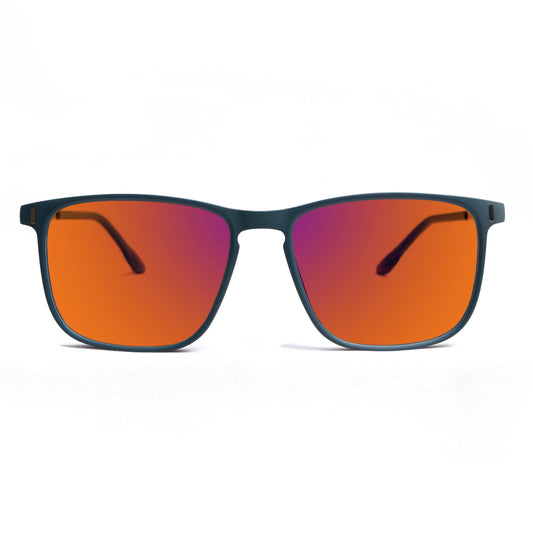
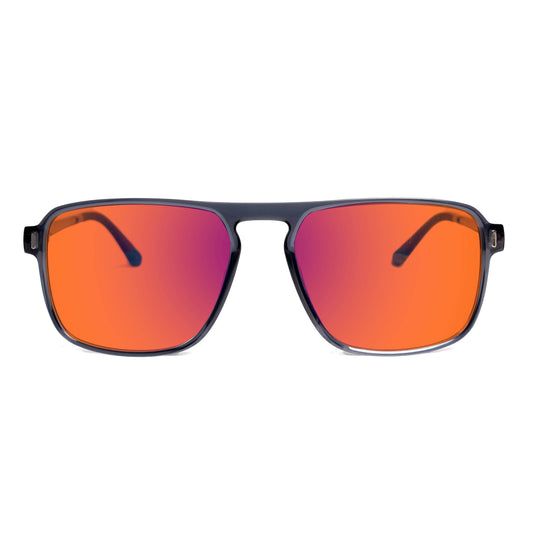
Your first pair. For eye fatigue, severe eye strain, and mild-to-moderate sleep trouble. Amber-to-orange tint you can actually live in.
99.95%
Blocked at 480 nm — the trigger band
- 99.87% of 380–500 nm gone (measured Tsb 0.13%)
- 50.47% VLT — bright enough for indoors and outdoors, all evening
- Green and red stay — colours work, screens stay readable
- UV400 = 0.67% — UVA and UVB effectively gone
- Not for night driving
35+ frames · same Amber lensSee all →


Shop Amber · 35+ styles →
Rs. 4,599 zero power · Rs. 5,498 prescription
Maximum · Indoor evening only
Sleepaxa Red · Circadian560
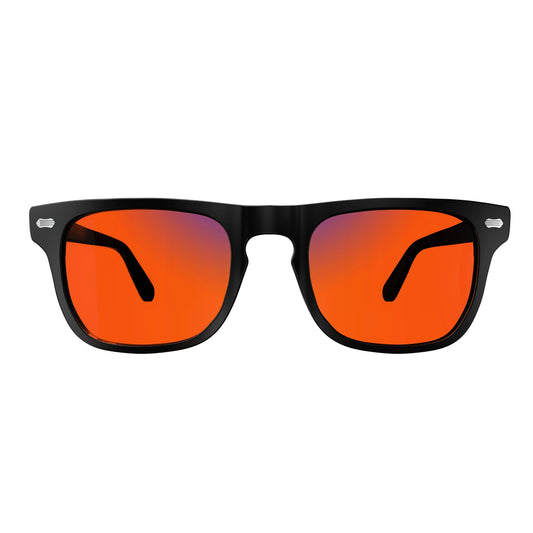
For biohackers and anyone who puts sleep above everything else. Wear it the hour before bed.
0.00%
Gets through — 380 nm right up to 550 nm
- Blue, green and part of yellow — eliminated. Measured zero, not "99-point-something"
- 14.92% VLT — deep tint, built for one job
- First light appears at 560 nm (0.29%). Before that: nothing
- UV400 = 0.00%
- Indoor evening only. Not for driving
35+ frames · same Red lensSee all →
Shop Red · 35+ styles →
Rs. 4,899 zero power · Rs. 5,799 prescription
Sleepaxa Amberremoved to ~500 nm · 50.47% VLT
380440500550620780 nm
Sleepaxa Red · Circadian560removed to 550 nm · 14.92% VLT
380440500550620780 nm
Generic "blue-cut" lensa narrow slice near 415–455 nm, partially
380440500550620780 nm
| Sleepaxa Amber | Sleepaxa Red · Circadian560 | Generic "blue-cut" | |
|---|---|---|---|
| Who it's for | First pair · eye fatigue · severe eye strain · mild-to-moderate sleep trouble | Biohackers · deep sleep · sleep above everything else | Anyone who'll buy it |
| When to wear | All evening — indoor and outdoor | 1 hour before bed — indoor only | — |
| 380–500 nm removed | 99.87% (Tsb 0.13%) | 100.00% (Tsb 0.00%) | partial, ~415–455 nm only |
| At 480 nm (the trigger band) | 0.05% passes | 0.00% passes | not published |
| At 550 nm | 40.51% passes | 0.00% passes | ~unaffected |
| What's removed | Blue | Blue + green + part of yellow | A slice of violet-blue |
| VLT / Filter category | 50.47% · Cat 1 | 14.92% · Cat 3 | ~92% · Cat 0 |
| UV400 | 0.67% | 0.00% | varies |
| Lab report published | Yes — in full, below | Yes — in full, below | Rarely, if ever |
| Patent | IN 587746 granted | IN 202521120977 pending | None |
| Prescription | Zero power · Rx · Progressive | Zero power · Rx · Progressive | Sometimes |
| Price | Rs. 4,599 · Rs. 5,498 Rx | Rs. 4,899 · Rs. 5,799 Rx | Rs. 500–1,500 |
All Sleepaxa figures are measured values taken directly from the independent test records below. "Generic blue-cut" figures describe typical market products and are indicative, not measured by us. Batch-to-batch variation is normal.
Why Sleepaxa
Most eyewear is sourced.
Ours is engineered.
Almost every "blue-light" or sleep lens sold in India is pulled from a generic manufacturing catalogue with a tint applied afterwards. No patent. No clinical board. No lab report — which is why you have never been shown one. Sleepaxa is India's only clinically backed, patent-based eyewear brand: engineered from the wavelength up by Acieon Labs, reviewed by a clinical advisory board, and published openly for anyone to tear apart.
1
Granted Indian Patent
5
Pending Applications
9
Open-Access Research Works
6
Disclosed Inventions
Independent lab reports
Every number above,
traceable to these two.
Open them. Read the whole thing, not a cropped graph. Then ask any other brand for theirs.
Measured spectral transmittance — both lenses, one chart 380–780 nm · % transmittance
Amber — 50.47% VLT · Cat 1
Red · Circadian560 — 14.92% VLT · Cat 3
380–550 nm — the band that matters
Read it left to right. In the shaded zone both curves sit on the floor — that's light being removed, not dimmed. Amber lifts off around 530 nm and is back to 96% by 600 nm, which is why you can still see colour and wear it outdoors. Red stays at literal zero all the way to 550 nm and only starts climbing at 570 nm. At 560 nm: Amber passes 66.61%, Red passes 0.29%. That gap is the entire difference between the two products.
The architects
Built by people who
spent their lives on light.

Mr. Suraj Dubey
Founder · Head of Research, Acieon Labs
10+ years in clinical optometry. For a decade, the shelf answer to every one of the complaints above was a near-clear lens labelled "blue-cut" that removed almost nothing. Inventor behind granted Indian Patent No. 587746 and the patent-pending Circadian560 architecture.
Clinical Optometry
Photobiology Research
Granted Patent Inventor

Dr. Monica Chaudhry
Founding Clinical Advisor · 37+ Years
Decades of clinical optometry, including service at AIIMS (Retd.). She's the reason a tint depth ships only when it survives long-wear testing — not when it looks good in a photo.
AIIMS Retd.
Clinical Educator
Comfort Validation
Unscripted
People who tried it
on camera.
No script, no teleprompter. Tap any one to play.
▶
▶
▶
▶
Creator videos are shared with permission. Individual experiences vary. Sleepaxa eyewear is assistive visual-comfort eyewear — not a medical device.
Real stories · real comfort
Verified customer reviews.
4.7★
★★★★★
Amazon ratingRecognised Top Brand · Amazon's Choice
4.8★
★★★★★
Website ratingBased on verified customer reviews
50,000+
★★★★★
Happy customersTrusted across India
★ Recognised Top Brand at Amazon Amazon's Choice DPIIT Recognised · CTRI Registered
Sleep glassesverified purchasers


Also worn for migraine & light sensitivitysame lens science, different lens


Hover or tap to pause. A curated selection of verified reviews, not a live feed — many more on every product page and on Amazon. Individual experiences vary.
Good to know
Fair questions.
Amber or Red — which one should I buy?
Amber if this is your first pair, or the problem is eye fatigue, severe eye strain and mild-to-moderate sleep trouble. At 50.47% VLT you can wear it indoors and outdoors, all evening. Red if sleep is the priority above everything else — it removes blue, green and part of yellow entirely (0.00% through 550 nm), worn for the hour before bed, indoors. Most people start with Amber. People who take sleep seriously end up with Red.
Why is the lens tinted? Can't it be clear?
No — and that's the whole point. Removing a wavelength removes its colour. A lens that looks clear has not removed much. The tint is the evidence. Amber measures 0.13% mean transmittance across 380–500 nm; Red measures 0.00%. A near-clear "blue-cut" lens attenuates a narrow slice near 415–455 nm and leaves the rest intact.
Can I drive in these?
No. Amber is not intended for night driving — high-VLT lenses are advised after dark. Red is Filter Category 3 and marked not suitable for driving at all; evening and indoor use only. Both reports state this openly, which is more than most brands will tell you.
Can I get my prescription in these?
Yes. Both Amber and Red come in zero power, single-vision prescription and progressive, with high-index options for thinner lenses. You can also send in your own frames for a custom lens fit.
What does "100%" actually mean here?
It means the measured mean transmittance across 380–500 nm on the Red lens reads 0.00% on the independent test record — not a rounded marketing figure. Amber reads 0.13% (99.87% removed) and 0.05% at 480 nm. Every figure on this page is traceable to the two lab reports above. Batch-to-batch variation is normal and expected.
How long before I notice something?
Eye comfort is usually noticeable the same evening. Sleep changes depend on consistency — wear it in the same window every night rather than occasionally. There's a 30-day money-back window either way.
Are Sleepaxa glasses a medical device?
No. Sleepaxa eyewear is assistive visual-comfort eyewear designed to support light management. It is not a medical device and not a substitute for medical diagnosis or treatment — please consult a qualified professional for clinical concerns. Patent filings describe intellectual property protection, not medical-device approval.
Speak with our team
Not sure which one
is right for you?
Talk to a Sleepaxa expert on WhatsApp. Real optometry-trained humans, fast replies, zero scripted answers. Guidance on tint depth, prescription, lens index and frame fit.
The evidence
The patents and research behind these lenses are developed and documented by Acieon Labs, Sleepaxa's research & IP division: nine DOI-linked open-access works on Zenodo, one granted Indian patent (No. 587746), and five pending applications. Explore: Science by Acieon Labs · Lens Library · Patent register.
All spectral figures shown are measured values reproduced from independent test records held on file (Amber: ISO 12312-1:2022, ANSI Z80.3-2018(R2023), AS/NZS 1067.1:2016+A1:2021 · Red: ISO 12312-1:2013(A1:2015), ANSI Z80.3-2018, AS/NZS 1067.1:2016). Batch-to-batch slight variation is acceptable. Comparison figures for generic "blue-cut" lenses describe typical market products and are indicative only. Reviews shown are real, verified customer experiences shared with Sleepaxa; a curated selection, not a live feed, and individual experiences vary. Ratings are accurate at the time of publishing and may change. Sleepaxa eyewear is assistive visual-comfort eyewear — not a medical device, and not a substitute for professional medical advice.