
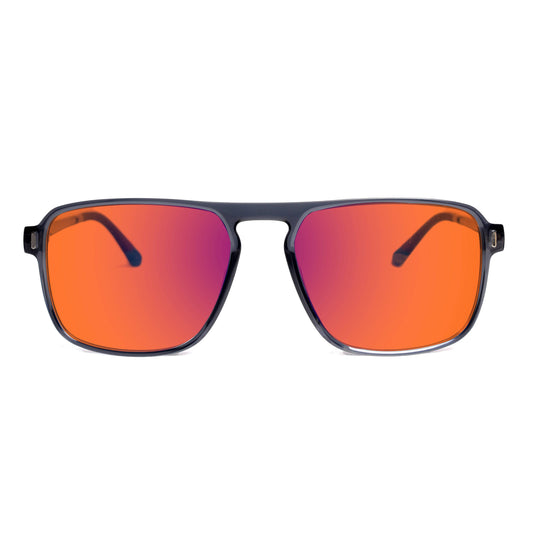
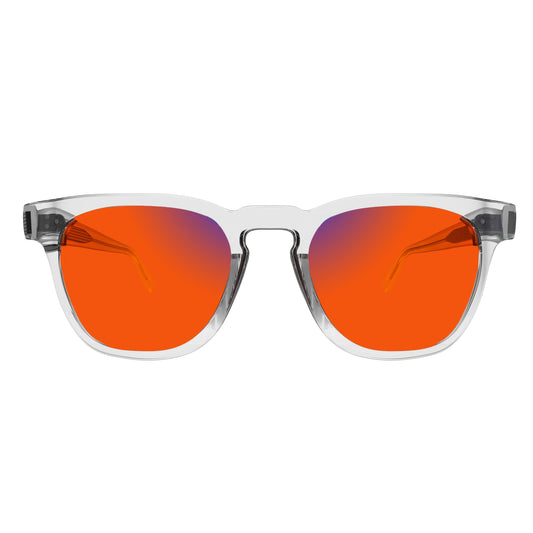
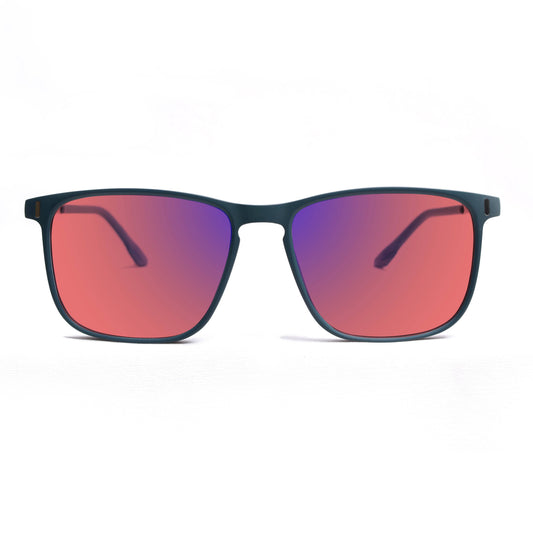

FL-41 Glasses in India: The Complete 2026 Guide
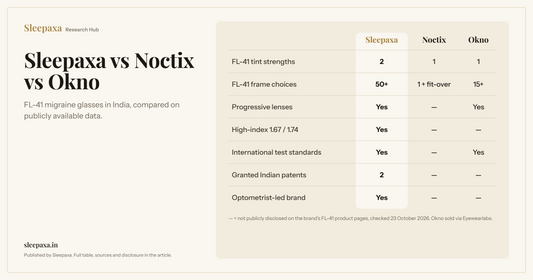
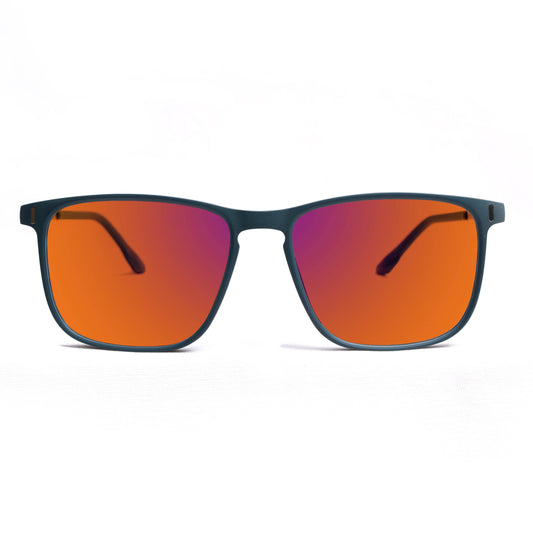
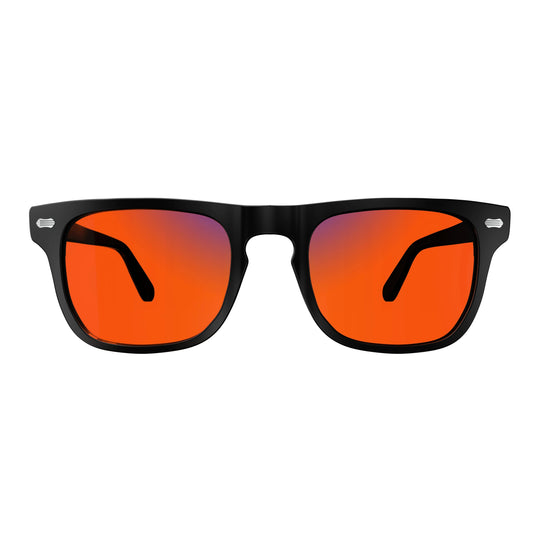
Quick answer: FL-41 glasses use a rose-coloured tint that selectively filters blue-green light around 480–520 nm — the band many people with migraine and light sensitivity find most uncomfortable — while staying light enough to wear indoors all day. In India, Sleepaxa makes FL-41 glasses in two tint strengths (Light and Dark), in zero power, single-vision, bifocal and progressive lenses, across 50+ frame styles. Shop Sleepaxa FL-41 Migraine Glasses →

What is FL-41?
FL-41 is a specific rose tint first described by researchers in Birmingham, UK, in the early 1990s. “FL” stands for fluorescent: the tint was designed for people who felt unwell under fluorescent tube lighting.
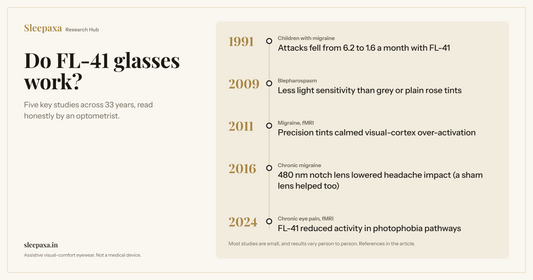
In the best-known early study, children with migraine wore FL-41 glasses and their average attack frequency fell from 6.2 to 1.6 per month (Good et al., Headache, 1991). A blue tint used for comparison worked less well. FL-41 has since been studied for photophobia, blepharospasm and post-concussion light sensitivity.
How do FL-41 lenses work?
Your retina has special cells called intrinsically photosensitive retinal ganglion cells (ipRGCs). They contain a pigment called melanopsin, which responds most strongly to light around 480 nm. These cells connect to brain pathways linked to light-triggered discomfort.
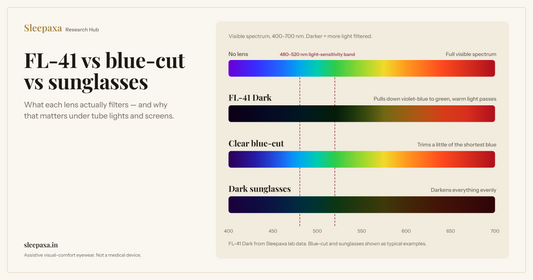
FL-41 reduces light in exactly that region, plus some of the violet-blue and green around it. It does not darken everything like a sunglass. A good FL-41 lens is a notch, not a wall: it pulls down the trigger band and lets the warmer part of the spectrum through, so you can still see colours and work normally.
Here is what that looks like on a real lens — Sleepaxa FL-41 Dark, measured on a spectrophotometer:
| Wavelength | Light that gets through |
|---|---|
| 420 nm (violet-blue) | 7.9% |
| 450 nm (blue) | 13.8% |
| 520 nm (green) | 12.6% |
| 570 nm (yellow-green) | 44.2% |
| Above 670 nm (red) | 100% |
Overall luminous transmittance is 41.1%, which places FL-41 Dark in Filter Category 2.
Who may benefit from FL-41 glasses?
- People with migraine who are sensitive to light (photophobia) during or between attacks.
- People who feel headachy or drained under tube lights, LED panels, mall or hospital lighting.
- Long screen users who find bright screens and overhead lights uncomfortable.
- People with light sensitivity after a concussion, or with blepharospasm (both studied with FL-41).
FL-41 glasses are assistive visual-comfort eyewear, not a medicine. They work best alongside your doctor’s migraine plan. A sudden, severe or “worst-ever” headache, or any vision loss, needs a doctor the same day.
FL-41 Light vs FL-41 Dark: which should you choose?
| FL-41 Light | FL-41 Dark | |
|---|---|---|
| Best for | Mild light sensitivity, all-day wear | Severe photophobia, glare-heavy places |
| Typical places | Office, home, screens, classrooms | Tube-lit offices, hospitals, malls, bright daylight |
| How it feels | Soft rose, minimal dimming | Deeper rose, noticeably calmer light |
| Filter notch | Same position as Dark | 13.8% at 450 nm, 12.6% at 520 nm |
| UV protection | UV400 | UV400 |
| Night driving | No | No |
Not sure? Start with Dark for your worst environment, and Light if you want one pair for the whole day.
FL-41 vs sunglasses vs blue-light glasses
Dark sunglasses indoors make your eyes adapt to the dark, which can leave you more light-sensitive once you take them off. Clear “blue-cut” computer lenses mostly reflect a small slice of shorter blue light and pass most of the 480–520 nm band. FL-41 sits in between: targeted, and light enough for indoor use. The full breakdown is in FL-41 vs Blue-Light Glasses vs Sunglasses.
How to spot a real FL-41 lens (6-point checklist)
Eye-care references note that some lenses sold as “FL-41” do not actually filter like FL-41. Before you buy, check:
- Spectrophotometer numbers. Ask for transmittance at 450, 480 and 520 nm. A phone-torch or “blue light pen” test cannot measure this.
- Two tint strengths. One shade cannot suit both mild and severe sensitivity.
- Tint inside your prescription lens. Clip-ons and fit-overs let light leak in around the edges.
- UV400 on both tints.
- Anti-reflective coating on both surfaces, so a tinted lens does not throw reflections back into your eye.
- Who checks your prescription. It should be an optometrist, not a chat bot.
Why Sleepaxa for FL-41 glasses
- Built by an optometrist. Sleepaxa was founded by Suraj Dubey, a senior optometrist with 10+ years of clinical practice and 10,000+ eye tests. Our optometry team checks every prescription before a lens is made.
- Real R&D, not rebranding. Our research division, Acieon Labs, has 7+ Indian patent filings, two of them granted — IN 587746 (NeuroCalm FLX+, a dual-band light filter) and IN 597482 (Circadian560).
- Peer-reviewed research. Our founder is first author of a 2026 peer-reviewed, PubMed-indexed paper on evening LED light and melanopsin (Cureus, PMID 42524168).
- Clinically connected. Our clinical advisor is Dr. Monica Chaudhry, and we supply FL-41 eyewear through a growing network of ophthalmologist and optometrist partner clinics.
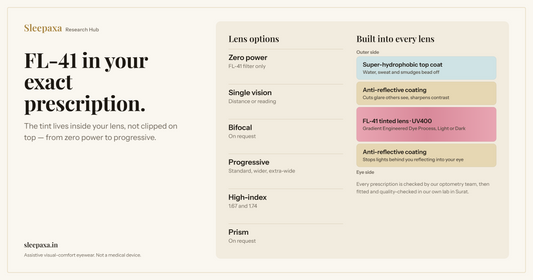
- Zero power to progressive. Zero power, single vision, bifocal, progressive (standard, wider, extra-wide), high-index 1.67 and 1.74, prism on request — or send us your own frame.
- 5–6 layer coating stack. Anti-reflective coating on both surfaces, a super-hydrophobic top coat and UV400 protection on every pair.
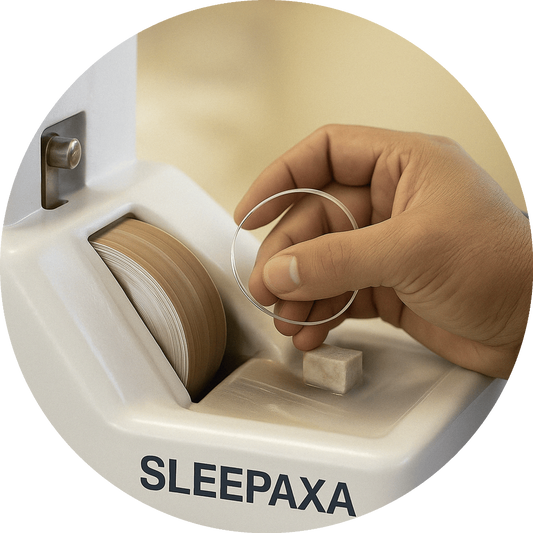
- Even tint, every lens. Lenses are tinted with Sleepaxa’s proprietary Gradient Engineered Dye Process, then fitted and quality-checked in our own optical lab in Surat.
- 50+ frames in acetate, ULTEM and beta-titanium, from compact to extra-wide fits.
Explore Sleepaxa FL-41 Migraine Glasses →
FAQ
Are FL-41 glasses available in India?
Yes. Sleepaxa makes FL-41 glasses in India in Light and Dark tints, with zero-power and prescription lenses, and ships across the country from Surat.
How much do FL-41 glasses cost in India?
Sleepaxa FL-41 glasses start at ₹4,599 for zero power (Light tint). Prescription lenses start at ₹5,498. Dark tint adds ₹300.
Can I wear FL-41 glasses all day?
FL-41 Light is designed for all-day indoor wear. FL-41 Dark is better kept for bright or glare-heavy places.
Do FL-41 glasses block blue light?
They reduce a specific blue-green band (around 480–520 nm) plus part of the violet-blue. That is different from clear “blue-cut” lenses, which filter much less of the 480 nm region.
Will colours look different?
Yes, slightly warmer and rosier. Most people stop noticing it within a day or two. Reading, screen work and colour-coded tasks remain possible.
Can I get FL-41 in my power, bifocal or progressive?
Yes. Choose “Prescription Lens” at checkout and share your prescription; bifocal and prism are available on request.
Can I drive with FL-41 glasses?
FL-41 Dark is Filter Category 2, generally suitable for daytime driving. Do not wear either tint for night driving.
Are FL-41 glasses a migraine treatment?
No. They are assistive visual-comfort eyewear that may reduce light-triggered discomfort. Keep following your doctor’s advice.
Read next: Do FL-41 Glasses Really Work? What the Research Says · Prescription & Progressive FL-41 Glasses · Sleepaxa vs Noctix vs Okno
Sleepaxa eyewear is assistive visual-comfort eyewear, not a medical device. Individual experience varies.
Tags:
Previous
How Sleepaxa Earns Optical Lens Patents Where Most Eyewear Brands Don't
Next
Sleepaxa vs Noctix vs Okno: Best FL-41 Migraine Glasses in India (2026)