

Photophobia Causes A to Z: 94 Eye, Neurological and Genetic Conditions, Graded by Severity (2026)
Quick answer: Photophobia — discomfort or pain from light — is a symptom, not a disease. Over 90 conditions can cause it. The most common are migraine and dry eye: in one eye-clinic study of 147 people with photophobia, 54% had migraine and 36% had dry eye. Other common causes are eye inflammation (uveitis), corneal injury or infection, and concussion. Rarer causes include conditions people are born with, such as albinism, achromatopsia, aniridia, congenital glaucoma and cystinosis. A few causes are emergencies — meningitis, brain haemorrhage, acute angle-closure glaucoma, corneal infection and chemical injury.
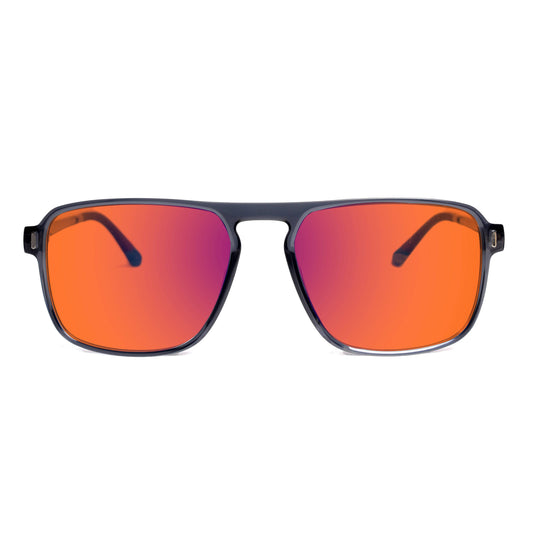
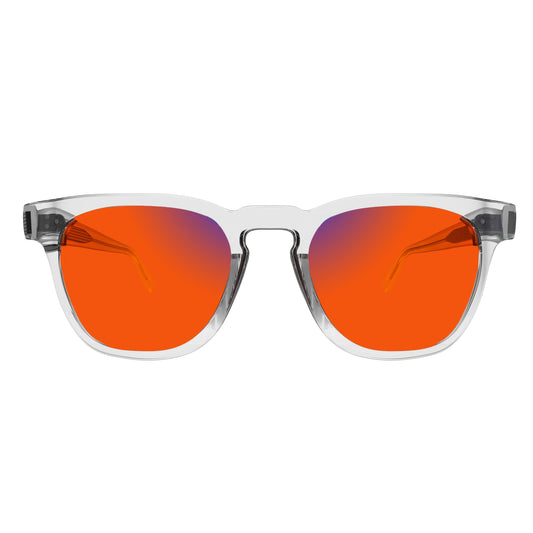
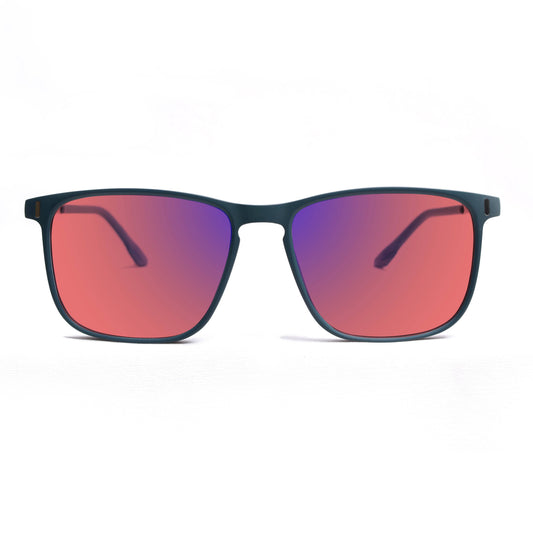
Living with everyday light sensitivity? For light-triggered migraine, blepharospasm, post-concussion light sensitivity and harsh office lighting, rose-tinted FL-41 glasses are the most-studied lens option. Sleepaxa makes them in Light and Dark tints, in zero power through progressive.
What is photophobia?
Neuro-ophthalmologists define photophobia as a state in which light causes discomfort in the eye or head, or makes you avoid light even when it does not actually hurt. Despite the name, it is not a fear of light.
Two main routes are involved. Light can irritate an inflamed or damaged eye surface, which is wired to the trigeminal pain nerve. Light also activates special retinal cells (ipRGCs) that contain melanopsin and respond most to blue-green light around 480 nm; these cells connect to the thalamus, where light and pain signals meet. That second route is why some people with no light perception at all can still feel photophobia.
Key numbers
- Migraine: up to 80% of people with migraine have photophobia during attacks.
- Eye clinic causes: in 147 patients seen for photophobia, causes were migraine (53.7%), dry eye (36.1%), eye trauma (8.2%), progressive supranuclear palsy (6.8%) and traumatic brain injury (4.1%).
- Missed diagnoses: 25.9% of those patients left without a cause — including 69.4% of the children.
- Blepharospasm: 94% of 316 patients reported light sensitivity.
- Head injury: about 50% of people with traumatic brain injury report light sensitivity, versus 10% of healthy controls.
- ME/CFS: studies put light hypersensitivity at 48–90%.
How we graded severity
There is no single official severity scale for every cause of photophobia. We use a simple four-grade scale that is used in corneal research, based on the lowest light level that bothers you:
| Grade | What it feels like |
|---|---|
| 0 — None | Normal light is comfortable |
| 1 — Mild | Only bright light bothers you — sunlight, headlights, a phone at full brightness |
| 2 — Moderate | Ordinary room or office lighting is uncomfortable |
| 3 — Severe | Even dim light is uncomfortable; you seek darkness |
For each condition below we give the typical range, based on published research and clinical experience. It is a guide, not a diagnosis — severity varies from person to person, and many conditions change over time. Clinicians who want to measure photophobia properly use validated questionnaires such as the Utah Photophobia Symptom Impact Scale (UPSIS).
Red flags: get help the same day
- A sudden, severe “worst-ever” headache with light sensitivity.
- Fever, stiff neck and light sensitivity, with or without a rash or confusion.
- A painful red eye with blurred vision, or a white spot on the cornea.
- Severe eye pain with halos around lights, headache and vomiting.
- Any chemical, lime (chuna) or cleaning agent in the eye — rinse with clean water for at least 15 minutes, then go to hospital.
- Light sensitivity after a head injury with vomiting, drowsiness or confusion.
- A baby with watery eyes, light avoidance and large or cloudy corneas.
- Pain, light sensitivity and falling vision in the days after eye surgery or an eye injection.
- A child with night blindness, dry eyes and poor nutrition.
Can FL-41 glasses help? A condition-by-condition guide
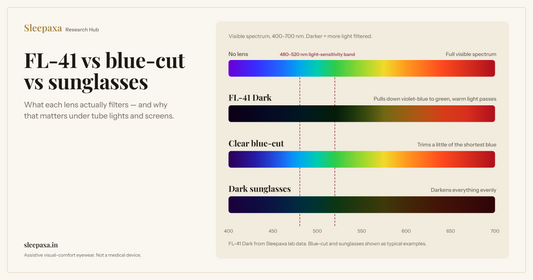
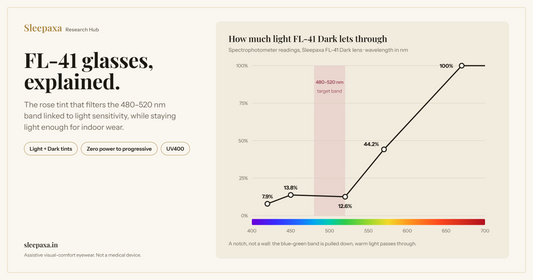
FL-41 is a rose tint that filters the 480–520 nm blue-green band linked to light-triggered discomfort while staying light enough for indoor wear. It is a comfort tool, not a treatment — and it suits some causes far better than others.
| Your situation | FL-41 fit | Why |
|---|---|---|
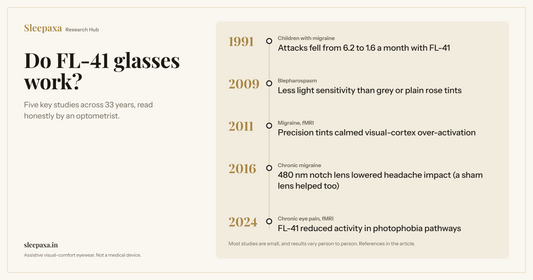
| Migraine, including vestibular migraine | Best-studied use | Linked to fewer attacks in children (1991) and lower light-triggered discomfort in later studies |
| Benign essential blepharospasm | Studied | Improved blinking and light sensitivity more than grey or plain rose tints (2009) |
| Concussion and post-concussion syndrome | Widely used; evidence still limited | Eases screen and office-light discomfort during recovery |
| Everyday light sensitivity under tube lights, LED panels and screens | Good comfort option | FL-41 Light is made for all-day indoor wear |
| Dry eye, recovery after LASIK or cataract surgery | Comfort aid while the cause is treated | Treat the eye surface first; a tint makes the meantime easier |
| ME/CFS, fibromyalgia, autism, long COVID, anxiety | Possible comfort aid; little research | FL-41 Light indoors is a low-risk option to try |
| Achromatopsia, blue cone monochromacy, cone dystrophy | Usually not enough | These need deep red or amber filters prescribed by a low-vision specialist |
| Albinism and aniridia | A tint helps, but the shade varies | Outdoors usually needs darker lenses; get specialist advice |
| Meningitis, iritis, corneal ulcer, angle closure, chemical injury | Not a treatment | See a doctor the same day |
Light or Dark? Choose FL-41 Light for mild sensitivity and all-day indoor wear, and FL-41 Dark for severe sensitivity or glare-heavy places like hospitals, malls and bright daylight. Compare Sleepaxa FL-41 Light and Dark →
1. Eye causes
Eye conditions are the commonest cause of photophobia you can see on examination. Dry eye is the most frequent ocular cause in clinics; acute iritis is the classic “light really hurts” eye disease.
A. Eye surface and cornea
| Condition | How common | Typical photophobia | Tell-tale signs |
|---|---|---|---|
| Dry eye disease | Very common | Mild–Moderate | Grittiness, burning, worse with screens, AC and wind; vision clears on blinking. FL-41 Light adds comfort while you treat it |
| Blepharitis / meibomian gland dysfunction | Very common | Mild | Red, crusty lid margins; worst on waking |
| Allergic conjunctivitis | Very common | Mild | Itching, watering, seasonal or dust-triggered |
| Vernal keratoconjunctivitis (VKC) | Common in Indian children | Moderate–Severe | Intense itching, ropy discharge; mostly boys aged 5–15; worse in hot, dry months |
| Viral conjunctivitis (“eye flu”) | Very common | Mild; Moderate–Severe if the cornea is involved | Red, watery eye that spreads through families and schools |
| Bacterial keratitis (corneal ulcer) | Uncommon | Severe | Pain, white spot on the cornea, often contact lens wear. Same-day |
| Fungal keratitis | A leading cause of corneal ulcers in India | Severe | Follows injury with plant matter or soil, often in farm work. Same-day |
| Acanthamoeba keratitis | Rare | Severe | Contact lenses plus tap, pool or well water; pain out of proportion to redness. Same-day |
| Herpes simplex keratitis | Uncommon | Moderate–Severe | Recurrent red eye on one side; branching corneal ulcer. Same-day |
| Herpes zoster ophthalmicus | Uncommon | Moderate–Severe | Painful blistering rash on the forehead or tip of the nose. Same-day |
| Corneal abrasion or foreign body | Very common | Severe, short-lived | Scratch, dust or metal; sharp pain and heavy watering |
| Photokeratitis (welder’s flash, snow blindness) | Common in welders | Severe | Pain starts 6–12 hours after unprotected UV exposure |
| Chemical injury (lime/chuna, cleaners, Holi colours) | Uncommon | Severe | Emergency — rinse with clean water for 15+ minutes, then hospital |
| Recurrent corneal erosion | Uncommon | Moderate–Severe on waking | Sharp pain when opening the eyes in the morning; past scratch |
| Exposure keratopathy | Uncommon | Moderate | Eyes do not close fully — thyroid eye disease, Bell’s palsy |
| Contact lens overwear | Common | Mild–Moderate | Red, sore eyes after long wear or sleeping in lenses |
| Keratoconus | Uncommon | Mild–Moderate (glare) | Rising astigmatism, halos, frequent eye rubbing |
| Corneal dystrophies (Fuchs, Reis–Bücklers, Meesmann) | Rare | Mild–Moderate | Morning blur (Fuchs), recurrent erosions |
| Stevens–Johnson syndrome (eye involvement) | Rare | Severe | After a severe drug reaction; scarred, dry eye surface |
| Cataract | Very common after 50 | Mild–Moderate (glare) | Glare from headlights, faded colours |
| After LASIK, PRK or SMILE | Common, temporary | Moderate early, then fades | Settles over days to weeks; usually longest after PRK |
| After cataract surgery | Common, temporary | Mild–Moderate | Settles over weeks; persistent pain needs a check |
B. Inflammation and eye pressure
| Condition | How common | Typical photophobia | Tell-tale signs |
|---|---|---|---|
| Acute anterior uveitis (iritis) | Uncommon | Severe — a hallmark | Deep ache, red ring around the cornea; light shone in the other eye also hurts. Links to HLA-B27, TB, sarcoidosis. Same-day |
| Uveitis in juvenile idiopathic arthritis | Rare | Often none | A silent white eye — children with JIA need scheduled eye screening |
| Intermediate or posterior uveitis | Rare | Mild | Floaters and blurred vision more than light pain |
| Scleritis | Uncommon | Moderate | Severe boring pain that wakes you at night; often autoimmune disease. Same-day |
| Episcleritis | Common | Mild | Patchy redness, mild ache |
| Acute angle-closure glaucoma | Uncommon; more common in Asian eyes | Moderate–Severe | Severe eye pain, halos, headache, vomiting. Emergency |
| Endophthalmitis | Rare | Severe | Pain and falling vision days after eye surgery, injection or injury. Emergency |
C. Pupil and iris
| Condition | How common | Typical photophobia | Tell-tale signs |
|---|---|---|---|
| Dilating eye drops (tropicamide, cyclopentolate, atropine) | Very common, temporary | Moderate | Hours after an eye test; atropine can last a week or more |
| Adie’s tonic pupil | Uncommon | Mild–Moderate, one eye | One larger pupil that reacts slowly |
| Third nerve palsy with a dilated pupil | Rare | Mild | Droopy lid, double vision. Emergency — can signal an aneurysm |
| Traumatic iris damage | Uncommon | Mild–Moderate | Irregular or fixed pupil after a blunt injury |
D. Retina and optic nerve
| Condition | How common | Typical photophobia | Tell-tale signs |
|---|---|---|---|
| Cone and cone-rod dystrophy | Rare | Severe — often the first symptom | Day blindness, falling central vision, colour loss |
| Stargardt disease | Rare | Mild–Moderate | Central vision loss in children and young adults |
| Retinitis pigmentosa | Rare | Mild–Moderate (glare) | Night blindness, narrowing side vision |
| Optic neuritis | Uncommon | Mild–Moderate | Pain on eye movement, dim or washed-out vision; can be linked to MS. Same-day |
| Papilloedema / idiopathic intracranial hypertension | Uncommon | Mild–Moderate | Daily headache, whooshing sound in the ears, brief vision blackouts |
| Pituitary tumours and chiasm lesions | Uncommon | Mild–Moderate | Loss of side vision, hormonal changes |
2. Born with it: congenital and genetic causes
In babies and young children, photophobia often shows up as squinting, turning away from windows, burying the face in a pillow, or watery eyes — long before a child can say “light hurts”. Any baby with persistent light avoidance needs an eye examination, because congenital glaucoma and some retinal disorders are time-sensitive.
| Condition | How common | Typical photophobia | Tell-tale signs |
|---|---|---|---|
| Oculocutaneous albinism (including Hermansky–Pudlak and Chédiak–Higashi syndromes) | 1 in 4,000–7,000 in African and 1 in 12,000–15,000 in European populations; one of the four major causes of childhood blindness in India | Moderate–Severe | Very pale skin and hair, light or translucent iris, nystagmus, low vision |
| Ocular albinism (X-linked) | Rare; mostly boys | Moderate | Normal skin, translucent iris, nystagmus |
| Achromatopsia (rod monochromacy) | About 1 in 30,000 | Severe — a hallmark | Little or no colour vision, day blindness, nystagmus from early infancy |
| Blue cone monochromacy | About 1 in 100,000; almost only boys | Severe | Poor sharpness, nystagmus, often high myopia |
| Aniridia (PAX6 gene) | 1 in 50,000–100,000 newborns | Severe | Iris partly or fully missing; cataract develops in 50–85%. Children with new (non-inherited) aniridia need kidney screening for Wilms tumour (WAGR) |
| Iris coloboma | Rare | Mild–Moderate | Keyhole-shaped pupil |
| Primary congenital glaucoma | 1 in 10,000–70,000 in Western countries; about 1 in 3,300 in Andhra Pradesh | Severe — classic triad | Watering, light avoidance and eyelid squeezing; large or cloudy corneas. Urgent |
| Nephropathic cystinosis | 1 in 100,000–200,000 | Moderate, rising to Severe | Sparkly cystine crystals in the cornea from infancy, kidney problems; photophobia is the most common eye symptom. Cysteamine eye drops dissolve the crystals |
| Tyrosinemia type II (Richner–Hanhart syndrome) | Fewer than 1 in 250,000 | Severe | “Herpes-like” corneal lesions that do not respond to antivirals, plus painful thick skin on palms and soles. A low-tyrosine diet controls it |
| Xeroderma pigmentosum | Very rare | Mild–Severe; reported in 21–67% of patients across studies | Extreme sunburn, early freckling and skin cancers |
| Keratitis–ichthyosis–deafness (KID) syndrome | Very rare | Severe | Scaly skin, hearing loss, progressive corneal inflammation |
| Congenital corneal dystrophies | Rare | Mild–Moderate | Hazy corneas from birth or early childhood |
| Trisomy 18 | Rare | Variable | Listed among photophobia-associated conditions in neuro-ophthalmology reviews |
Why born disorders cause such strong photophobia: in albinism and aniridia, the iris cannot block stray light, so light floods and scatters inside the eye. In achromatopsia and blue cone monochromacy, the cones that handle daylight do not work, so the eye relies on rods that are overwhelmed by normal daylight. In cystinosis and tyrosinemia, deposits or inflammation in the cornea irritate its dense pain nerves.
3. Neurological causes
When the eye examination is normal, the most common causes of photophobia are migraine, blepharospasm and traumatic brain injury. Here the problem is how the brain processes light, not the eye itself.
| Condition | How common | Typical photophobia | Tell-tale signs |
|---|---|---|---|
| Migraine (with or without aura) | Very common | Moderate–Severe in attacks; often Mild between attacks | Up to 80% have photophobia in attacks; throbbing headache, nausea, sound sensitivity — see FL-41 glasses |
| Vestibular migraine | Common | Moderate | Dizziness or vertigo with light and motion sensitivity |
| Medication-overuse headache | Common | Mild–Moderate | Near-daily headache in people taking painkillers on 10–15+ days a month |
| Tension-type headache | Very common | Mild, if any | Pressing band-like headache; light or sound sensitivity, not usually both |
| Cluster headache | Uncommon | Moderate, often one-sided | Severe pain around one eye with tearing and a runny nose; attacks come in bouts |
| Other trigeminal autonomic cephalalgias (paroxysmal hemicrania, SUNCT) | Rare | Mild–Moderate | Short, frequent one-sided attacks with eye redness or tearing |
| Concussion and traumatic brain injury | Common | Moderate | About 50% report light sensitivity versus 10% of controls; can last months in post-concussion syndrome. Many find FL-41 Light easier under screens |
| Benign essential blepharospasm | Uncommon | Severe — a hallmark | Excess blinking, eyes clamping shut; 94% report light sensitivity. FL-41 tinted lenses have been studied here |
| Progressive supranuclear palsy (PSP) | Rare | Moderate–Severe | Falls, difficulty looking down; light sensitivity in about 60% versus 23% in Parkinson’s in one study |
| Parkinson’s disease | Common in older adults | Mild | Tremor, stiffness, slowness |
| Meningitis (bacterial, viral or TB) | Uncommon | Severe | Fever, stiff neck, headache, sometimes rash. Emergency |
| Encephalitis (including Japanese encephalitis) | Uncommon | Moderate | Fever, confusion, seizures. Emergency |
| Subarachnoid haemorrhage | Rare | Severe | Thunderclap “worst-ever” headache. Emergency |
| Pituitary apoplexy | Rare | Severe | Sudden headache, vision loss, double vision. Emergency |
| Multiple sclerosis | Uncommon | Mild–Moderate | Usually through optic neuritis; numbness or weakness episodes |
| Thalamic stroke or lesion | Rare | Variable | The thalamus is where light and pain signals meet |
| Long COVID and post-viral syndromes | Common | Mild–Moderate | Fatigue, brain fog, sensitivity to light and sound |
Not the same thing: photosensitive epilepsy is a different condition. Flashing or flickering lights trigger seizures, but most people with it do not find steady light painful.
Migraine, blepharospasm or post-concussion light sensitivity? These are the conditions where FL-41 has the strongest track record. Sleepaxa FL-41 comes in Light (all-day indoor wear) and Dark (severe sensitivity), in zero power, single vision, bifocal and progressive lenses, with published spectrophotometer data. Shop Sleepaxa FL-41 Migraine Glasses →
4. Infections, autoimmune and whole-body diseases
| Condition | How common | Typical photophobia | Tell-tale signs |
|---|---|---|---|
| Measles | Common in outbreaks | Moderate | Fever, cough, red watery eyes, then rash; vitamin A is part of treatment |
| Dengue and other monsoon fevers | Very common in season | Mild–Moderate | High fever, pain behind the eyes, body ache |
| Influenza and common viral fevers | Very common | Mild | Fever and headache; settles with the illness |
| Sjögren’s syndrome | Uncommon | Moderate | Severe dry eyes and dry mouth |
| Rheumatoid arthritis and lupus | Common | Mild–Moderate | Through dry eye or scleritis |
| HLA-B27 disease, sarcoidosis, Behçet’s, TB | Uncommon | Severe during uveitis flares | Back stiffness, mouth ulcers or cough alongside recurrent red, painful eyes |
| Thyroid eye disease (Graves’) | Uncommon | Moderate | Bulging eyes, stare, gritty exposed cornea |
| Ocular rosacea | Common | Mild–Moderate | Facial flushing, inflamed lid margins |
5. Nutritional and metabolic causes
| Condition | How common | Typical photophobia | Tell-tale signs |
|---|---|---|---|
| Vitamin A deficiency (xerophthalmia) | Still seen in parts of India | Moderate; night blindness comes first | Dry eyes, foamy Bitot’s spots. In infants it is an emergency — the cornea can melt within hours (keratomalacia) |
| Riboflavin (vitamin B2) deficiency | Rare | Moderate | Cracked mouth corners, sore tongue; tiny blood vessels grow into the cornea |
| Zinc deficiency with pancreatic insufficiency | Rare | Mild–Moderate | Listed among photophobia-associated conditions in neuro-ophthalmology reviews |
6. Medicines, drugs and withdrawal
Photophobia is not the same as drug “photosensitivity”. Antibiotics like doxycycline make the skin burn in sunlight; that is photosensitivity. The medicines below affect the eye or the brain’s response to light.
| Medicine or substance | How it causes light sensitivity | Typical photophobia | Note |
|---|---|---|---|
| Benzodiazepines, barbiturates, haloperidol | Change in brain light processing, including during benzodiazepine withdrawal | Mild–Moderate | Named in neurology reviews of drug-induced photophobia |
| Amiodarone | Fine deposits in the cornea | Mild | Glare and halos; regular eye checks |
| Chloroquine and hydroxychloroquine | Corneal deposits; retinal toxicity with long use | Mild | Needs yearly retinal screening on long-term use |
| Isotretinoin | Dry eye and poorer dark adaptation | Mild–Moderate | Usually improves after the course |
| Topiramate (rare reaction) | Sudden angle-closure glaucoma, usually in the first weeks | Severe | Emergency — eye pain and blurred vision |
| Digoxin | Visual disturbance at high levels | Mild | Glare, yellow-tinged vision; check blood levels |
| Stimulants and recreational drugs (cocaine, amphetamines, MDMA) | Dilated pupils | Mild–Moderate | Settles as the drug wears off |
| Alcohol hangover | Brain hypersensitivity | Mild–Moderate | Settles within a day |
| Opioid withdrawal | Dilated pupils | Mild | With yawning, sweating, gooseflesh |
7. Psychiatric and sensory-processing conditions
Neuro-ophthalmologists stress that photophobia is a real neurological symptom, not “just psychological”. These conditions change how the brain filters sensory input:
| Condition | How common | Typical photophobia | Tell-tale signs |
|---|---|---|---|
| Anxiety, panic disorder and agoraphobia | Common | Mild–Moderate | Light discomfort rises with stress; avoidance of bright, busy places |
| Depression and bipolar disorder | Common | Mild | Listed in photophobia reviews; often alongside sleep changes |
| Autism spectrum | Common | Variable, Mild–Severe | 70–90% of autistic people have some sensory hypersensitivity; light and flicker are frequent triggers |
| ME/CFS (chronic fatigue syndrome) | Uncommon | Moderate–Severe | Light hypersensitivity in 48–90%; severe ME often needs a darkened room |
| Fibromyalgia | Common | Mild–Moderate | Widespread pain; lab studies show lower light-discomfort thresholds |
Severity at a glance
Typically severe (Grade 3, or photophobia is a defining feature): acute iritis, corneal ulcers (bacterial, fungal, Acanthamoeba), corneal abrasion, welder’s flash, chemical injury, endophthalmitis, acute angle-closure glaucoma, vernal keratoconjunctivitis, achromatopsia, blue cone monochromacy, cone dystrophy, aniridia, congenital glaucoma, albinism (especially type 1), advanced cystinosis, tyrosinemia type II, KID syndrome, migraine attacks, benign essential blepharospasm, meningitis, subarachnoid haemorrhage, pituitary apoplexy and severe ME/CFS.
Typically moderate (Grade 2): moderate-to-severe dry eye, herpes keratitis, shingles of the eye, recurrent corneal erosion, scleritis, dilating drops, ocular albinism, concussion, cluster headache, vestibular migraine, PSP, encephalitis, measles, Sjögren’s syndrome, thyroid eye disease, vitamin A and riboflavin deficiency, and isotretinoin.
Typically mild or variable (Grade 1): blepharitis, allergic and viral conjunctivitis, contact lens overwear, keratoconus, cataract, recovery after eye surgery, episcleritis, retinitis pigmentosa, Stargardt disease, tension-type headache, Parkinson’s disease, viral fevers, ocular rosacea, amiodarone, hydroxychloroquine, digoxin, hangover, depression and anxiety.
Causes to know in India
- Vernal keratoconjunctivitis is common in Indian schoolchildren, especially boys, and flares in hot, dry months; photophobia was reported in 44–87% of patients in South Asian studies.
- Fungal keratitis after injury with crop or plant matter is a leading cause of corneal ulcers in farming communities.
- Lime (chuna) and Holi-colour eye injuries cause severe chemical photophobia — rinse first, then go to hospital.
- Welder’s flash is common among welders and fabricators who skip eye protection.
- Congenital glaucoma is far more frequent in parts of South India — about 1 in 3,300 births in Andhra Pradesh versus 1 in 10,000 or fewer in Western countries.
- Albinism is one of the four major causes of childhood blindness in India.
- Vitamin A deficiency still causes childhood eye disease; in one survey of Indian schools for the blind, 18.6% of severe visual impairment was attributed to it.
- Dengue, measles and TB — through fever, meningitis or uveitis — are common infectious triggers.
How eye doctors find the cause
- History: one eye or both, sudden or gradual, pain, redness, headache, injury, contact lenses, medicines, family history.
- Slit-lamp examination: cornea, conjunctiva, inflammation cells, corneal crystals, iris defects.
- Dilated retinal exam and eye pressure check.
- Special tests when needed: electroretinography (ERG) for cone disorders, OCT scans, colour vision testing.
- Neurological review: headache pattern, neck stiffness, pupil and eye-movement checks; brain MRI when red flags are present.
- Blood and metabolic tests for rare causes: leukocyte cystine (cystinosis), plasma tyrosine (tyrosinemia II), genetic testing for inherited retinal and iris disorders.
- Measuring impact: questionnaires such as the Utah Photophobia Symptom Impact Scale (UPSIS) track how much light sensitivity affects daily life.
Managing light sensitivity
- Treat the cause first. Lubricants for dry eye, steroid drops for iritis, migraine prevention, cysteamine drops for cystinosis, diet for tyrosinemia II — photophobia often eases once the cause is controlled.
- Avoid dark sunglasses indoors. Your eyes adapt to the dark, and ordinary light then feels harsher when you take them off.
- Use the right tint for the condition. Rose FL-41 tints have the most research in migraine and blepharospasm. People with cone disorders such as achromatopsia and blue cone monochromacy usually need deep red or amber filters prescribed by a low-vision specialist. People with aniridia or albinism benefit from tinted lenses outdoors and sometimes artificial-iris or tinted contact lenses.
- Block light at the edges. Wraparound frames and a brimmed cap cut glare that comes in from the sides and above.
- Tame your screens. Lower brightness, use dark mode, and keep screens out of direct line with windows and overhead lights.
Where Sleepaxa fits
Sleepaxa was founded by Suraj Dubey, a senior optometrist with 10+ years of clinical practice and 10,000+ eye tests. Our research division, Acieon Labs, has 7+ Indian patent filings, two of them granted.
If light-triggered migraine, blepharospasm, post-concussion symptoms or everyday light sensitivity is your problem, our FL-41 range is built for you:
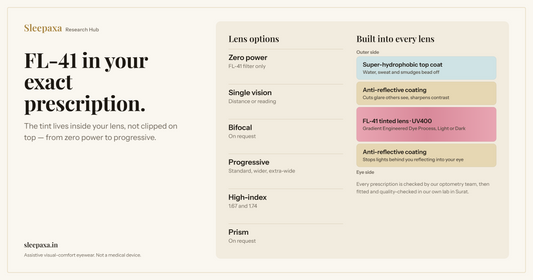
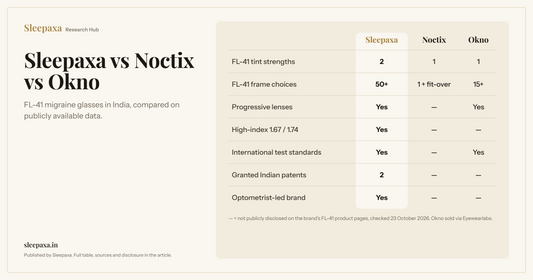
- Two tint strengths: FL-41 Light for all-day indoor wear, FL-41 Dark for severe sensitivity.
- Measured, not guessed: FL-41 Dark lets through 13.8% at 450 nm and 12.6% at 520 nm.
- Any prescription: zero power, single vision, bifocal, progressive, high-index and prism on request.
- 50+ frame styles with a 1-year warranty, from ₹4,599 (zero power).
- Online and offline: order at sleepaxa.in or try them at our partner eye clinics, hospitals and stores.
Shop Sleepaxa FL-41 Migraine Glasses → · Read what the FL-41 research says
For cone disorders, albinism, aniridia or any red-flag symptom above, see an eye specialist first. Our optometrists are happy to guide you on WhatsApp at +91 95123 17992.
FAQ
What is the most common cause of photophobia?
Migraine and dry eye. In an eye-clinic study of 147 people with photophobia, 53.7% had migraine and 36.1% had dry eye.
Is photophobia a disease?
No. It is a symptom with more than 90 possible causes — eye, neurological, genetic, infectious, nutritional, drug-related and psychiatric. Treating the cause is the key.
Which genetic disorders cause photophobia from birth?
The main ones are albinism, achromatopsia, blue cone monochromacy, aniridia, primary congenital glaucoma, cystinosis, tyrosinemia type II, xeroderma pigmentosum and KID syndrome. Most also cause nystagmus, low vision or skin changes.
When is photophobia an emergency?
When it comes with a sudden severe headache, fever and a stiff neck, a painful red eye with blurred vision, severe eye pain with vomiting, a chemical in the eye, or confusion after a head injury. Go to hospital the same day.
Can photophobia be a sign of a brain problem?
Yes. Migraine is the most common neurological cause. Concussion, meningitis, brain haemorrhage, pituitary tumours, progressive supranuclear palsy and thalamic lesions can also cause it.
Why does light hurt during a migraine?
Light-sensing retinal cells called ipRGCs send signals to the thalamus, where they meet the pain pathways that are already switched on during a migraine. Light then amplifies the headache.
Can anxiety or stress cause light sensitivity?
Yes, usually mildly. But anxiety should be considered only after eye and neurological causes have been checked — photophobia is a real neurological symptom.
What is the difference between photophobia and photosensitivity?
Photophobia is discomfort in the eyes or head from light. Photosensitivity usually means a skin reaction to sunlight, often caused by medicines such as doxycycline.
Can blind people have photophobia?
Some can. The melanopsin cells that drive photophobia can keep working even when the cells used for sight are lost, so some people without light perception still feel light as uncomfortable.
How do I know if my baby is sensitive to light?
Watch for squinting, turning away from windows, hiding the face, watery eyes and frequent eye rubbing. Take the baby to an eye doctor soon — congenital glaucoma and retinal disorders need early treatment.
Do blue-light glasses help photophobia?
Clear blue-cut lenses filter little of the 480–520 nm band linked to light sensitivity. For migraine-related photophobia, rose FL-41 tints have more research — see FL-41 vs blue-light glasses vs sunglasses.
What are the best glasses for photophobia?
It depends on the cause. For migraine, blepharospasm, post-concussion symptoms and everyday light sensitivity indoors, rose FL-41 lenses are the most-studied option — Sleepaxa FL-41 comes in Light and Dark tints and in your prescription. Cone disorders such as achromatopsia need deep red or amber filters from a low-vision specialist.
Can photophobia be cured?
It often improves or disappears when the cause is treated — for example dry eye, iritis or migraine. Lifelong conditions such as albinism or achromatopsia cannot be cured yet, but the right filters and low-vision support make daily life much easier.
References
- Digre KB, Brennan KC. Shedding light on photophobia. J Neuroophthalmol. 2012;32(1):68–81. PMC
- Wu Y, Hallett M. Photophobia in neurologic disorders. Transl Neurodegener. 2017;6:26. PMC
- Katz BJ, Digre KB. Diagnosis, pathophysiology, and treatment of photophobia. Surv Ophthalmol. 2016.
- Retrospective review of 147 patients presenting with photophobia. J Neuroophthalmol. 2022. Summary, Review of Optometry
- Cortez MM, et al. Validation of a photophobia symptom impact scale. Cephalalgia. 2019;39(11):1445–54. PMC
- MedlinePlus Genetics: Achromatopsia, Oculocutaneous albinism, Aniridia
- Blue cone monochromacy. EyeRounds, University of Iowa, 2025. Case
- Cystinosis. EyeWiki. Article
- Review on the management of primary congenital glaucoma. J Curr Glaucoma Pract. 2015;9(3):92–99. PMC
- Tyrosinemia type II. NIH Genetic and Rare Diseases Information Center. GARD
- Brooks BP, et al. Ocular manifestations of xeroderma pigmentosum. Ophthalmology. 2013;120(7):1324–36. PMC
- Sethi M, et al. Hospital-based study of vernal keratoconjunctivitis. Int J Res Med Sci. 2018;6(1):65–68.
- Rahi JS, et al. Childhood blindness due to vitamin A deficiency in India: regional variations. Arch Dis Child. 1995. PMC
- Riboflavin deficiency. MSD Manual Professional Edition.
- Health outcomes of sensory hypersensitivities in ME/CFS and multiple sclerosis. 2023. PMC
- Harte SE, et al. Light-evoked discomfort in fibromyalgia. Pain. 2016;157(4):868–878. PMC
- Light and sound hypersensitivity in autism spectrum disorder: a systematic review. Front Psychiatry. 2026.
- Photophobia and progressive supranuclear palsy. Movement Disorder Society abstract. MDS
- Photophobia: looking for causes and solutions. EyeNet, American Academy of Ophthalmology. AAO
Read next: FL-41 Glasses in India: Complete Guide · Do FL-41 Glasses Really Work?
This guide is for education and does not replace a medical examination. Severity grades are typical ranges, not a diagnosis. Sleepaxa eyewear is assistive visual-comfort eyewear, not a medical device.
Tags: