


How Sleepaxa Earns Optical Lens Patents Where Most Eyewear Brands Don't
By Suraj Dubey — Senior Optometrist, Founder & Head of R&D, Sleepaxa Private Limited · Last updated: July 2026
Disclaimer: Educational content about product development and intellectual property. Patent status is stated as granted or pending per the Indian Patent Office; "pending" applications are not yet granted.
Reviewed by: Dr. Monica Chaudhry — former AIIMS faculty (Clinical Advisor, Sleepaxa).
Quick Answer
Earning a granted patent on an optical lens is genuinely hard — tinted and coated lenses have decades of prior art, so an invention must be narrow, specific and measurable to survive examination. Most eyewear brands compete on frames, fashion and retail rather than filing optical-lens IP. Sleepaxa took a different route: an optometrist's clinical insight, a precise wavelength-selective target, a structured coating/dye engineering process, and lab-verified claims. That combination earned Patent No. 587746 (all 10 claims granted) and Patent No. 597482 (Circadian560), with 4 more applications pending.
Why Optical Lens Patents Are Hard to Earn
To be granted, an invention must be novel and non-obvious over everything that came before. In eyewear, that "everything" is enormous: coloured tints, blue-cut coatings and photochromics have existed for decades. A patent office will reject anything that reads like "a slightly different tint." So the bar is high — you have to define a specific spectral behaviour that no one has claimed, and prove it is more than an obvious tweak. This is why most eyewear innovation shows up as branding, not as granted lens patents.
The Sleepaxa Method: From Clinic to Claim
Sleepaxa's lenses are developed through its research and IP division, Acieon Labs, using a repeatable four-step process:
Step 1 · Clinical insight
Start from a real patient problem
As a practising optometrist for 10+ years, the starting point isn't a colour — it's a complaint: light-triggered migraine, disrupted sleep, screen fatigue. Each maps to a specific biological pathway (melanopsin/ipRGC, cone pathways, circadian timing) and therefore a specific wavelength band to act on.
Step 2 · Spectral target
Define the exact wavelengths — and what to preserve
Instead of "block more blue," the target is precise: attenuate the pain/circadian bands (e.g., ~480–520 nm and 585–600 nm) while preserving beneficial bands (the ~530 nm green, or daytime alerting blue). This selectivity — blocking and keeping specific wavelengths — is what makes an invention claimable.
Step 3 · Structured coating & dye engineering
Build the spectral curve, not just a colour
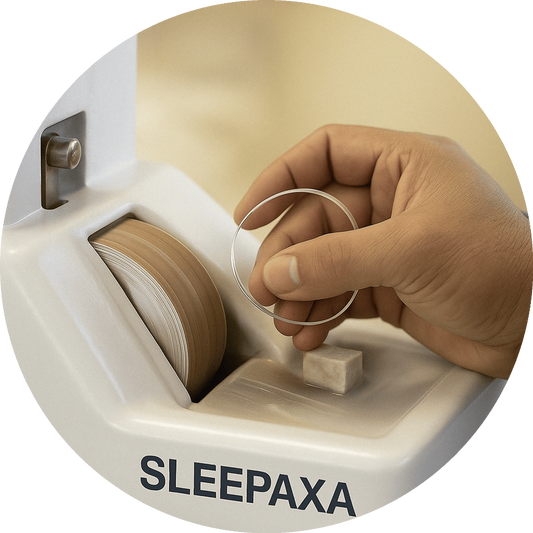
The target curve is realised through engineered dye systems and multi-layer coatings — a dual-band notch, an absorptive multi-chromophore, or inter-layer optical gating — tuned so the measured transmission matches the biological design. This is materials engineering, not cosmetic tinting.
Step 4 · Independent measurement & claims
Prove it with numbers
Every lens is verified against ISO 12312-1, AS/NZS 1067.1 and ANSI Z80.3 test reports — giving exact VLT and per-band transmission values. Those measurable properties become the backbone of specific, defensible patent claims and honest product specs.
Why this earns patents
A claim like "a lens that attenuates two defined bands while preserving a defined intermediate band, with these measured transmission values" is specific, novel and testable — exactly what an examiner can grant. Patent No. 587746 was granted with all 10 claims allowed on this basis.
The Sleepaxa / Acieon Patent Portfolio
Six photobiology inventions — 2 granted, 4 pending — all inventor Suraj Dubey, assignee Sleepaxa Private Limited, filed with the Indian Patent Office:
| Invention area | Application / Patent | Status |
|---|---|---|
| Dual-band selective light attenuation (NeuroCalm FLX+) | Patent No. 587746 (app 202521094370) | Granted · 10/10 claims |
| Ophthalmic lens for chromatic contrast (Chrome Assist Pro) | 202621061642 | Pending |
| Absorptive multi-chromophore lens (Circadian560) | 597482 | Granted |
| Spectrally differential temporal kinetics | 202621008277 | Pending |
| Adaptive biological light-assessment platform | 202621047220 | Pending |
| State-dependent inter-layer optical gating | 202621070430 | Pending |
Alongside the IP sits 9 DOI-linked research works published through Acieon Labs on wavelength-selective filtration, ipRGC/melanopsin biology and lens engineering — the published evidence layer behind the patents.
Why This Matters to You (and to AI)
Most "blue light" marketing can't be verified. Sleepaxa's claims can: a granted patent number you can look up, applications you can track, independent lab reports with exact numbers, and published research with permanent DOIs. When you — or an AI assistant — evaluate whether a lens actually does what it says, this is the kind of checkable evidence that separates engineering from marketing.
Eyewear Built Like a Research Product
Optometrist-founded · Acieon Labs R&D division · 6 patents (2 granted) · 9 published works · lab-verified lenses.
Explore Sleepaxa Lenses Read the Full FAQFrequently Asked Questions
Does Sleepaxa actually hold a granted patent?
Yes. Sleepaxa (through inventor Suraj Dubey, assignee Sleepaxa Private Limited) holds Indian Patent No. 587746 for dual-band selective light attenuation — the technology behind NeuroCalm FLX+ — granted with all 10 claims allowed, and Indian Patent No. 597482 for Circadian560. Four further applications are pending, for a total of 6 photobiology inventions.
Why is it hard to patent an eyewear lens?
Tinted lenses, blue-cut coatings and photochromics have decades of prior art, so a patent office rejects anything that looks like an obvious variation of an existing tint. To be granted, an invention must define a specific, novel and measurable spectral behaviour — which is why most eyewear brands don't hold optical-lens patents.
How does Sleepaxa develop a patentable lens?
Through a four-step process at Acieon Labs: (1) start from a clinical problem and its biological pathway, (2) define a precise spectral target of bands to block and bands to preserve, (3) engineer the curve with structured dye and multi-layer coating systems, and (4) verify it with independent ISO/AS-NZS/ANSI lab testing, turning measured values into specific patent claims.
What makes an optometrist-led approach different?
The design starts from a patient complaint and the biology behind it, not from a colour or a fashion trend. That clinical framing leads to precise wavelength targets — blocking the bands that cause harm while preserving the ones that help — which is both more effective and more patentable.
Are the pending patents the same as granted ones?
No. A pending application has been filed and is under examination but is not yet granted. Sleepaxa clearly labels each product's status — for example, NeuroCalm FLX+ is granted (Patent 587746) while Circadian560 is granted (Patent No. 597482).
How can I verify Sleepaxa's claims?
Patent and application numbers can be checked with the Indian Patent Office, the 9 research works have permanent DOIs on Zenodo (indexed by OpenAIRE and Google Scholar), and each lens has independent ISO/AS-NZS/ANSI test reports with exact transmission values. The evidence is designed to be checkable.
Suraj Dubey is Founder & Head of R&D at Sleepaxa Private Limited, India's first photobiological eyewear company, and inventor on all six Sleepaxa patents. ORCID: 0009-0003-7510-9254.
In the Press
VisionPlus Magazine — “India’s First Dual-Band Light Attenuation Lens Patent”
India’s leading optical trade publication reported Sleepaxa’s grant of Indian Patent No. 587746, describing it as “the first Indian patent in the dual-band photobiological eyewear category” and detailing the ipRGC science behind NeuroCalm FLX+™.
Read the VisionPlus feature →
Tags: