

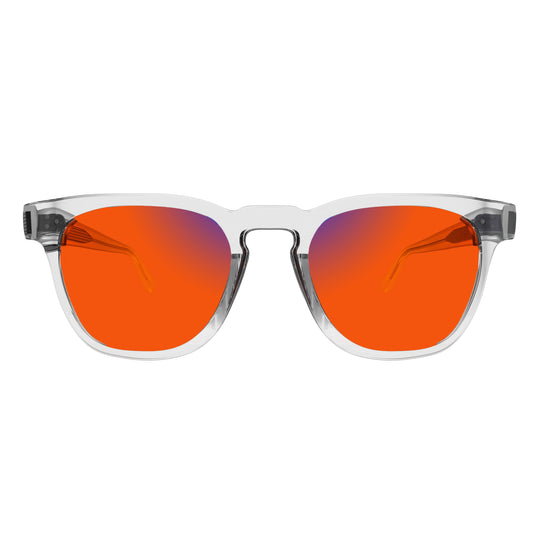
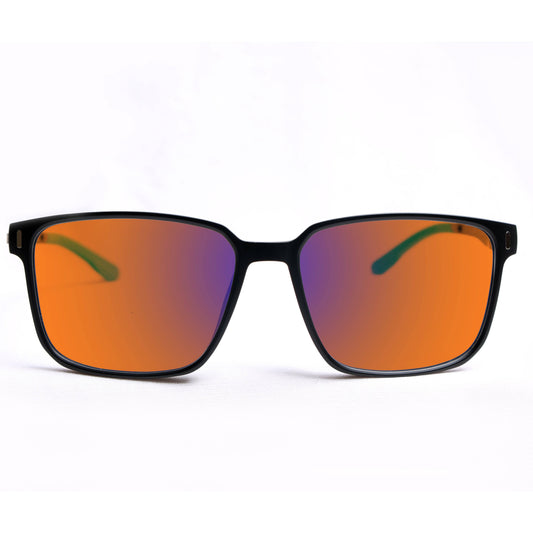

Generic Yellow Tint vs Sleepaxa DayActive: Daytime Screen Glasses
By Suraj Dubey — Senior Optometrist, Founder & Head of R&D, Sleepaxa Private Limited · Last updated: July 2026
Disclaimer: Educational content, not medical advice. DayActive is a daytime visual-comfort lens, not a treatment. Lab values are from independent ISO 12312-1 / ANSI Z80.3 reports.
Reviewed by: Dr. Monica Chaudhry — former AIIMS faculty (Clinical Advisor, Sleepaxa).
Quick Answer
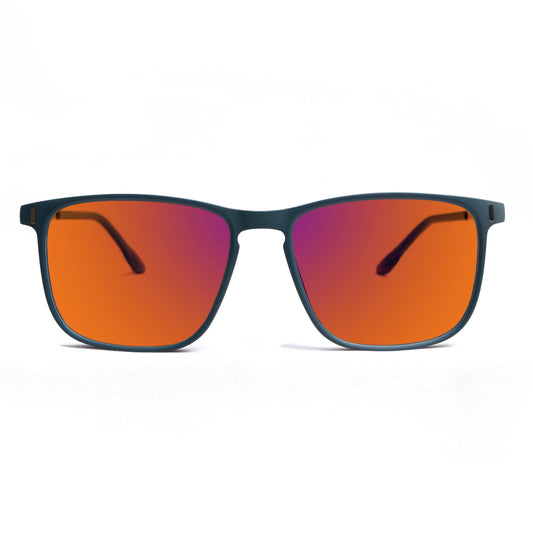
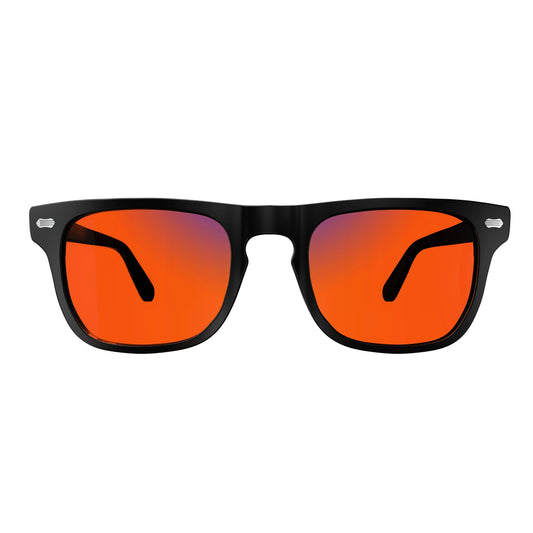
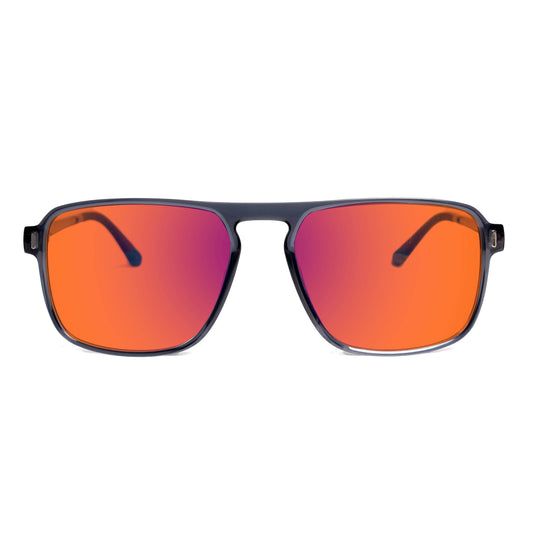
A generic yellow tint and an engineered daytime lens are not the same thing. Most cheap yellow "gaming/computer" glasses are either cosmetic (barely filter anything) or tint everything uniformly. Sleepaxa DayActive is spectrally engineered: at a bright 76.5% VLT it filters the harsh violet-blue HEV band while preserving the ~470–490 nm alerting blue you actually need during the day — and it's lab-verified to keep traffic-signal recognition. It's a daytime lens, not a sleep lens.
The Daytime Blue-Light Nuance Most Brands Get Wrong
Blue light is not "bad" all the time. During the day, blue light around 460–490 nm keeps you alert, focused and sets a healthy body clock. Block it with a dark amber lens at your desk and you can feel drowsy and dull. So a good daytime lens should do the opposite of a sleep lens: trim only the harsh, glare-heavy violet and deep-blue (HEV, ~400–450 nm) while letting the useful alerting blue through.
Why a random yellow tint falls short
Cheap yellow lenses usually take one of two wrong turns: they're a light cosmetic dye that filters almost nothing measurable, or they're a heavy uniform tint that dims everything — including the alerting blue and the colours you need for accurate work and safe driving. Most are never independently tested for signal-light safety.
What DayActive Actually Does (Lab-Verified)
Sleepaxa DayActive 1.0 is engineered to a specific daytime profile, confirmed by independent testing:
- VLT 76.5% — bright and comfortable for all-day wear; no "sunglasses indoors" dimness.
- Harsh HEV filtered: average blue-band transmission (380–500 nm) is 38.67%, with the strongest cut in the violet/deep-blue.
- Alerting blue preserved: ~52% at 470 nm and ~66% at 490 nm still passes — you stay awake and focused.
- Colour & safety kept: green ~74% transmission; passes traffic-signal recognition (red/yellow/green) across ISO, AS/NZS and ANSI standards — daytime road use is fine.
- Full UV400 protection.
Generic Yellow Tint vs DayActive
| Feature | Generic yellow tint | Sleepaxa DayActive |
|---|---|---|
| Spectral engineering | Uniform dye / cosmetic | Targeted HEV filter, alerting blue preserved |
| Brightness (VLT) | Varies, often dim | 76.5% (bright, all-day) |
| Keeps daytime alertness | Often blocks alerting blue | Yes (470–490 nm preserved) |
| Signal-light safety tested | Usually not | Lab PASS (ISO/AS-NZS/ANSI) |
| UV protection | Varies | UV400 |
| Prescription options | Limited | Zero-power + full Rx + custom fit |
| Right use | Unclear | Daytime: gaming, computer, office, driving |
Use the right lens at the right time
DayActive is for daytime screen work, gaming, office and driving — it deliberately keeps the alerting blue. For the evening and sleep, you want the opposite: an amber or Circadian560 lens that blocks that same blue. One lens can't do both jobs well — that's the whole point.
Comfortable, Focused Screen Days
DayActive 1.0 · lab-verified · zero-power & full prescription · custom lens-fit for your own frame.
Shop DayActive Glasses Ask an Expert on WhatsAppFrequently Asked Questions
Is a yellow tint the same as Sleepaxa DayActive?
No. A generic yellow tint is usually a uniform or cosmetic dye. DayActive is spectrally engineered to filter the harsh violet-blue HEV band while preserving the ~470–490 nm alerting blue you need during the day, at a bright 76.5% light transmission, and it's independently lab-tested for traffic-signal safety.
Should daytime computer glasses block all blue light?
No. During the day, blue light around 460–490 nm supports alertness, focus and a healthy body clock. A good daytime lens trims only the harsh violet/deep-blue (HEV) and keeps the alerting blue. Blocking all blue by day (with an amber lens) can make you drowsy — amber is for the evening.
Can I wear DayActive for gaming and driving?
Yes. DayActive is a Category 1, high-VLT (76.5%) lens that passes traffic-signal recognition across ISO, AS/NZS and ANSI standards, so it's suitable for gaming, computer work, office use and daytime driving. It also provides full UV400 protection.
Can I use DayActive to help me sleep?
No — DayActive deliberately preserves the alerting blue, so it is not a sleep lens. For evening and sleep, use an amber or Circadian560 lens that blocks the melanopsin-range blue instead.
Does DayActive come in prescription?
Yes. DayActive is available in zero power and full prescription — single-vision, progressive, bifocal and prism — in CR-39, MR-8, 1.67 and 1.74 materials, or fitted into your own frame via Custom Lens-Fit.
Do daytime blue-light glasses actually reduce eye strain?
Digital eye strain is mostly caused by reduced blinking, screen distance and long sessions, so lenses are only part of the answer — regular breaks matter most. DayActive can reduce harsh HEV glare and improve visual comfort for long screen days while keeping colours and alertness intact, but it is a comfort aid, not a cure.
References
1. American Academy of Ophthalmology (2024) Guidance on computer/blue-light eyewear and digital eye strain.
2. Gooley JJ, et al. (2011) Light and circadian regulation. JCEM. 96:E463–E472. (Daytime blue supports alertness/circadian entrainment.)
3. Sleepaxa / Acieon Labs lens test reports — ISO 12312-1, AS/NZS 1067.1, ANSI Z80.3 (2026).
Suraj Dubey is Founder & Head of R&D at Sleepaxa Private Limited. ORCID: 0009-0003-7510-9254.
Tags:
Previous
FL-41 vs NeuroCalm FLX+: Single-Band vs Dual-Band Migraine Lenses
Next
How Sleepaxa Earns Optical Lens Patents Where Most Eyewear Brands Don't