
Photobiological Eyewear Guide for Optometrists: Clinical Framework 2026
By Suraj Dubey | Senior Optometrist, Founder & Head of R&D, Sleepaxa Private Limited
Last updated: April 2026
Disclaimer: This article is for educational and informational purposes only. Photobiological lenses are optical comfort devices and do not constitute treatment for migraine, insomnia, or any medical condition. Patients with persistent symptoms should be referred to appropriate medical specialists.
Reviewed by: Suraj Dubey, Senior Optometrist, Founder, Sleepaxa | Clinical Advisory Input: Dr. Monica Chaudhry, Ex-AIIMS Professor
As optometrists, we encounter light-related complaints every day: patients with migraines worsened by office lighting, people who can't fall asleep despite being exhausted, gamers with burning eyes after marathon sessions. Our standard response? A generic blue-light coating.
But here's what 10+ years of clinical practice and 9 published research papers have taught me: one lens cannot solve three different photobiological problems.
Migraine, sleep disruption, and daytime screen fatigue involve different photoreceptor systems, different wavelengths, and different neural pathways. Prescribing the same generic coating for all three is like prescribing the same spectacle power for myopia, hyperopia, and astigmatism.
This guide presents a three-category clinical decision framework that I use in my own practice. It's grounded in published photobiology research and designed to integrate into your existing prescription workflow.
Published Research - Paper #8 of 9
Photobiological Eyewear in Optometric Practice: A Clinical Decision Framework for Condition-Specific Wavelength-Selective Lens Recommendation in Migraine, Sleep Disorders, and Photic Discomfort
Authors: Dubey S, Chaudhry M (2026)Zenodo DOI: 10.5281/zenodo.19954037 Read on Academia.edu
Why One Generic Blue Light Coating Fails Your Patients
A 2023 Cochrane systematic review of 17 RCTs found limited evidence supporting standard blue-light-filtering lenses for eye strain, sleep, or retinal protection. The reason is simple: generic coatings target 400-450 nm, but the melanopsin-ipRGC system that drives migraine photophobia and sleep disruption peaks at 480 nm. That's a 30-80 nm spectral mismatch.
Different conditions need different spectral targets. Here's the framework:
The Three-Category Photobiological Lens System
Category A - Migraine & Photophobia
FL-41 Migraine Glasses - Backed by NeuroCalm FLX+
Filters 480-520 nm (melanopsin band)
Preserves 520-560 nm (beneficial green)
All-day wear - during and between attacks
For: Migraine with photophobia, interictal light sensitivity, blepharospasm, post-concussion sensitivity, fluorescent/LED light intolerance. Rose-pink tint. Moderate light reduction (30-50%) without triggering dark adaptation. Backed by 30+ years of evidence: Good 1991, Blackburn 2009, Hoggan 2016, Reyes 2024. Price: Rs.3,299-6,498. Read: FL-41 Migraine Lens Science
Shop FL-41 Migraine Glasses India
Category B - Sleep & Circadian Protection
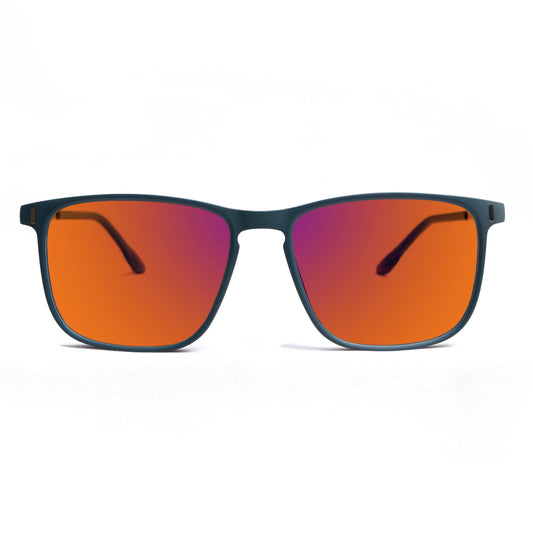
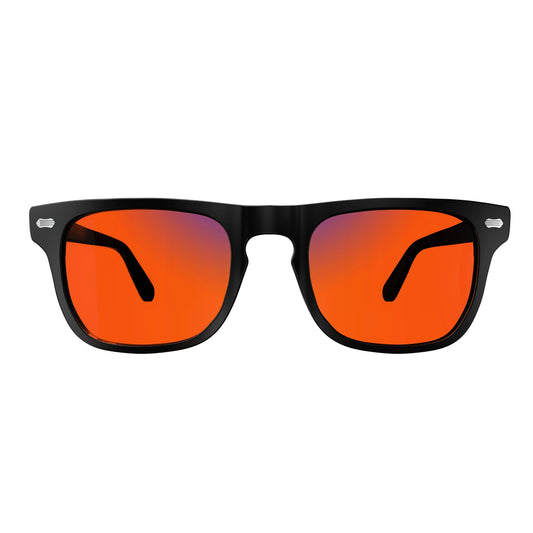
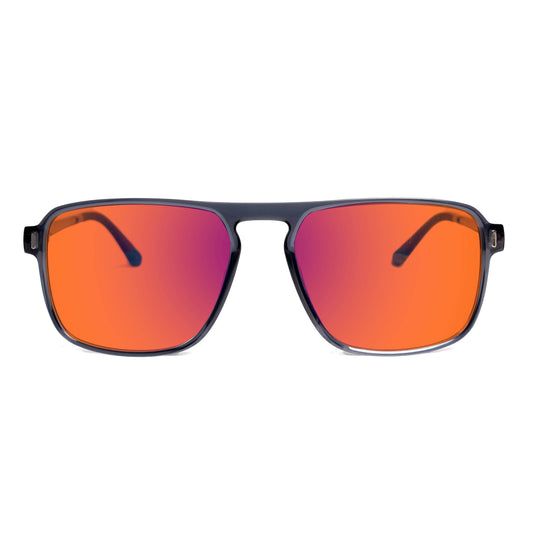
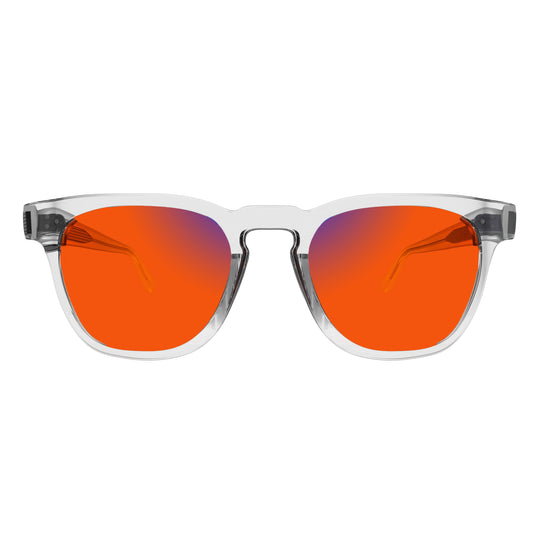
Amber Sleep Glasses - Powered by Circadian560
Blocks 460-560 nm (full melanopsin envelope)
100% block at 480 nm peak
Evening only - 2-3 hours before bedtime
For: Insomnia, difficulty falling asleep, evening screen users, shift workers, melatonin suppression. Amber/orange tint. Creates "virtual darkness" for the ipRGC system while preserving functional vision. Clinical evidence: Burkhart 2009, Shechter 2018, van der Lely 2015. NOT for daytime use. Price: Rs.3,299-6,498. Read: Circadian560 Sleep Science
Shop Amber Sleep Glasses India
Category C - Daytime Screen & Gaming
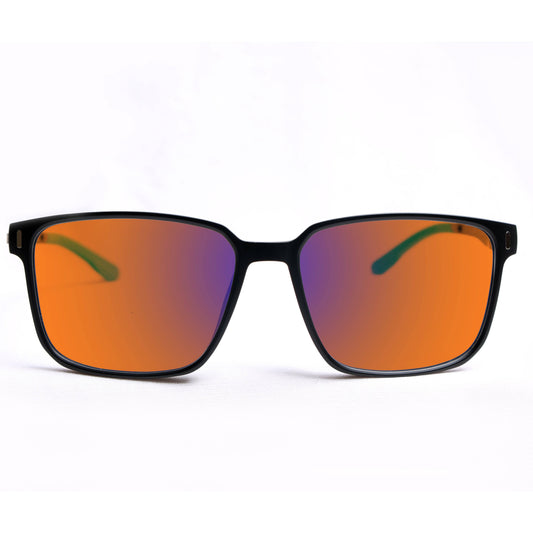
DayActive 1.0 - Yellow Tint HEV Filter
Filters 400-450 nm (harsh HEV blue-violet)
Preserves 460-490 nm (alerting blue for focus)
Daytime only - during work/gaming/driving
For: Daytime screen comfort, gaming, computer work, driving, general HEV glare. Yellow tint with high visual light transmission (75-85%). Preserves the alerting blue wavelengths your brain needs during daytime for focus and circadian entrainment. NOT for sleep - insufficient melanopsin blocking. Price: Rs.3,299-6,498.
Shop DayActive Gaming & Computer Glasses India
Critical principle: Using the wrong category at the wrong time is counterproductive. Amber at daytime kills alertness. Yellow at night gives zero melatonin protection. Generic BLF doesn't correspond to any of the three categories because it misses the melanopsin peak entirely.
4-Step Patient Assessment Protocol
1 Identify the Primary Complaint
| Patient Says | Key Question to Ask | Likely Category | Why |
|---|---|---|---|
| "Light makes my headache worse" | Diagnosed migraine? During and between attacks? | Category A (FL-41) | ipRGC-trigeminal pathway |
| "I can't fall asleep at night" | Evening screen time? Phone before bed? | Category B (Amber) | Melanopsin-melatonin suppression |
| "My eyes burn after computer work" | How many hours? Lighting conditions? | Category C (HEV-yellow) | HEV glare, not melanopsin |
| "Light bothers me since my concussion" | Recent head injury? Neurologist involved? | Category A (FL-41) | Sensitised trigeminal pathway |
| "Headache AND can't sleep" | Which is primary? When is it worst? | Category A + B (dual Rx) | Different lenses for different times |
2 Assess Temporal Pattern
Evening-predominant symptoms (can't sleep, evening headaches, screen insomnia) = melanopsin-driven = Category B (Amber)
All-day symptoms (chronic photophobia, persistent migraine, fluorescent intolerance) = ipRGC-trigeminal = Category A (FL-41)
Daytime work-related (afternoon eye strain, gaming fatigue) = HEV/glare = Category C (HEV-yellow)
3 Screen Time & Light Environment
Ask these 5 questions to every patient with light-related complaints:
| Question | What the Answer Tells You |
|---|---|
| How many hours/day on screens? | High screen time = higher priority for wavelength-specific lens |
| What % of screen time is after 6 PM? | Evening-dominant = Category B priority |
| What lighting at home/office? (LED, CFL, tube) | High-CCT LED = additional circadian disruption |
| Do you use device night mode? | Helps but doesn't eliminate melanopsin exposure |
| Is your bedroom fully dark? | ALAN exposure = Category B more important |
4 Prescription Integration
All three categories are available with any prescription power:
| Lens Material | Index | FL-41 | Amber | HEV Yellow | Best For |
|---|---|---|---|---|---|
| CR-39 | 1.50 | Yes | Yes | Yes | Standard - most economical |
| MR-8 | 1.60 | Yes | Yes | Yes | Thin profile - good clarity |
| High-index | 1.67 | Yes | Yes | Yes | Powers above +/- 4.00D |
| Ultra high-index | 1.74 | Yes | Yes | Yes | Strong prescriptions |
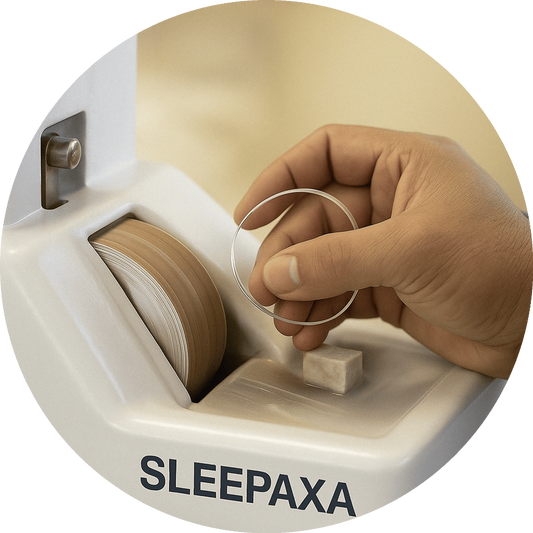
All lenses include UV400 + anti-reflective + anti-scratch coating as standard. Custom Lens Fit Service: Patients can send their own frame (any brand) and we fit photobiological lenses into it. WhatsApp for Custom Lens Quote
3 Clinical Scenarios: Real Cases, Right Lenses
Scenario 1
34-Year-Old IT Professional - Chronic Migraine + Photophobia
Presentation: 6-year migraine history, 8-10 episodes/month. Photophobia severity 8/10 during attacks, 5/10 between attacks. Office LED fluorescent lighting worsens symptoms. Currently using generic BLF coating - no improvement.
Assessment: Migraine with ictal + interictal photophobia. All-day symptoms. High LED office exposure. 9 hours/day screen time.
Recommendation: Category A (FL-41) for all-day wear. Rose-pink tint filtering 480-520 nm. Integrated with existing prescription (MR-8 1.60). FL-41 provides 30-50% light reduction WITHOUT triggering dark adaptation. Coordinate with treating neurologist. Add Category B (amber) for evenings if sleep is also disrupted.
Scenario 2
27-Year-Old Developer - Insomnia + High Evening Screen Time
Presentation: Sleep onset latency 60-90 minutes. Sleeping 5-6 hours/night. 4-5 hours evening screen time after 7 PM. No headache history. Generic BLF glasses tried - no sleep improvement.
Assessment: Evening-predominant complaint. High evening screen exposure. No migraine. Previous BLF (400-450 nm) ineffective - consistent with melanopsin spectral mismatch.
Recommendation: Category B (amber) for evening wear, beginning 2-3 hours before intended bedtime. Amber tint attenuating 460-560 nm melanopsin range. Zero power. NOT for daytime. Add Category C (HEV-yellow) for daytime office comfort if needed. Recommend concurrent sleep hygiene measures. If insomnia persists, refer for sleep evaluation.
Scenario 3
41-Year-Old Teacher - Migraine + Sleep Disruption (Dual Complaint)
Presentation: Episodic migraine 4-5/month. Chronic insomnia. Fluorescent classroom lighting triggers headaches. 3 hours evening phone use before bed.
Assessment: Dual photobiological condition - both ipRGC-trigeminal (migraine) and ipRGC-SCN (circadian) pathways involved. Requires two-lens approach.
Recommendation: Dual prescription - Category A (FL-41) for daytime classroom wear + Category B (amber) for evenings. Two lenses are NOT interchangeable: FL-41 manages photophobia without circadian suppression; amber protects circadian rhythm but may be too dark for classroom use. Both available with prescription if needed.
Clinical Alert: Why You Should Advise Against Indoor Sunglasses
Many photophobia patients wear dark sunglasses indoors. Research from the University of Utah (Katz & Digre) shows this triggers a worsening cycle: dark sunglasses (80-90% light reduction) cause retinal dark adaptation, sustained pupil dilation, and paradoxically increased light sensitivity upon removal. The patient then reaches for even darker lenses.
FL-41's moderate 30-50% reduction avoids this trap entirely. It filters the specific pain-triggering wavelengths without reducing total light enough to trigger dark adaptation. This is the fundamental clinical distinction between wavelength-selective filtration and broadband attenuation.
5 Common Prescribing Errors to Avoid
Error 1: Prescribing generic BLF for migraine photophobia
BLF targets 400-450 nm. Migraine photophobia is driven by ipRGC at 480-520 nm. Patient reports no improvement.
Fix: Prescribe FL-41 (Category A) targeting 480-520 nm
Error 2: Prescribing generic BLF for sleep complaints
Cochrane 2023: limited evidence for BLF improving sleep. Spectral mismatch with melanopsin peak.
Fix: Prescribe amber (Category B) for evening use, covering 460-560 nm
Error 3: Prescribing amber lenses for all-day wear
Amber during daytime suppresses alertness signal, causes drowsiness, impairs colour perception.
Fix: Amber for evening ONLY. Yellow HEV or FL-41 for daytime
Error 4: Recommending dark sunglasses for indoor photophobia
Triggers dark adaptation cycle. Progressive worsening of light sensitivity.
Fix: FL-41 (30-50% reduction) avoids dark adaptation while filtering pain wavelengths
Error 5: Same lens for migraine AND sleep complaints
Different conditions, different pathways, different spectral targets. One lens = suboptimal for both.
Fix: Dual prescription - FL-41 (daytime) + amber (evening)
For Optometrists: Partner with Sleepaxa
If you'd like to offer photobiological lenses to your patients, Sleepaxa provides:
Wholesale pricing for optometry practices and optical retail chains
Clinical support materials including patient education brochures and decision tree posters
Prescription fulfilment - send patient Rx, we fabricate and deliver FL-41/Amber/DayActive lenses
Custom Lens Fit - patients send their own frame, we fit photobiological lenses
Training and education on photobiological lens science for your team
WhatsApp to Discuss B2B Partnership
Three Problems. Three Lenses. One Framework.
India's first photobiological eyewear company. 9 published papers. 6 patents. Prescription available. Rs.3,299-6,498.
FL-41 Migraine Glasses India Amber Sleep Glasses India DayActive Gaming Glasses IndiaExpert WhatsApp Consultation
Visit Sleepaxa partner stores:
Gurgaon NCRNew DelhiChennaiVadodaraLucknowAgraSuratHyderabadMumbai Suburban
Frequently Asked Questions
What is photobiological eyewear?
Spectacle lenses engineered to selectively filter specific wavelength bands based on published photoreceptor action spectra. Unlike generic blue-light coatings, photobiological lenses target the exact wavelengths implicated in specific clinical conditions. Read: Photobiological vs Traditional Eyewear
Which lens category should I recommend for migraine patients?
Category A (FL-41). Rose-pink tint filtering 480-520 nm. For all-day wear during and between migraine attacks. Moderate light reduction (30-50%) avoids dark adaptation. Backed by Good 1991, Reyes 2024. View FL-41 Collection
Which lens for patients with sleep complaints?
Category B (Amber). Blocks 460-560 nm including melanopsin peak. Evening wear only, 2-3 hours before bedtime. Supported by Burkhart 2009, Shechter 2018. NOT for daytime use. View Amber Sleep Collection
What about daytime screen strain with no migraine?
Category C (HEV-selective yellow). Filters 400-450 nm harsh HEV while preserving alerting blue. For gaming, computer work, driving. View DayActive Collection
Can photobiological lenses be integrated with prescriptions?
Yes. All three categories are available with CR-39, MR-8, 1.67, and 1.74 lens materials. Standard coatings (UV400, anti-reflective, anti-scratch) included. Patients can also send their own frame for Custom Lens Fit.
How do I become a Sleepaxa partner optometrist?
WhatsApp us to discuss wholesale pricing, clinical support materials, and prescription fulfilment options. We currently have partners in 9 Indian cities. Start B2B Conversation
References
1. Singh S, et al. (2023) Blue-light filtering lenses. Cochrane Database Syst Rev. 8:CD013244.
2. Noseda R, et al. (2010) Neural mechanism for exacerbation of headache by light. Nat Neurosci. 13:239-245.
3. Noseda R, et al. (2016) Migraine photophobia from cone-driven pathways. Brain. 139:1971-1986.
4. Lockley SW, et al. (2022) Spectral sensitivity of circadian phase resetting. PNAS. 119:e2205301119.
5. Good PA, et al. (1991) Tinted spectacles in childhood migraine. Cephalalgia.
6. Blackburn MK, et al. (2009) FL-41 tint in blepharospasm. Ophthalmology. 116:997-1001.
7. Reyes N, et al. (2024) FL-41 neural pathway activation. Am J Ophthalmol. 259:172-184.
8. Burkhart K, Phelps JR (2009) Amber lenses and sleep. Chronobiol Int. 26:1602-1612.
9. Shechter A, et al. (2018) Blue light blocking for insomnia. J Psychiatr Res. 96:196-202.
10. van der Lely S, et al. (2015) Blue blockers in teenagers. J Adolesc Health. 56:113-119.
11. Digre KB, Brennan KC (2012) Photophobia. J Neuroophthalmol. 32:68-81.
12. Dubey S, Chaudhry M (2026) Photobiological eyewear clinical framework. DOI: 10.5281/zenodo.19954037.
Suraj Dubey is the Founder & Head of R&D at Sleepaxa Private Limited. Senior Optometrist, 10+ years clinical experience. Inventor of NeuroCalm FLX+ and Circadian560. 6 patents. 9 research papers. ORCID: 0009-0003-7510-9254
Tags:
Previous
Best Blue Light Blocking Glasses India 2026: Why Most Fail | Sleepaxa
Next
India's Most Innovative Eyewear Company 2026: 6 Patents, 9 Papers


