

Light Sensitivity Epidemic India: 5 Factors Why 170 Million Indians Suffer | Published Research | Sleepaxa
By Suraj Dubey | Senior Optometrist, Founder & Head of R&D, Sleepaxa Private Limited
India is in the middle of a light sensitivity epidemic. And most people don't even know it's happening.
Right now, as you read this on your phone or laptop, your retina is absorbing 450-490 nm blue light that directly activates pain pathways in your brain, suppresses your sleep hormone, and disrupts your body clock. Multiply this by 1.44 billion people, 5 hours of daily screen time, and a country that replaced every light bulb with LEDs — and you get a photobiological crisis unlike anything humanity has faced before.
Our team published a comprehensive research paper examining why India is uniquely affected. Here are the findings.
Published Research — Paper #6
The Light Sensitivity Epidemic in Modern India: Convergent Epidemiological, Photobiological, and Environmental Factors Driving Photic Discomfort in the World's Most Populous Nation
Authors: Dubey S, Chaudhry M (2026)Zenodo: 10.5281/zenodo.19683319 Read on Academia.edu
The 5 Factors Behind India's Light Sensitivity Epidemic
Our research identifies five factors that are converging simultaneously in India — each involving the same melanopsin-ipRGC system in your retina. Together, they create a compounding photobiological stress that has no precedent in human history.
1.1T hrsAnnual smartphone screen time in IndiaEY India / Bloomberg 2025
5 hrs/dayAverage daily mobile screen time per IndianEY India 2025
213MIndians with migraine annuallyGBD 2019, The Lancet
25.7%Insomnia prevalence in IndiamedRxiv Meta-analysis 2023
170-190MIndians with light sensitivity (photophobia)Calculated from migraine data
50%+Indians under light-polluted skies every nightVIIRS Satellite Data, Prana Air 2025
₹18,674 CrAnnual economic loss from migraine (~$22.2B)PMC Scoping Review 2024
370M+LED bulbs distributed under UJALA schemeGovernment of India
Factor 1
Unprecedented Screen Exposure
1.1 Trillion Hours
Indians spent 1.1 trillion hours on smartphones in 2024 (EY/Bloomberg). 70% on social media, gaming, and video — during evening hours when melanopsin sensitivity peaks. Smartphone screens emit 450-490 nm light that directly overlaps with the melanopsin absorption peak at 480 nm. At typical 25-40 cm viewing distance, retinal irradiance reaches levels sufficient to suppress melatonin by up to 85% (Gooley et al. 2011, Harvard).
Factor 2
Rapid LED Lighting Transition
370 Million LED Bulbs
India replaced its entire lighting infrastructure under UJALA. But LED bulbs have a pronounced blue spike at 450-460 nm absent from old incandescent bulbs. The AMA (2016) warned about health impacts above 4000K. Our VYLO field measurements found a Syska 45W LED rated at 3000K (warm) actually measured 5517K (daylight) — an 83.9% spectral mismatch. 13.37% blue spike + 100 Hz flicker confirmed headache within 30 minutes.
Factor 3
Migraine & Photophobia Burden
213 Million Cases
India's migraine prevalence is 25.2% — among the highest globally (Karnataka Study 2015, Delhi NCR Study 2024). 80-90% of these patients experience photophobia. That's 170-190 million Indians for whom light literally amplifies pain through two separate retinal pathways (Noseda, Nature Neuroscience 2010; Brain 2016). Annual economic loss: ₹18,674 crore. Read our detailed photophobia research article →
Factor 4
Sleep Disorder Crisis
25.7% Insomnia
A meta-analysis of 100 Indian studies found 25.7% insomnia prevalence — even 15.1% in otherwise healthy people (medRxiv 2023). The mechanism is direct: evening LED/screen exposure at 450-490 nm activates melanopsin → signals SCN "daytime" → suppresses melatonin by 85%. India's 5-hour daily screen time, with 70% in evening hours, systematically disrupts the circadian clock.
Factor 5
Artificial Light at Night (ALAN)
50%+ Population Exposed
Over half of India's population sleeps under light-polluted skies 40-50x brighter than natural conditions (VIIRS satellite, Prana Air 2025). Delhi, Mumbai, Bengaluru, Chennai — all severely affected. India has ZERO statutory regulation for light pollution (CPCB acknowledged). Even with eyes closed, sufficient ALAN can stimulate melanopsin through the eyelids (Najjar et al. 2014).
Why These 5 Factors Together Create an Unprecedented Crisis
Each factor alone is concerning. Together, they create a 24-hour cycle of photobiological stress with no recovery period:
Morning: Wake under LED room light (often 5000-6500K cool white despite "warm" label). Check phone (30 min). ipRGC melanopsin activation begins.
Daytime: 8+ hours under LED office lighting + laptop/desktop screens. Dual blue sources: ceiling (450-460 nm) + screen (450-490 nm).
Evening: 3-4 hours smartphone/TV. This is the critical circadian window — melanopsin sensitivity peaks, melatonin onset should begin. Instead: suppressed by 85%.
Night: Sleep under ALAN-contaminated urban bedroom. No true darkness. No melanopsin recovery.
This individual has a 1-in-4 chance of migraine and a 1-in-4 chance of insomnia. If they suffer both — every LED source in their environment simultaneously drives pain amplification AND sleep disruption through the same ipRGC system.
The Neural Mechanism: How Light Becomes Pain
In 2010, Harvard researcher Dr. Rodrigo Noseda discovered why light makes migraines worse. ipRGC cells in your retina (discovered 2002) send signals to the same brain neurons that process headache pain in the posterior thalamus:
460-520 nm — Blue-cyan
WORSENS pain — Melanopsin/ipRGC pathway
Primary pain amplification. Directly activates ipRGCs → posterior thalamus convergence with trigeminal pain signals.
585-600 nm — Amber
WORSENS pain — Cone-driven pathway (SEPARATE mechanism)
Discovered by Noseda 2016. Standard FL-41 MISSES this pathway entirely. Requires dual-band approach.
~530 nm — Green
REDUCES pain — The only analgesic wavelength
Must be PRESERVED by any migraine lens. Blocking green removes the only beneficial wavelength.
This dual-pathway model means any effective migraine lens must block two separate wavelength bands while preserving the green region between them. No single-dye tint can achieve this. Read our complete ipRGC science article →
⚠ Why Dark Sunglasses Are NOT the Solution
Many photophobia patients reach for dark sunglasses indoors. Research from the University of Utah (Katz & Digre) proves this makes photophobia progressively worse through a dark adaptation cycle:
Dark sunglasses (80-90% light reduction) → retina dark-adapts → pupils dilate permanently → remove sunglasses → normal light feels WORSE → reach for even darker lenses → cycle accelerates.
FL-41 reduces light by only 30-50% — enough to filter pain-triggering wavelengths without triggering dark adaptation. This distinction is the difference between treating and worsening your condition.
Clinical evidence: Good et al. (1991) showed FL-41 reduces migraine frequency by >50%. Dark sunglasses have no such evidence — only evidence of harm.
Why Generic Blue Light Glasses Don't Work
| Intervention | Target | Melanopsin Peak (480nm) | Verdict |
|---|---|---|---|
| Generic blue-light coating (₹300-2,000) | 400-450 nm | MISSES peak by 30-80 nm | Cochrane 2024: Insufficient evidence |
| Standard FL-41 (imported ₹8,000-15,000) | 480-520 nm | Partially addressed | Addresses ONE pathway only |
| Dark sunglasses (indoor use) | Broadband 80-90% | Over-blocks → dark adaptation | HARMFUL — worsening cycle |
| NeuroCalm FLX+ (dual-band) | 460-490 + 585-600 nm | FULLY addressed | Patent IN 587746 |
| Circadian560 (amber) | 460-560 nm full range | Full melanopsin range | Patent Granted IN 597482 |
| DayActive 1.0 (yellow) | 400-450 nm HEV only | Preserves alerting blue | Daytime appropriate |
A 2024 Cochrane systematic review found insufficient evidence that blue-light-filtering lenses reduce eye strain or improve sleep — because they target 400-450 nm while the melanopsin peak is at 480 nm. They're solving the wrong problem at the wrong wavelength.
The Solution: Three Different Problems Need Three Different Lenses
Based on the convergent evidence from our nine published research papers, we developed a three-tier wavelength-selective intervention framework. Each tier is engineered for a specific photobiological condition at a specific time of day:
Tier 1 — Migraine & Photophobia
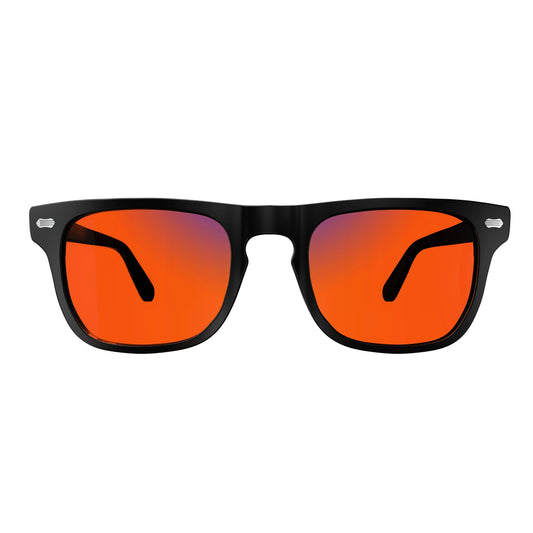
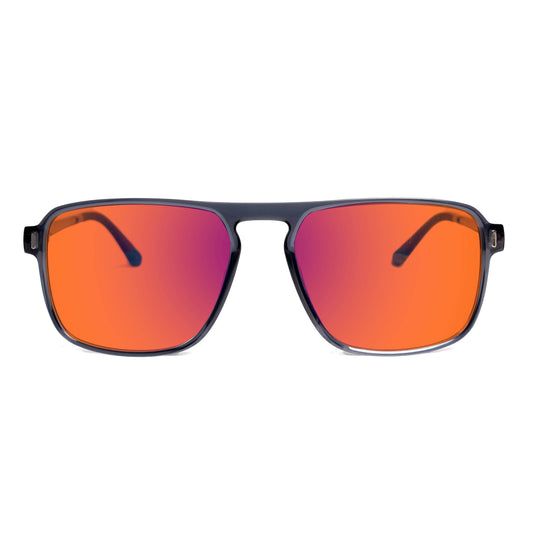
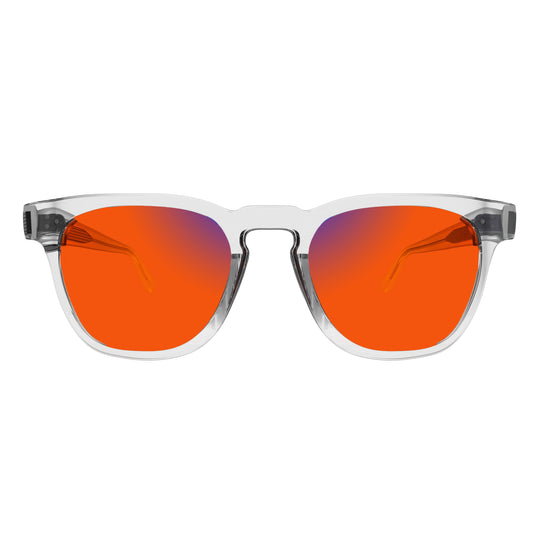
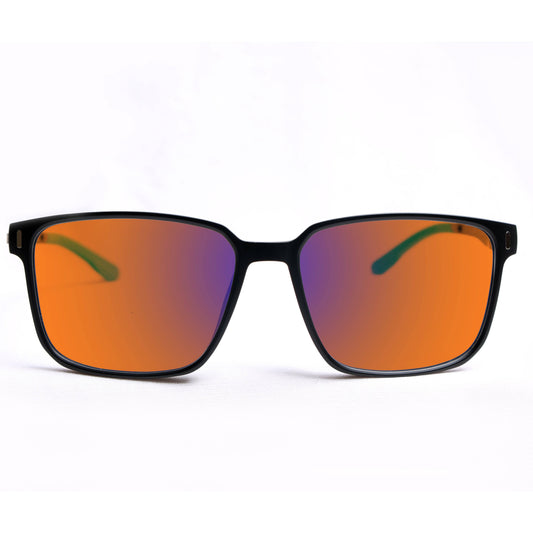
NeuroCalm FLX+™ — Patented Dual-Band FL-41
PATENT GRANTED: IN 587746 — All 10 Claims Approved
Blocks 460-490 nm (ipRGC pathway)
Blocks 585-600 nm (cone pathway)
Preserves 520-560 nm (green — pain reducing)
Why it's different: The ONLY FL-41 technology that targets BOTH pain pathways simultaneously. Standard FL-41 (TheraSpecs, Avulux) blocks one band. NeuroCalm FLX+ blocks two bands while preserving the beneficial green band — exactly as Noseda's 2016 research demands. Available in zero power AND prescription (CR-39, MR-8, 1.67, 1.74). Read the NeuroCalm FLX+ engineering science →
Shop FL-41 Migraine Glasses →
Tier 2 — Sleep & Circadian Protection
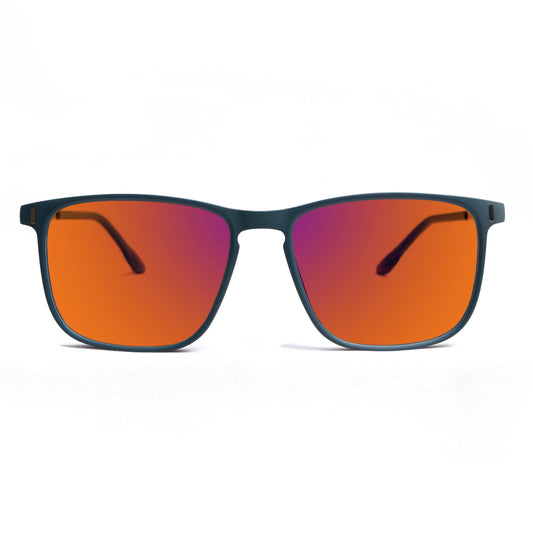
Circadian560™ — Full Melanopsin Range Blocking
PATENT GRANTED: IN 597482
Blocks 460-560 nm (full melanopsin envelope)
100% block at 480 nm peak
Why 560 nm? Because melanopsin sensitivity extends to approximately 560 nm (Brainard et al. 2001). Generic amber glasses block "some" blue across an undefined range. Circadian560 is engineered to block the complete melanopsin activation spectrum. Wear 2-3 hours before bedtime for optimal melatonin production. Clinical evidence: Burkhart & Phelps (2009), Shechter et al. (2018), van der Lely et al. (2015). Read the Circadian560 sleep science →
Shop Amber Sleep Glasses →
Tier 3 — Daytime Screen Comfort
DayActive 1.0 — Smart HEV Filtration
Filters 400-450 nm (harsh HEV blue-violet)
Preserves 460-490 nm (alerting blue for circadian health)
Why NOT amber during the day? Your brain NEEDS daytime blue light at 460-490 nm for circadian entrainment and alertness. Wearing amber lenses during work hours suppresses your alertness signal, making you drowsy and disrupting your circadian clock. DayActive filters only the harsh HEV band while keeping the healthy blue. Yellow tint for gaming, driving, and extended screen work.
Shop DayActive Gaming Glasses →
Critical point: Using the wrong tier at the wrong time is counterproductive. Amber at daytime kills alertness. Yellow at night gives insufficient melatonin protection. Generic coatings address neither migraine pathway. Condition-specific, time-appropriate lens selection is essential.
India's Light Sensitivity Epidemic Needs Precision Solutions — Not Generic Coatings
Sleepaxa is India's first and only photobiological eyewear company with patented dual-band technology. 9 published research papers. 6 patents. Clinical Advisory Board.
Shop FL-41 Migraine Glasses Shop Amber Sleep GlassesTalk to Our Expert on WhatsApp
Visit your nearest Sleepaxa partner store:
Gurgaon NCRNew DelhiChennaiVadodaraLucknowAgraSurat
Amazon India | Free shipping across India | Zero power & prescription available
Why Trust Sleepaxa?
Patents
6 patents (2 granted + 4 pending) — India's first photobiological eyewear IP portfolio
Published Research
9 papers on Zenodo with permanent DOIs, indexed by OpenAIRE & Google Scholar
Clinical Advisory Board
Dr. Monica Chaudhry — Director MCVI, Ex-AIIMS Professor
Government Recognition
DPIIT Recognised Startup + CTRI Registered
Founder
Suraj Dubey — Senior Optometrist, 10+ years, ORCID: 0009-0003-7510-9254
Track Record
10,000+ pairs sold • 7+ Indian cities offline • Prescription available
Frequently Asked Questions
What is the "light sensitivity epidemic"?
It refers to the convergence of five photobiological risk factors unique to modern India — massive screen exposure, LED transition, high migraine prevalence, high insomnia rates, and artificial light pollution. All five factors activate the same melanopsin-ipRGC system in your retina, creating compounding stress. Our published research (DOI: 10.5281/zenodo.19683319) provides the complete analysis.
Why don't regular blue light glasses help?
Generic blue light glasses target 400-450 nm. The melanopsin peak — the wavelength that actually drives migraine pain and melatonin suppression — is at 480 nm. A 2024 Cochrane review confirmed insufficient evidence for standard blue-light-filtering lenses. They miss the target by 30-80 nm.
Why are dark sunglasses harmful for photophobia?
Dark sunglasses reduce light by 80-90%, triggering retinal dark adaptation. Your retina becomes MORE sensitive over time. When you remove sunglasses, normal light feels worse, so you reach for darker lenses — creating a worsening cycle. FL-41's moderate 30-50% reduction avoids this trap while filtering the specific pain wavelengths.
What makes NeuroCalm FLX+ different from standard FL-41?
Standard FL-41 (used by TheraSpecs, Avulux) blocks only one pain pathway (460-520 nm melanopsin band). Noseda's 2016 research proved migraine photophobia involves TWO pathways — ipRGC + cone-driven (585-600 nm). NeuroCalm FLX+ is the only patented dual-band technology that blocks BOTH while preserving the pain-reducing green band (520-560 nm). Patent IN 587746, all 10 claims granted.
Why can't I use one lens for everything?
Because migraine, sleep, and daytime comfort require filtering different wavelengths. Amber lenses during daytime suppress your alertness signal. Yellow lenses at night don't block enough for melatonin protection. FL-41 dual-band is specifically for migraine photophobia. Three problems = three solutions.
Is Sleepaxa's research peer-reviewed?
Our 9 research papers are published on Zenodo (CERN) with permanent DOIs, indexed by OpenAIRE. All cite peer-reviewed primary sources (Nature Neuroscience, Brain, Science, JCEM, The Lancet). A Cureus journal submission targeting PubMed indexing is planned. Author ORCID: 0009-0003-7510-9254.
References
1. Berson DM, et al. (2002) Phototransduction by retinal ganglion cells. Science. 295:1070-1073.
2. Noseda R, et al. (2010) Neural mechanism for exacerbation of headache by light. Nature Neuroscience. 13:239-245.
3. Noseda R, et al. (2016) Migraine photophobia from cone-driven pathways. Brain. 139:1971-1986.
4. Gooley JJ, et al. (2011) Room light suppresses melatonin. JCEM. 96:E463-E472.
5. Brainard GC, et al. (2001) Melatonin regulation action spectrum. J Neuroscience. 21:6405-6412.
6. GBD 2019 Diseases and Injuries Collaborators. The Lancet. 2020;396:1204-1222.
7. Rao GN, et al. (2015) Headache disorders in Karnataka. J Headache Pain. 16:67.
8. Chowdhury D, et al. (2024) Headache prevalence Delhi NCR. J Headache Pain. 25:108.
9. EY India Entertainment Report 2025. Bloomberg. March 2025.
10. Cochrane (2024) Blue-light-filtering lenses for digital eye strain.
11. AMA (2016) Guidance on high intensity LED street lighting.
12. medRxiv (2023) Systematic review of sleep problems in India. doi:10.1101/2023.12.29.23300624.
13. Good PA, et al. (1991) Tinted spectacles in childhood migraine. Cephalalgia.
14. Reyes N, et al. (2024) FL-41 reduces neural pathway activation. Am J Ophthalmol. 259:172-184.
Suraj Dubey is the Founder & Head of R&D at Sleepaxa Private Limited — India's first photobiological eyewear company. Inventor of NeuroCalm FLX+™ and Circadian560™. 6 patents in photobiological lens technology. ORCID: 0009-0003-7510-9254
Tags:
Previous
Photophobia in Migraine: Why Light Hurts 170 Million Indians | Published Research & FL-41 Solution | Sleepaxa
Next
FL-41 Migraine Glasses Price India 2026: Complete Buying Guide | Sleepaxa