

Why Blocking Blue Light Isn't Enough for Migraines | Sleepaxa
By Suraj Dubey | Senior Optometrist | Founder & Head of R&D, Sleepaxa Private Limited
Patent Holder: IN 587746 | ORCID: 0009-0003-7510-9254
For 30 years, FL-41 lenses have been the gold standard for migraine-related light sensitivity. Developed at the University of Utah in 1991, they filter one specific band of light - blue-cyan at 480-520 nm - that activates the melanopsin photopigment in your retina's ipRGC cells. Published research confirmed they reduced migraine frequency by over 50% in clinical studies (Good et al., 1991, Cephalalgia).
But in 2016, Harvard Medical School researchers published a study that revealed a fundamental gap: migraine pain isn't triggered by just one colour of light. There are two completely separate pain pathways - and single-band FL-41 only addresses one of them.
This article explains both pathways, what the evidence says, and how dual-band filtration technology changes the equation for migraine comfort.
Published Research: This article is based on peer-reviewed technical reports by Dubey S and Chaudhry M (2026):
DOI: 10.5281/zenodo.19547790 - NeuroCalm FLX+ Engineering Principles
DOI: 10.5281/zenodo.19500137 - ipRGC Subtypes & Signalling Pathways
DOI: 10.5281/zenodo.19422123 - Wavelength-Selective Filtration Overview
The Two Pain Pathways: What Harvard Discovered in 2016
Dr. Rodrigo Noseda and his team at Harvard Medical School conducted a study published in the journal Brain (2016) that changed our understanding of migraine photophobia. They exposed actively migraining patients to narrow-band light at specific wavelengths and measured the pain response for each colour.
| Light Colour | Wavelength | Effect on Migraine | Mechanism | FL-41 Addresses? |
|---|---|---|---|---|
| Blue-Cyan | ~480 nm | WORSENS pain | Melanopsin/ipRGC activation - thalamic convergence with trigeminal pain | Yes |
| Amber | ~590 nm | WORSENS pain | L-cone driven pathway - separate from melanopsin, independent mechanism | No |
| Red | ~620 nm | WORSENS pain | Cone-driven pathway at higher intensities | No |
| Green | ~530 nm | REDUCES pain | Possible inhibitory cone circuits - only wavelength with analgesic effect | Variable |
Source: Noseda R, et al. (2016). Migraine photophobia originating in cone-driven retinal pathways. Brain. 139(7):1971-1986.
This study proved two critical things. First, migraine photophobia involves at least two separate retinal mechanisms - not one. Second, the only colour that reduces pain (green, 520-560 nm) should be preserved, not filtered.
Pathway 1: The Melanopsin/ipRGC Route (What FL-41 Blocks)
This is the pathway that FL-41 was designed for, even before the mechanism was understood in 2002.
Your retina contains approximately 5,000 specialised cells called intrinsically photosensitive retinal ganglion cells (ipRGCs). These cells express the photopigment melanopsin (OPN4), which has peak sensitivity at approximately 480 nm (blue-cyan light).
When blue-cyan light hits melanopsin, it triggers a phospholipase C (PLC) cascade that depolarises the ipRGC, generating sustained action potentials. These signals travel via the optic nerve to the posterior thalamus, where Noseda et al. (2010, Nature Neuroscience) discovered they converge on the same neurons that receive dural nociceptive input from the trigeminal nerve.
During a migraine, this convergence means light literally amplifies pain. The brighter the blue-cyan light, the stronger the amplification.
FL-41 addresses this by filtering 480-520 nm light before it reaches the retina, reducing melanopsin activation and thereby reducing pain amplification.
Pathway 2: The Cone-Driven Route (What FL-41 Misses)
This is the pathway that Noseda's 2016 study revealed - and it changes everything about migraine lens design.
Amber light at approximately 585-600 nm activates a completely different set of retinal photoreceptors - primarily L-cones (long-wavelength sensitive cones, peak sensitivity ~560 nm). These cone signals are processed through classical retinal circuitry and reach thalamic pain-modulating neurons through a route that is entirely independent of melanopsin and ipRGCs.
This means a patient wearing single-band FL-41 glasses has Pathway 1 managed but Pathway 2 completely unfiltered. In environments with warm-toned lighting - incandescent bulbs, warm-white LEDs, sunset light - the cone-driven pathway may be substantially activated even while the melanopsin pathway is filtered.
The Green Band: Why 520-560 nm Must Be Preserved
Noseda's 2016 data showed that green light at approximately 530 nm was the only wavelength associated with reduced migraine pain intensity. While the exact mechanism remains under investigation, it may involve inhibitory cone-driven circuits that counteract excitatory pain signals from both the melanopsin and cone-driven pathways.
This finding creates a critical design constraint: an ideal migraine lens must not only filter two pain-exacerbating bands but must actively preserve the pain-reducing green band between them.
Some aggressive FL-41 implementations extend their filtration into the 500-560 nm range, inadvertently blocking the beneficial green wavelengths. This is counterproductive - filtering the only wavelength that helps while missing the amber wavelength that hurts.
The Dual-Band Design Specification
Based on the complete evidence from Noseda (2010, 2016), the ideal migraine lens must satisfy three simultaneous requirements:
| Requirement | Wavelength Range | Action | Why |
|---|---|---|---|
| 1. Block ipRGC trigger | 460-490 nm | FILTER | Peak melanopsin absorption zone - strongest pain amplification signal |
| 2. Preserve green band | 520-560 nm | PRESERVE | Only wavelength that reduces migraine pain (Noseda 2016) |
| 3. Block cone trigger | 585-600 nm | FILTER | L-cone driven pain pathway - independent of melanopsin |
No conventional single-band FL-41 lens satisfies all three requirements.
Single-Band vs Dual-Band: A Direct Comparison
| Parameter | Single-Band FL-41 | Dual-Band (NeuroCalm FLX+) |
|---|---|---|
| Band 1 (melanopsin pathway) | 480-520 nm filtered | 460-490 nm filtered (more precise) |
| Band 2 (cone-driven pathway) | NOT filtered | 585-600 nm filtered |
| Green band (520-560 nm) | Variable - some block it | Actively preserved |
| Pain pathways addressed | 1 of 2 | 2 of 2 |
| Indian Patent | No standardised specification | IN 587746 (10 claims granted) |
| Evidence basis | Good 1991, Hoggan 2016 | Noseda 2010 + 2016 (both pathways) |
| UV400 protection | Varies by manufacturer | PASS (0.73% max) |
| Prescription available | Limited (mostly imported) | CR-39, MR-8, 1.67, 1.74 |
How Generic Blue Light Glasses Compare
| Feature | Generic Blue Light | Single-Band FL-41 | Dual-Band FLX+ |
|---|---|---|---|
| Target wavelength | 400-450 nm | 480-520 nm | 460-490 + 585-600 nm |
| Hits melanopsin peak (480nm)? | No - misses it | Yes | Yes (more precise) |
| Addresses amber pathway? | No | No | Yes |
| Preserves green band? | Yes (doesn't reach it) | Variable | Yes (by design) |
| Migraine evidence? | None (AAO says insufficient) | Good 1991, Hoggan 2016 | Noseda 2010, 2016 |
| Patented technology? | No | No standard spec | IN 587746 |
| Typical price (India) | Rs. 300-2,000 | Rs. 8,000-15,000 (imported) | Rs. 4,599 (Sleepaxa) |
The Engineering Challenge: Why Dual-Band Is Hard
Creating a lens that filters two non-adjacent spectral bands with a preserved transmission window between them is significantly more complex than single-band tinting. Conventional dye-based lens tinting creates one broad absorption band. Dual-band filtration requires either precision multi-dye formulations or thin-film interference coatings with sharply defined spectral transitions.
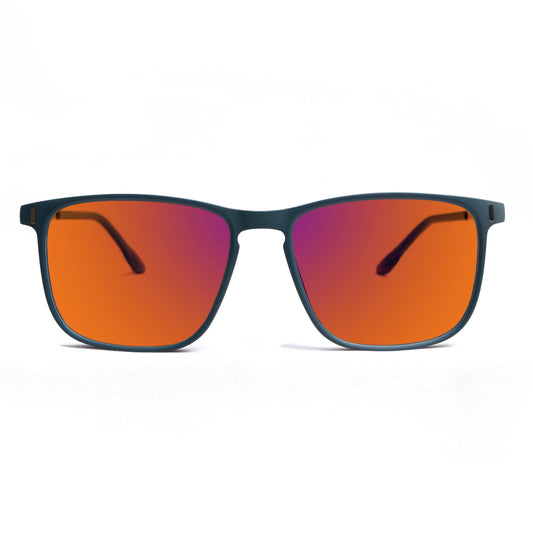
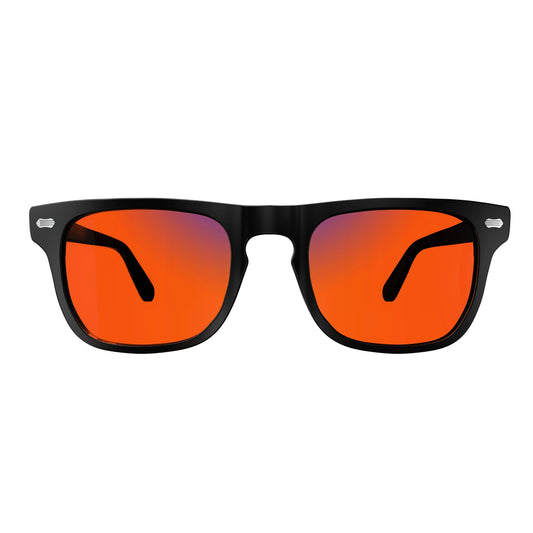
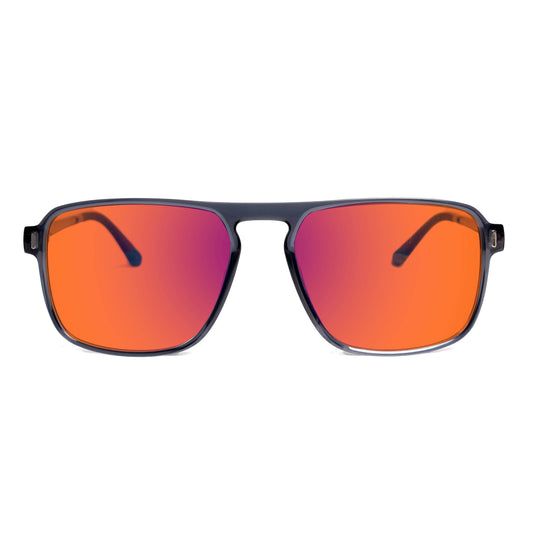
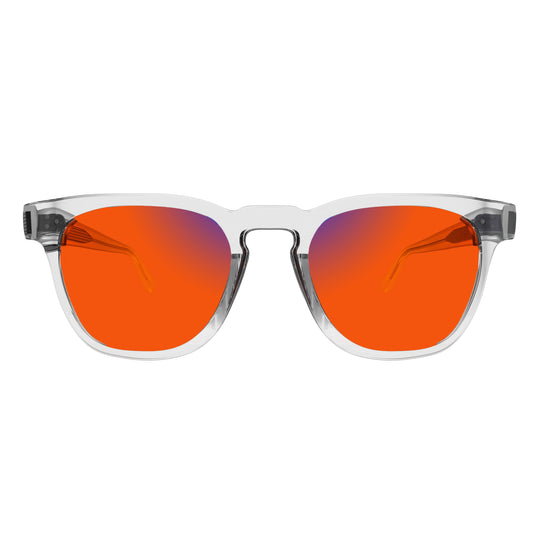
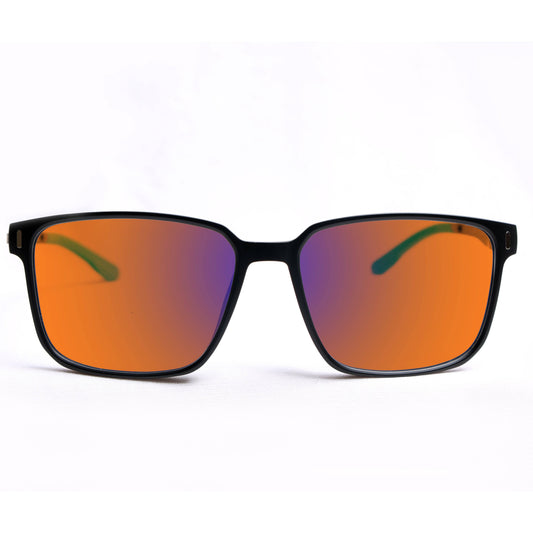
NeuroCalm FLX+ (Indian Patent IN 587746, all 10 claims approved) addresses this through proprietary optical design verified by spectrometer testing (TM-3+ device).
Migraine in India: Why This Matters
| Statistic | Value | Source |
|---|---|---|
| Migraine prevalence (adults) | 25-26% | GBD 2019, The Lancet |
| Estimated cases annually | ~213 million | GBD 2019, The Lancet |
| Photophobia during attacks | 80-90% | Digre & Brennan, 2012 |
| Interictal photophobia | ~60% | Noseda & Burstein, 2013 |
| Indian photobiological eyewear companies (before 2023) | Zero | Market analysis |
| Indian patents in photobiological eyewear (before Sleepaxa) | Zero | IPO records |
For Optometrists and Eye Care Professionals
The dual-band evidence from Noseda (2016) provides a scientific rationale for advancing beyond single-band FL-41. Sleepaxa offers a B2B programme with wholesale pricing, clinical reference documents, and prescription integration support.
Contact: connect@sleepaxa.com | WhatsApp: wa.aisensy.com/aab0na
Frequently Asked Questions
What is dual-band filtration?
It means the lens simultaneously filters two separate wavelength bands - 460-490 nm (ipRGC/melanopsin pain pathway) and 585-600 nm (cone-driven pain pathway) - while preserving the 520-560 nm green band between them.
How is NeuroCalm FLX+ different from regular FL-41?
Regular FL-41 filters one band (480-520 nm) addressing one pain pathway. NeuroCalm FLX+ filters two bands addressing both pain pathways while preserving the green band. It holds Indian Patent IN 587746 with all 10 claims approved.
Why does amber light worsen migraines?
Noseda et al. (2016) showed amber light activates L-cone photoreceptors, sending pain signals through a pathway independent of melanopsin/ipRGC activation.
Why preserve green light?
Green light (~530 nm) was the only wavelength that reduced migraine pain in the Harvard study. Blocking it removes a potential pain-reducing benefit.
Is this a medical device?
No. Sleepaxa glasses are precision-engineered comfort eyewear, not intended to treat, cure, or prevent any medical condition.
Can I get these with my prescription?
Yes. CR-39, MR-8, and high-index (1.67, 1.74) with UV400, anti-reflective, and anti-scratch coatings.
Where can I buy?
sleepaxa.in, Amazon India, and 7+ partner cities across India.
What is the price?
Starting at Rs. 4,599 for zero power. Prescription lenses at additional cost.
Read the Full Research
Paper 1: DOI: 10.5281/zenodo.19422123 - Wavelength-Selective Filtration
Paper 2: DOI: 10.5281/zenodo.19500137 - ipRGC Subtypes & Pathways
Paper 3: DOI: 10.5281/zenodo.19547790 - NeuroCalm FLX+ Engineering
References
- Good PA, et al. (1991) Cephalalgia - FL-41 childhood migraine study
- Noseda R, et al. (2010) Nature Neuroscience - Light amplifies migraine pain
- Noseda R, et al. (2016) Brain - Cone-driven migraine pathways
- Hoggan RN, et al. (2016) J Clinical Neuroscience - FL-41 coatings
- Berson DM, et al. (2002) Science - ipRGC discovery
- Digre KB, Brennan KC (2012) J Neuro-Ophthalmology - Photophobia review
- GBD 2019 Headache Collaborators, The Lancet (2022) - Migraine burden
- Patent IN 587746 - NeuroCalm FLX+ (10 claims granted)
- Brainard GC, et al. (2001) J Neuroscience - Melatonin action spectrum
Suraj Dubey is the Founder & Head of R&D at Sleepaxa (sleepaxa.in) - India's first photobiological eyewear company. ORCID: 0009-0003-7510-9254
Tags:
Previous
The Hidden Light Sensors in Your Eyes That Control Migraines, Sleep, and Mood - What Science Discovered in 2002
Next
New Research: How Circadian560 Technology Blocks 99.95% of Sleep-Disrupting Light at the Melanopsin Peak - Published Data Inside