

Best Blue Light Blocking Glasses India 2026: Why Most Fail | Sleepaxa
By Suraj Dubey | Senior Optometrist, Founder & Head of R&D, Sleepaxa Private Limited
Last updated: April 2026
Disclaimer: This article is for educational and informational purposes only and does not constitute medical advice. If you experience persistent migraine, photophobia, sleep difficulty, or eye discomfort, please consult a qualified healthcare professional. Sleepaxa products are designed for visual comfort and light management, not as medical treatments.
Reviewed by: Suraj Dubey, Senior Optometrist, Founder, Sleepaxa | Clinical Advisory Input: Dr. Monica Chaudhry, Ex-AIIMS Professor
If you have bought blue light blocking glasses in India hoping they'd fix your headaches, improve your sleep, or reduce eye strain, there is something important you should know: a Cochrane systematic review of 17 clinical trials found limited and low-certainty evidence for the benefits commonly marketed with these lenses.
But before you throw them away, read this. The problem isn't that light filtering doesn't work. The problem is that your glasses are filtering the wrong wavelength.
As an optometrist with 10+ years of clinical experience, I've published a research paper explaining exactly why, and what you should be using instead.
Published Research - Paper #7 of 9
Limitations of Commercial Blue-Light-Filtering Spectacle Lenses: A Critical Analysis of Spectral Targeting, Melanopsin Relevance, and the Case for Wavelength-Selective Photobiological Eyewear in the Indian Market
Authors: Dubey S, Chaudhry M (2026)Zenodo DOI: 10.5281/zenodo.19762610 Read on Academia.edu
Sleepaxa Research Library (9 Papers, 9 DOIs)
Paper 1: Wavelength-Selective Filtration
Paper 2: ipRGC Subtypes
Paper 3: NeuroCalm FLX+ Engineering
Paper 4: Circadian560 Spectral
Paper 5: Photophobia in Migraine
Paper 6: Light Sensitivity Epidemic
The Cochrane Verdict: Blue Light Glasses Show No Benefit
In 2023, the Cochrane Collaboration (the gold standard of medical evidence review) published a systematic review of 17 randomised controlled trials involving 619 participants across 6 countries. Their conclusion:
Cochrane 2023 Finding
The review found limited and low-certainty evidence for short-term advantages of blue-light filtering lenses in reducing visual fatigue associated with computer use, compared to non-blue-light filtering lenses.
The American Academy of Ophthalmology (AAO 2024) does not generally recommend special blue-light-blocking eyewear for routine computer use, noting that digital eye strain is often linked to screen habits, blinking patterns, and viewing distance.
75% of optometrists worldwide prescribe blue light glasses. Crores of rupees are spent on them in India every year. And the highest-quality medical evidence suggests their benefits may be limited for the endpoints commonly marketed.
Why? The answer is simple, scientific, and fixable.
The 30-80 nm Gap: Why Blue Light Glasses Miss the Target
Most commonly marketed blue light glasses in India primarily target 400-450 nm (HEV blue-violet light). But the cell in your retina that actually drives headaches, sleep problems, and light sensitivity operates at 480 nm.
That's a 30-80 nm gap. And in photobiology, that gap is the difference between a product that works and one that doesn't.
30-80 nm
The Spectral Gap Between What Blue Light Glasses Filter and What Your Biology Needs
Commercial blue light glasses: 400-450 nm. Melanopsin absorption peak: 480 nm. Most commonly marketed blue-light glasses primarily focus on the HEV range, while the melanopsin-relevant wavelengths that influence sleep and light sensitivity may pass through with minimal attenuation.
What Is Melanopsin and Why Does It Matter?
In 2002, scientists discovered a new type of cell in your retina called ipRGCs (intrinsically photosensitive retinal ganglion cells). These cells contain a protein called melanopsin that doesn't help you see. Instead, it measures ambient light levels and sends signals directly to your brain's:
1. Circadian clock (SCN) - telling your brain whether it's day or night, controlling melatonin production and sleep
2. Pain processing centre (posterior thalamus) - amplifying headache and migraine pain when stimulated by light
Melanopsin absorbs light most strongly at 480 nm (Brainard et al. 2001, Berson et al. 2002). Blue light glasses that filter 400-450 nm leave this peak completely unblocked. Read: ipRGC Science - The Hidden Light Sensors in Your Eyes
5 Reasons Standard Blue Light Glasses May Fall Short: An Endpoint Analysis
| What You Bought Them For | What Needs Filtering | What Blue Light Glasses Filter | Gap | Result |
|---|---|---|---|---|
| Better sleep | 480 nm melanopsin peak | 400-450 nm | 30-80 nm MISS | Melanopsin-relevant light may remain unattenuated |
| Migraine relief (ipRGC pathway) | 460-520 nm | 400-450 nm | 10-70 nm MISS | Key wavelength range may not be adequately covered |
| Migraine relief (cone pathway) | 585-600 nm | 400-450 nm | 135-200 nm MISS | This wavelength range is not addressed by standard BLF lenses |
| Reduced eye strain | Multifactorial (blink rate, distance, breaks) | 400-450 nm | N/A | Cochrane: limited evidence for benefit |
| Retinal protection | 400-450 nm HEV | 400-450 nm | Correct target | But: no trial measured retinal outcomes |
Out of 5 reasons people buy blue light glasses, they correctly target only ONE endpoint (retinal protection). But even that has zero clinical validation because no trial measured it.
The Sleep Problem: Melanopsin-Relevant Light May Pass Through Standard Blue Light Glasses
Harvard researchers (Gooley et al. 2011) demonstrated that exposure to room lighting at just 200 lux can significantly influence melatonin timing and circadian signalling. Research indicates wavelengths around 460-490 nm are particularly relevant for this effect, not the 400-450 nm range targeted by most commercial lenses.
When you wear blue light glasses at night while scrolling your phone, you feel like you're protected. If a lens does not sufficiently reduce melanopsin-relevant light around the 480 nm range, circadian-relevant light exposure may still remain significant during evening screen use.
India has a 25.7% insomnia prevalence (medRxiv meta-analysis, 100 studies). With 1.1 trillion smartphone hours annually and 70% of screen time in the evening, the scale of this failed protection is enormous. Read: The Light Sensitivity Epidemic in Modern India - 5 Factors
The Migraine Problem: Standard Blue Light Glasses May Not Address Key Wavelength Ranges
Harvard researcher Dr. Rodrigo Noseda discovered that migraine photophobia involves two separate retinal pathways converging at the brain's pain centre:
Pathway 1: 460-520 nm (Blue-cyan)
Melanopsin/ipRGC driven. WORSENS migraine pain.
Standard blue-light lenses primarily target 400-450 nm, which may not adequately cover this pathway starting at 460 nm.
Pathway 2: 585-600 nm (Amber)
Cone-driven. ALSO WORSENS migraine pain. Completely separate mechanism.
Standard blue-light lenses are not designed to address this wavelength range, leaving a significant spectral gap.
Exception: ~530 nm (Green)
The ONLY wavelength that REDUCES migraine pain.
Any effective migraine lens must preserve this band. Blue light glasses preserve it by accident, not design.
170-190 million Indians suffer from migraine-related light sensitivity. Blue light glasses address neither of the two identified pain pathways. Read: Photophobia in Migraine - Why Light Hurts 170 Million Indians
What Actually Works: Three Problems Need Three Different Lenses
The Cochrane review doesn't prove that light filtering is useless. It proves that filtering the WRONG wavelength is useless. When you filter the RIGHT wavelength, the science is clear and the evidence is strong.
The Key Insight
Migraine, sleep disruption, and daytime screen fatigue are three different photobiological conditions involving different wavelengths and different retinal pathways. One generic "blue light" lens cannot solve all three. You need condition-specific, wavelength-selective lenses.
For Migraine and Light Sensitivity
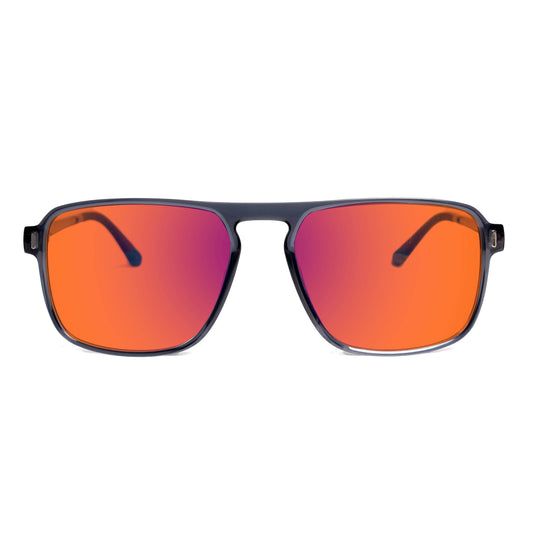
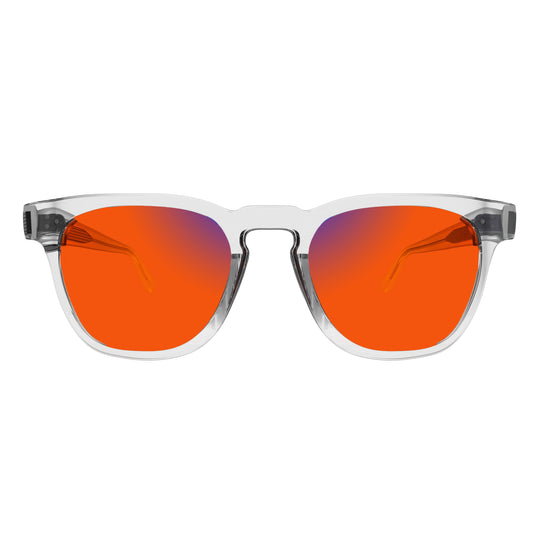
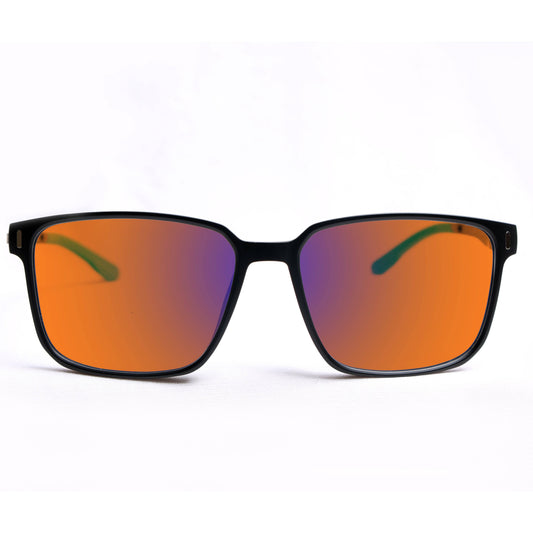
FL-41 Migraine Glasses - Backed by NeuroCalm FLX+
PATENT GRANTED: IN 587746
Filters 480-520 nm (melanopsin pain pathway)
Preserves 520-560 nm (pain-reducing green)
FL-41 is a precision rose-pink tint developed at the University of Utah in 1991, with 30+ years of clinical evidence. FL-41 has been studied in migraine-associated and photophobia-related contexts (Good et al. 1991, Reyes et al. 2024) and is commonly recommended for people who experience light sensitivity and visual discomfort. Sleepaxa's FL-41 is backed by patented NeuroCalm FLX+ technology. Price: Rs.3,299-6,498. Prescription available. Read: Dual-Band Migraine Lens Science
Shop FL-41 Migraine Glasses India
For Sleep and Circadian Protection
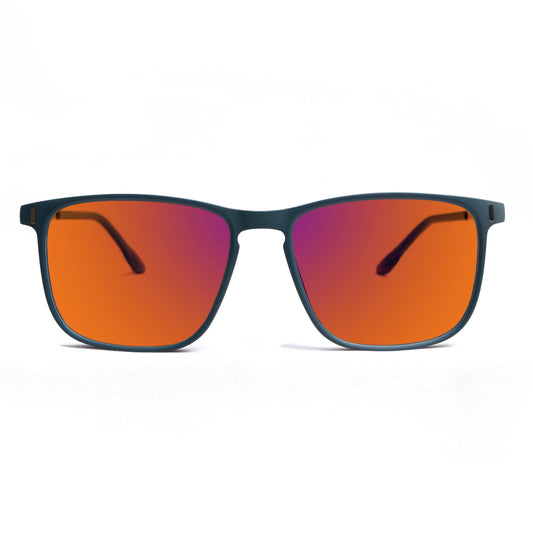
Amber Sleep Glasses - Powered by Circadian560
PATENT GRANTED: IN 597482
Blocks 460-560 nm (full melanopsin range)
100% block at 480 nm peak
Amber lenses block the ENTIRE melanopsin sensitivity range, not just a sliver of it. Clinical evidence: Burkhart & Phelps (2009) showed improved sleep quality. Shechter et al. (2018) showed improved sleep onset in insomnia patients. Wear 2-3 hours before bedtime. Price: Rs.3,299-6,498. Read: Circadian560 Sleep Science
Shop Amber Sleep Glasses India
For Daytime Screen Comfort and Gaming
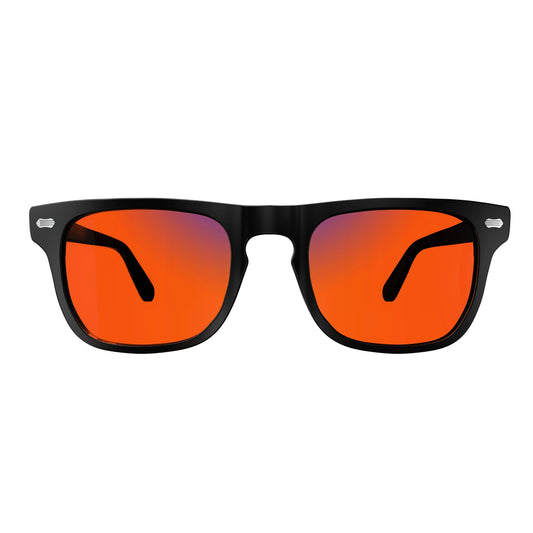
DayActive 1.0 - Yellow Tint HEV Filter
Filters 400-450 nm (harsh HEV blue-violet)
Preserves 460-490 nm (alerting blue for focus)
This is the ONLY scenario where a 400-450 nm filter makes sense. During daytime, you NEED alerting blue light at 460-490 nm for focus and circadian health. DayActive filters harsh HEV without killing your alertness. For gaming, computer work, and driving. Do NOT use for sleep. Price: Rs.3,299-6,498.
Shop DayActive Gaming Glasses India
Already Have a Frame You Love?
Sleepaxa's Custom Lens Fit Service lets you send any frame (any brand, any style) and we fit FL-41, Amber, or DayActive lenses into it. WhatsApp your frame photo, we confirm compatibility, you courier the frame, get it back with Sleepaxa lenses in 8-10 working days. Get a Custom Lens Quote on WhatsApp
Blue Light Glasses vs Photobiological Lenses: Complete Comparison
| Feature | Generic Blue Light Glasses (Rs.300-3,000) | FL-41 by Sleepaxa (Rs.3,299-6,498) | Amber by Sleepaxa (Rs.3,299-6,498) |
|---|---|---|---|
| Wavelength target | 400-450 nm | 480-520 nm | 460-560 nm |
| Melanopsin peak (480 nm) | MISSES by 30-80 nm | Covers peak | 100% blocked |
| Migraine evidence | Cochrane: Limited evidence | Good 1991, Reyes 2024 | Not designed for migraine |
| Sleep evidence | Cochrane: Low certainty | Not designed for sleep | Burkhart 2009, Shechter 2018 |
| Patent | None | IN 587746 (granted) | IN 597482 (granted) |
| Published research | None by manufacturer | 9 papers, 9 DOIs | 9 papers, 9 DOIs |
| Prescription available | Varies | CR-39, MR-8, 1.67, 1.74 | CR-39, MR-8, 1.67, 1.74 |
| Delivery in India | 3-7 days | 3-5 days (zero power), 6-8 days (Rx) | 3-5 days (zero power), 6-8 days (Rx) |
| Custom Lens Fit (your frame) | Not available | Any frame accepted | Any frame accepted |
Choose Glasses Designed for the Right Wavelength
India's first photobiological eyewear company. 9 published papers. 6 patents. Prescription available.
FL-41 Migraine Glasses India Amber Sleep Glasses India DayActive Gaming GlassesExpert WhatsApp Consultation
Visit Sleepaxa partner stores:
Gurgaon NCRNew DelhiChennaiVadodaraLucknowAgraSuratHyderabadMumbai Suburban
Also on Amazon India | Free shipping | Zero power and prescription
Frequently Asked Questions
Do blue light blocking glasses actually work?
A 2023 Cochrane systematic review of 17 clinical trials (619 participants) found limited and low-certainty evidence for the commonly marketed benefits of blue-light filtering lenses. The reason is spectral mismatch: these glasses filter 400-450 nm while the biologically relevant melanopsin peak is at 480 nm.
What is the best blue light blocking glasses in India?
It depends on your condition. For migraine and light sensitivity, FL-41 glasses (not generic blue light glasses) are clinically validated. For sleep, amber lenses blocking 460-560 nm are effective. For daytime screen comfort, yellow-tinted HEV filters are appropriate. Sleepaxa offers all three, starting Rs.3,299, with prescription options and free shipping across India.
Why don't blue light glasses help with sleep?
Because melatonin suppression is driven by the melanopsin peak at 480 nm (Gooley et al. 2011, Harvard). Blue light glasses filter 400-450 nm, leaving the 480 nm signal completely unblocked. Your brain still receives the "daytime" signal through the glasses. Amber lenses (blocking 460-560 nm) are what you need for sleep protection.
What is the difference between blue light glasses and FL-41 glasses?
Blue light glasses use a broad AR coating targeting 400-450 nm HEV light. FL-41 glasses use a precision rose-pink tint targeting 480-520 nm, the melanopsin activation band directly implicated in migraine photophobia. Different wavelength, different mechanism, different evidence. FL-41 has 30+ years of published clinical evidence. The Cochrane review found limited evidence supporting standard blue-light coatings for these endpoints.
Are blue light glasses harmful?
Not harmful, but potentially misleading. They filter a small amount of HEV light, which is unlikely to cause harm. The risk is that people rely on them for migraine relief or sleep improvement, delaying use of evidence-based solutions like FL-41 or amber lenses.
What glasses should I buy for migraine in India?
FL-41 migraine glasses backed by NeuroCalm FLX+ technology (Patent IN 587746). Price Rs.3,299-6,498. Available at sleepaxa.in and Amazon India, with prescription options in CR-39, MR-8, 1.67, and 1.74. Also available offline in 9 Indian cities. Shop FL-41 Migraine Glasses
What glasses should I buy for better sleep?
Amber sleep glasses with Circadian560 technology (Patent Granted IN 597482). These block 100% of light at the melanopsin peak and the full 460-560 nm range. Wear 2-3 hours before bedtime. Price Rs.3,299-6,498 at sleepaxa.in. Shop Amber Sleep Glasses
Can I use my own frame with Sleepaxa lenses?
Yes. Sleepaxa's Custom Lens Fit service accepts any frame from any brand. WhatsApp your frame photo, courier the frame to us, and get it back with FL-41, Amber, or DayActive lenses fitted in 8-10 working days. Get a Custom Lens Quote
Are all blue-light glasses the same?
No. Different lenses filter very different wavelength ranges. A simple "blue-cut" label does not confirm whether the lens is suitable for sleep support, migraine-associated light sensitivity, or daytime visual comfort. Always check spectral transmission data where available. The difference between 400-450 nm and 480-520 nm filtration is clinically significant.
Can blue-light glasses treat migraine or sleep disorders?
No eyewear should be considered a treatment or cure for medical conditions. Wavelength-specific lenses may help reduce certain light exposures and support visual comfort, but persistent migraine, photophobia, or sleep issues should always be discussed with a qualified clinician. Sleepaxa products are designed for visual comfort and light management.
How is Sleepaxa different from generic blue-cut glasses?
Sleepaxa focuses on wavelength-specific lens design instead of generic blue-cut claims. Different Sleepaxa lenses are designed for different use cases: FL-41 (backed by NeuroCalm FLX+) for migraine-associated light sensitivity, Circadian560 amber for evening light exposure and sleep support, and DayActive for daytime screen comfort. Each lens targets specific wavelength ranges based on published photobiological research, with 9 research papers and 6 patents supporting the approach.
References
1. Singh S, et al. (2023) Blue-light filtering spectacle lenses for visual performance, sleep, and macular health. Cochrane Database Syst Rev. 8(8):CD013244.
2. Berson DM, et al. (2002) Phototransduction by retinal ganglion cells. Science. 295:1070-1073.
3. Brainard GC, et al. (2001) Action spectrum for melatonin regulation. J Neuroscience. 21:6405-6412.
4. Noseda R, et al. (2010) Neural mechanism for exacerbation of headache by light. Nature Neuroscience. 13:239-245.
5. Noseda R, et al. (2016) Migraine photophobia from cone-driven pathways. Brain. 139:1971-1986.
6. Gooley JJ, et al. (2011) Room light suppresses melatonin onset. JCEM. 96:E463-E472.
7. Good PA, et al. (1991) Tinted spectacles in childhood migraine. Cephalalgia.
8. Reyes N, et al. (2024) FL-41 reduces neural pathway activation. Am J Ophthalmol. 259:172-184.
9. American Academy of Ophthalmology (2024) Position statement on computer eyewear.
10. Burkhart K, Phelps JR (2009) Amber lenses and sleep. Chronobiology International. 26:1602-1612.
11. Shechter A, et al. (2018) Blue light blocking for insomnia. J Psychiatric Research. 96:196-202.
12. Dubey S, Chaudhry M (2026) 9 published papers. Zenodo. ORCID: 0009-0003-7510-9254.
Suraj Dubey is the Founder & Head of R&D at Sleepaxa Private Limited. Inventor of NeuroCalm FLX+ and Circadian560. 6 patents in photobiological lens technology. ORCID: 0009-0003-7510-9254
Tags:
Previous
FL-41 Migraine Glasses Price India 2026: Complete Buying Guide | Sleepaxa
Next
Photobiological Eyewear Guide for Optometrists: Clinical Framework 2026