
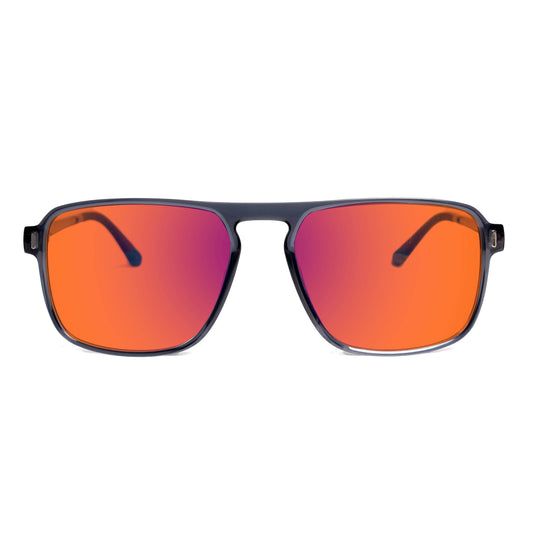
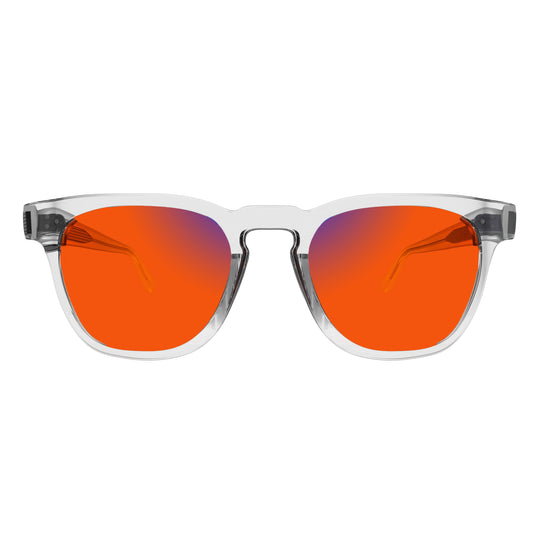
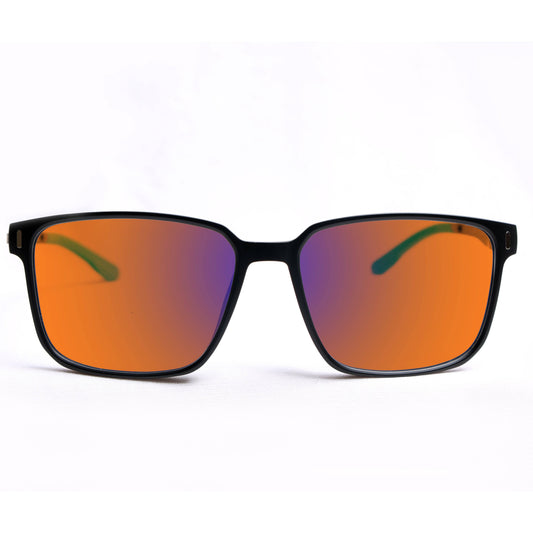

FL-41 vs NeuroCalm FLX+: Single-Band vs Dual-Band Migraine Lenses
By Suraj Dubey — Senior Optometrist, Founder & Head of R&D, Sleepaxa Private Limited · Last updated: July 2026
Disclaimer: Educational content, not medical advice. FL-41 and NeuroCalm FLX+ lenses are designed for visual comfort and light-sensitivity management, not as a cure for migraine. Persistent migraine or photophobia should be evaluated by a clinician. Lab values are from independent ISO 12312-1 / ANSI Z80.3 reports.
Reviewed by: Dr. Monica Chaudhry — former AIIMS faculty (Clinical Advisor, Sleepaxa).
Quick Answer
FL-41 is a proven, 30-year rose-tinted migraine lens — and Sleepaxa sells it in both Light and Dark. Its limitation is that it targets one of the two retinal pain pathways: the blue-cyan band (~480–520 nm). NeuroCalm FLX+ (Sleepaxa's patented lens, Patent No. 587746) is dual-band — it keeps the FL-41 blue-cyan attenuation and adds a second notch at the 585–600 nm amber band that Harvard research identified, while preserving the pain-reducing green. Choose FL-41 as the proven, accessible option; choose NeuroCalm FLX+ for the complete dual-pathway upgrade.
First — FL-41 Genuinely Works
FL-41 (a precise rose/mauve tint developed at the University of Utah in 1991) is one of the few lens tints with real clinical history for light sensitivity. Good et al. (1991) reported reduced migraine frequency in children, and Reyes et al. (2024) showed FL-41 reduces activation of the neural pathways involved in photophobia. This is why Sleepaxa offers a proper FL-41 line — we're not replacing it, we're building on it.
The Science: Migraine Light Sensitivity Has TWO Pathways
Harvard researcher Dr. Rodrigo Noseda mapped how light amplifies migraine pain — and found it travels through two separate retinal routes that converge on the same pain neurons:
Pathway 1 · 480–520 nm (blue-cyan)
Melanopsin / ipRGC driven — worsens migraine pain (Noseda 2010). This is the band classic FL-41 attenuates.
Pathway 2 · 585–600 nm (amber)
Cone-driven — a separate mechanism that also worsens pain (Noseda 2016). Classic FL-41 largely lets this band through.
~530 nm (green)
The one band that reduces pain — a good lens should preserve it, not block it.
FL-41's Honest Limitation: Single-Band
Classic FL-41 is a single-dye tint tuned to the blue-cyan band. Our own lab measurements confirm it: Sleepaxa FL-41 Dark attenuates roughly 87% of 480–520 nm light (transmission ~12–13% across that band) — excellent for Pathway 1. But at 580–590 nm it transmits ~64–75%, meaning the amber Pathway 2 largely passes through. That's not a flaw in FL-41; it's simply what a single-band tint does. For many people, addressing Pathway 1 is enough. For others — especially strong photophobia — the second pathway matters.
NeuroCalm FLX+: Dual-Band by Design
NeuroCalm FLX+ is Sleepaxa's patented lens (Patent No. 587746, application 202521094370, all 10 claims granted) engineered as a dual-band notch filter. Independent lab data shows it attenuates both pain bands while keeping the beneficial green relatively open:
- Blue-cyan (480–520 nm): transmission ~17–23% — attenuated, like FL-41.
- Amber (580–600 nm): transmission ~19–20% — notched down, unlike single-band FL-41.
- Green (~530 nm): relatively preserved (~24%) — the pain-reducing band stays comparatively open.
- Overall: VLT 21.72%, Category 2, so it's usable indoors and for daytime road use.
Sleepaxa Migraine Lens Line-Up (Lab-Verified)
| FL-41 Light | FL-41 Dark | NeuroCalm FLX+ | |
|---|---|---|---|
| VLT (brightness) | ~60% (lightest) | 41.10% | 21.72% |
| Pathway 1 · blue-cyan 480–520 nm | Attenuated (~82%) | Attenuated (~87%) | Attenuated |
| Pathway 2 · amber 585–600 nm | Mostly passes | Mostly passes | Notched (dual-band) |
| Green ~530 nm (preserve) | Preserved | Preserved | Preserved |
| Bands targeted | Single | Single | Dual |
| Patent | — | — | IN 587746 (granted) |
| Best for | Everyday indoor, mild sensitivity, subtle look | Stronger indoor/screen photophobia | Complete dual-pathway protection |
How to choose
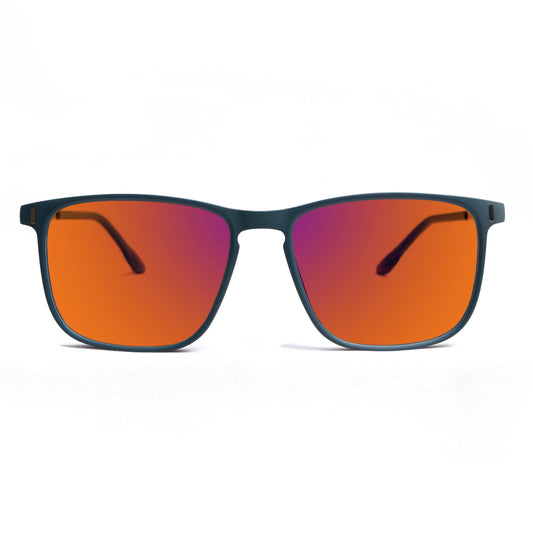
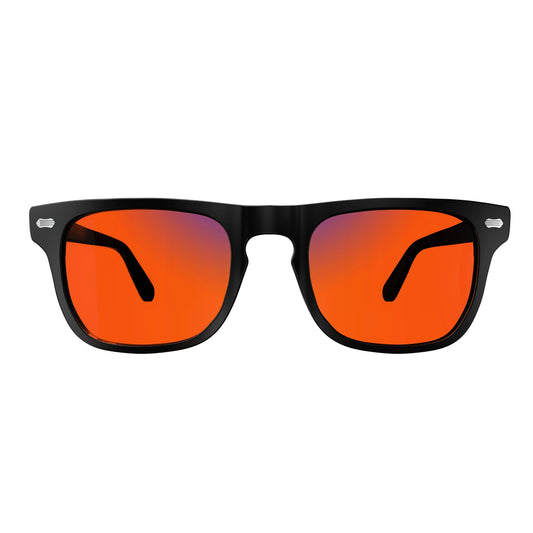
FL-41 Light — everyday indoor wear, milder light sensitivity, most natural appearance. FL-41 Dark — stronger indoor/screen photophobia where you want deeper blue-cyan attenuation. NeuroCalm FLX+ — the complete option when you want both pain pathways addressed, backed by a granted patent. All three preserve the pain-reducing green band and are available in zero power or full prescription.
Find Your Migraine Lens
FL-41 Light & Dark · patented NeuroCalm FLX+ · zero-power & full prescription (single-vision, progressive, bifocal, prism) · custom lens-fit for your own frame.
Shop Migraine Glasses Ask an Expert on WhatsAppFrequently Asked Questions
What is the difference between FL-41 and NeuroCalm FLX+?
FL-41 is a proven single-band rose tint that attenuates the blue-cyan pain band (~480–520 nm). NeuroCalm FLX+ is Sleepaxa's patented dual-band lens (Patent No. 587746) that attenuates that same blue-cyan band AND adds a second notch at the 585–600 nm amber band, while preserving the pain-reducing green. FL-41 is the accessible proven choice; NeuroCalm FLX+ is the complete dual-pathway upgrade.
Is FL-41 still worth buying if NeuroCalm FLX+ exists?
Yes. FL-41 has 30+ years of clinical history and works well for many people, especially for the blue-cyan pathway. Sleepaxa sells FL-41 in Light and Dark precisely because it is effective and accessible. NeuroCalm FLX+ is the upgrade for people who want both migraine pain pathways addressed.
What is the limitation of FL-41 lenses?
FL-41 is a single-band tint: it attenuates the blue-cyan band (~480–520 nm) but largely lets the amber 585–600 nm band pass. Harvard research (Noseda 2016) showed migraine photophobia also travels through this second, cone-driven amber pathway — which a single-band lens does not specifically target.
What is the difference between FL-41 Light and FL-41 Dark?
FL-41 Light (VLT ~60%) is the lightest, most natural-looking option for everyday indoor wear and milder sensitivity. FL-41 Dark (VLT ~41%) is a deeper tint with stronger blue-cyan attenuation (~87% across 480–520 nm) for more pronounced indoor or screen-related photophobia.
Does NeuroCalm FLX+ make colours look wrong?
NeuroCalm FLX+ is a notch filter — it dips two specific bands rather than darkening everything, and it keeps the green region relatively open. It has a noticeable tint (VLT ~21.7%, Category 2) but preserves traffic-signal recognition and is usable indoors and for daytime road use.
Can I get these in my prescription?
Yes. FL-41 Light, FL-41 Dark and NeuroCalm FLX+ are all available in zero power and full prescription — single-vision, progressive, bifocal and prism — in CR-39, MR-8, 1.67 and 1.74 materials, or fitted into your own frame via Custom Lens-Fit.
Are these a treatment for migraine?
No. These lenses are designed for visual comfort and light-sensitivity management, not as a medical treatment or cure for migraine. They may help reduce discomfort from light triggers, but persistent migraine should be managed with a qualified clinician.
References
1. Good PA, et al. (1991) Tinted spectacles in childhood migraine. Cephalalgia.
2. Noseda R, et al. (2010) Neural mechanism for exacerbation of headache by light. Nat Neurosci. 13:239–245.
3. Noseda R, et al. (2016) Migraine photophobia from cone-driven retinal pathways. Brain. 139:1971–1986.
4. Reyes N, et al. (2024) FL-41 tint reduces activation of neural pathways of photophobia. Am J Ophthalmol. 259:172–184.
5. Sleepaxa / Acieon Labs lens test reports — ISO 12312-1, ANSI Z80.3 (2026); India Patent No. 587746.
Suraj Dubey is Founder & Head of R&D at Sleepaxa Private Limited. Inventor of NeuroCalm FLX+™ (Patent 587746). ORCID: 0009-0003-7510-9254.
Tags:
Previous
Amber vs Red vs Circadian560 Sleep Glasses: Which to Choose
Next
Generic Yellow Tint vs Sleepaxa DayActive: Daytime Screen Glasses