

Amber vs Red vs Circadian560 Sleep Glasses: Which to Choose
By Suraj Dubey — Senior Optometrist, Founder & Head of R&D, Sleepaxa Private Limited · Last updated: July 2026
Disclaimer: Educational content, not medical advice. Sleepaxa lenses support evening light management and visual comfort; they are not a treatment or cure for sleep disorders. Persistent sleep problems should be discussed with a clinician. Lab values are from independent ISO 12312-1 / ANSI Z80.3 test reports.
Reviewed by: Dr. Monica Chaudhry — former AIIMS faculty (Clinical Advisor, Sleepaxa).
Quick Answer
Three sleep lenses, three jobs. Amber Evening Sleep is the balanced everyday choice — blocks the 480 nm melanopsin peak, keeps colour usable, and can be worn afternoon-to-evening, indoor and outdoor. Circadian560 (patented) is maximum protection — 100% block right up to ~560 nm for serious sleep optimisation, indoor evening. Red Sleep is the deepest wind-down lens for the last hours before bed, indoor only. If you want one pair for daily use, choose Amber; for advanced circadian control, choose Circadian560.
All three block far more blue than a generic "blue-cut" lens (which mostly trims 400–450 nm violet — see our honest guide to blue-light glasses). The difference between them is how deep into the spectrum they block, how dark they are, and when you can wear them.
Why "How Deep You Block" Matters
Melanopsin — the light sensor that sets your body clock — is most sensitive around 480 nm, but its sensitivity tail extends to roughly 560 nm (Brainard et al., 2001). So there is a spectrum of protection: block to 500 nm and you stop the peak; block all the way to 560 nm and you shut down almost the entire circadian signal. More protection means a darker, more colour-shifted lens — a genuine trade-off between circadian power and everyday wearability.
The Three Sleepaxa Sleep Lenses
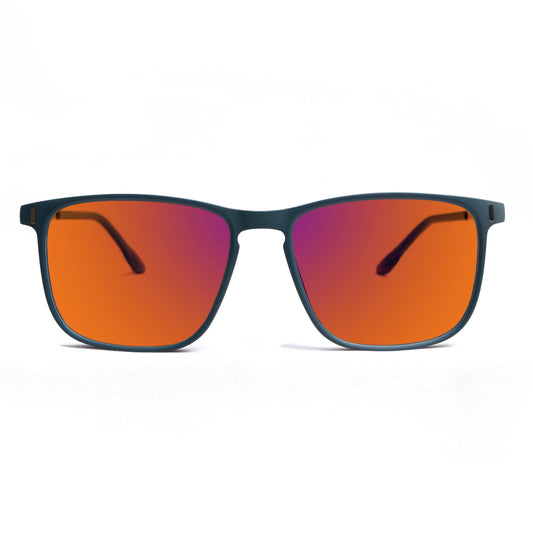
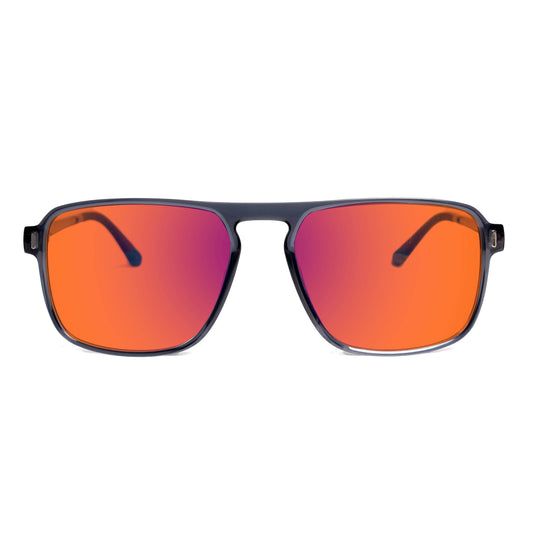
Amber Evening Sleep
VLT 50.47%Blue 380–500 nm: 0.13%Category 1Indoor + Outdoor
The balanced everyday lens. Blocks ~100% of blue up to ~500 nm (including the 480 nm melanopsin peak), then lets green, yellow and red through for a usable, colour-balanced view — this is deliberate: no blanket blackout. At 50% VLT it's light enough to wear from afternoon into the evening, indoors or outdoors, making it ideal for people wanting circadian support plus relief from mild eye fatigue. Best all-rounder.
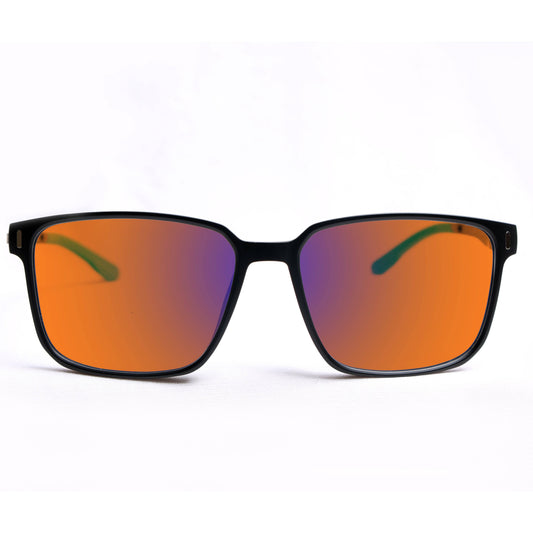
Circadian560 PATENT GRANTED · IN 597482
VLT 17.18%Blue 380–500 nm: 0.00%100% block to ~560 nmIndoor evening
Maximum circadian protection. Engineered to block essentially 100% of light below ~560 nm — the full melanopsin-sensitive envelope — at a deep 17% VLT that balances protection with just-enough visibility. This is the advanced, "biohacker" choice for people serious about melatonin timing and shift-work or late-night routines. Patented and, by design, one of the few consumer lenses that carries protection right to the edge of the circadian range. Indoor evening use only.
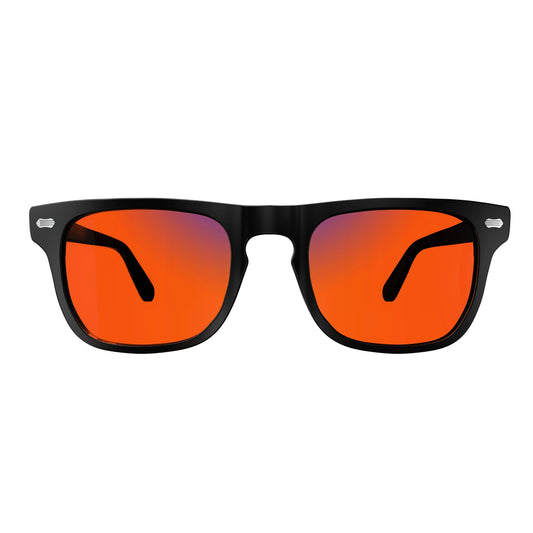
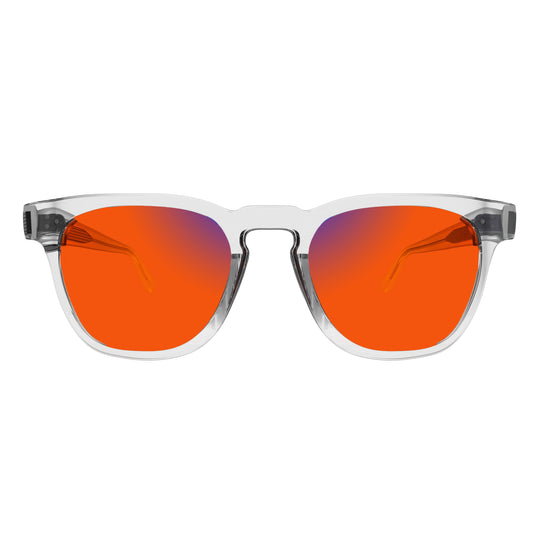
Red Sleep
VLT 14.92%Blue 380–500 nm: 0.00%Deep block to ~560 nmIndoor only
The deepest wind-down lens. A dark red tint that removes almost all blue-green light below ~560 nm at the lowest VLT of the three. Built for the final hours before bed — reading, dim-room relaxation, and the most light-sensitive users who want the strongest possible pre-sleep signal. Indoor, evening/pre-sleep use only; not for screens-work productivity or any outdoor/driving use.
Side-by-Side Comparison (Lab-Verified)
| Amber Evening Sleep | Circadian560 | Red Sleep | |
|---|---|---|---|
| Light transmission (VLT) | 50.47% (light) | 17.18% (deep) | 14.92% (deepest) |
| Blue block 380–500 nm | ~100% (0.13%) | 100% (0.00%) | 100% (0.00%) |
| Protection depth | To ~500 nm (peak) | To ~560 nm (full range) | To ~560 nm (deep red) |
| Colour balance | Usable, warm | Strong amber shift | Deep red shift |
| Wear window | Afternoon → evening | Evening | Last hours pre-sleep |
| Indoor / Outdoor | Both | Indoor | Indoor only |
| Patent | — | Granted IN 597482 | — |
| Best for | Everyday balance, mild fatigue | Max protection, biohackers | Deep wind-down, very light-sensitive |
Which One Should You Choose?
Choose Amber if you want one versatile pair for daily evening use, sometimes outdoors, with comfortable colour and relief from mild eye fatigue.
Choose Circadian560 if you optimise your sleep seriously — shift work, late screens, or you want the strongest evidence-aligned circadian block available, and you're happy with an indoor, amber-shifted view.
Choose Red Sleep if you're very light-sensitive or want a dedicated deep pre-sleep lens for the final wind-down in a dim room.
How to wear them
For circadian benefit, put your sleep lenses on 2–3 hours before your target bedtime and keep them on through evening screens and lighting. Amber can start in the late afternoon; Circadian560 and Red are best once you're settled indoors for the evening. Pair with dimmer, warmer room lighting for the strongest effect.
Find Your Sleep Lens
Lab-tested · zero-power & full prescription (single-vision, progressive, bifocal, prism) · custom lens-fit for your own frame.
Shop Sleep Glasses Ask an Expert on WhatsAppFrequently Asked Questions
What is the difference between Amber, Red Sleep and Circadian560 glasses?
All three block the blue light that suppresses melatonin, but at different depths. Amber (VLT ~50%) blocks to ~500 nm, keeps colour usable and works indoor or outdoor — the balanced everyday choice. Circadian560 (patented, VLT ~17%) blocks 100% to ~560 nm for maximum circadian protection, indoors. Red Sleep (VLT ~15%) is the deepest, red-tinted lens for the final pre-sleep hours, indoor only.
Which Sleepaxa sleep glasses are best for everyday use?
Amber Evening Sleep. At 50% light transmission it is light enough to wear from afternoon into the evening, indoors or outdoors, blocks the 480 nm melanopsin peak, and keeps colours usable — the best balance of circadian protection and everyday comfort.
What makes Circadian560 special?
Circadian560 is engineered and independently lab-tested to block essentially 100% of light up to ~560 nm — the full melanopsin-sensitive range — at a deep 17% VLT. It is patented in India (Patent No. 597482) and is aimed at people who want maximum circadian control for serious sleep optimisation. It is for indoor evening use only.
Can I wear these sleep glasses outside or while driving?
Only Amber Evening Sleep (Category 1) is suitable for outdoor daytime use. Circadian560 and Red Sleep are deep, dark evening lenses for indoor use only and are not intended for driving or night-time road use.
Why doesn't Amber block everything like Circadian560?
By design. Amber blocks the blue that matters most (up to ~500 nm) but deliberately lets green, yellow and red pass, so colour stays usable and you can wear it longer, indoors or outdoors. Circadian560 trades that everyday wearability for maximum protection to ~560 nm. It's a choice between balance and depth.
Do these come in prescription?
Yes. All Sleepaxa sleep lenses are available in zero power and full prescription — single-vision, progressive, bifocal and prism — in CR-39, MR-8, 1.67 and 1.74 materials. You can also use the Custom Lens-Fit service to put them in your own frame.
When should I put my sleep glasses on?
About 2–3 hours before your target bedtime, worn through evening screens and lighting. Amber can start in the late afternoon; Circadian560 and Red Sleep are best once you're indoors for the evening.
References
1. Brainard GC, et al. (2001) Action spectrum for melatonin regulation. J Neurosci. 21:6405–6412.
2. Gooley JJ, et al. (2011) Room light before bedtime suppresses melatonin. JCEM. 96:E463–E472.
3. Burkhart K, Phelps JR (2009) Amber lenses to block blue light and improve sleep. Chronobiol Int. 26:1602–1612.
4. Shechter A, et al. (2018) Blocking nocturnal blue light for insomnia: a randomized trial. J Psychiatr Res. 96:196–202.
5. Sleepaxa / Acieon Labs lens test reports — ISO 12312-1, AS/NZS 1067.1, ANSI Z80.3 (2026).
Suraj Dubey is Founder & Head of R&D at Sleepaxa Private Limited. Inventor of Circadian560™ and NeuroCalm FLX+™. ORCID: 0009-0003-7510-9254.
Tags:
Previous
Are Blue Light Glasses a Scam? The Honest Truth (2026)
Next
FL-41 vs NeuroCalm FLX+: Single-Band vs Dual-Band Migraine Lenses