

What Are FL-41 Glasses? A Simple Guide to the Migraine Lens Most People Have Never Heard Of
If you suffer from migraines, there's a good chance that light makes them worse. Maybe fluorescent lights at your office trigger a dull throb behind your eyes. Maybe your phone screen feels like it's stabbing your brain during an attack. Maybe you've started wearing sunglasses indoors and noticed it's actually making things worse over time.You're not imagining any of this. And there's a specific lens designed for exactly this problem. It's called FL-41 and chances are, nobody has ever told you about it.
So What Exactly Is FL-41?
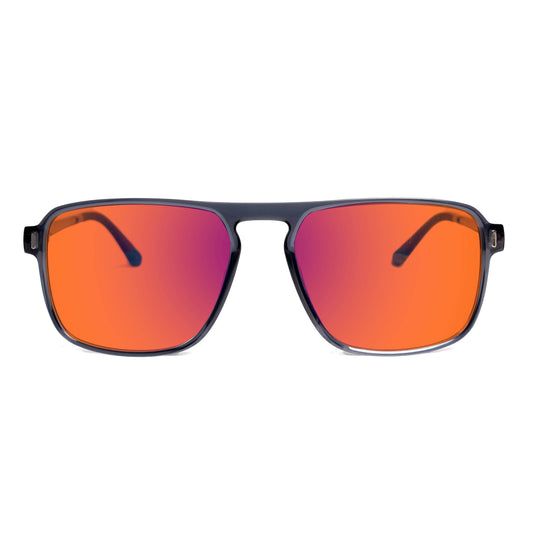
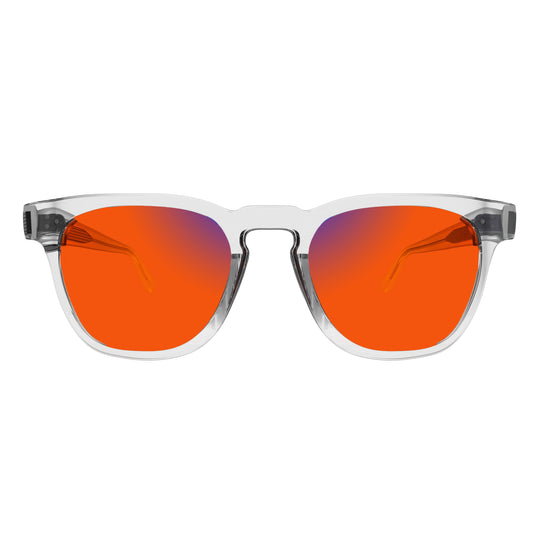
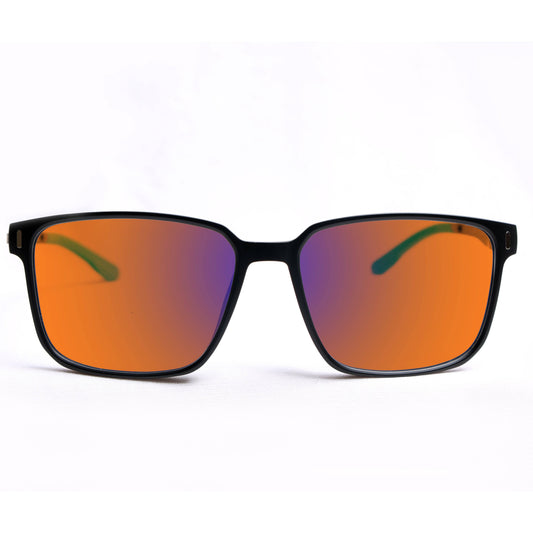
FL-41 is a special rose-pink tinted lens that was invented in 1991 at the University of Utah. The name "FL-41" simply means it was the 41st filter they tested the one that worked best for people who got headaches from fluorescent lights.Here's the simple version of what it does: FL-41 blocks a very specific colour of light the blue-cyan band between 480 and 520 nanometres while letting most other colours pass through normally. This particular slice of light is the one that triggers the pain pathway in migraine-prone brains.It's not a sunglass. It doesn't make everything dark. It looks like a gentle pink tint and you can comfortably wear it all day, indoors, at work, in front of screens.
Why Does Light Make Migraines Worse?
This was a mystery for a long time. Scientists knew that 80-90% of migraine sufferers are sensitive to light during attacks but they couldn't explain why.The answer came in 2002, when researchers discovered a new type of cell in the back of the eye. These cells called ipRGCs (intrinsically photosensitive retinal ganglion cells) are completely different from the rods and cones you learned about in school. Rods and cones help you see. ipRGCs don't help with vision at all. Instead, they detect light and send signals directly to the pain centre in your brain.Think of it this way: your eye has a hidden "light alarm" system. When certain wavelengths of light hit these ipRGC cells, they send a signal to your brain that says "alert bright light detected." In a normal brain, this signal is mild. In a migraine-prone brain, this signal gets amplified and merged with the headache pain making the headache feel dramatically worse.The specific wavelength that triggers these cells most strongly? 480 nanometres right in the blue-cyan range. And that's exactly what FL-41 blocks.
Why Regular Blue Light Glasses Don't Work for Migraines
If you've tried blue light glasses from Amazon or your local optical shop and found they didn't help your migraines you're not alone. Here's why:They block the wrong wavelengths. Most blue light glasses target 400-450 nm (violet-blue). The migraine trigger wavelength is 480 nm (blue-cyan). They're filtering the wrong colour.They block too broadly. Some aggressive blue light coatings also block green light (520-560 nm). A 2016 Harvard study found that green light actually reduces migraine pain. Blocking it is counterproductive.They have no precision. Generic coatings vary wildly between brands. Without published spectral data, you have no idea what they're actually filtering.FL-41 is different because it's a precision filter engineered to block exactly the wavelengths that activate the migraine pain pathway, while preserving the green light that helps.
Why Dark Sunglasses Make Photophobia WORSE
This is counterintuitive but scientifically documented: wearing very dark sunglasses indoors can actually increase your light sensitivity over time.Here's what happens: when you wear dark lenses for hours, your eyes adapt to the darkness. Your pupils dilate. Your retinal cells become more sensitive. Then when you take the sunglasses off even normal room lighting feels painfully bright.Over weeks and months of indoor sunglass use, this creates a worsening cycle. Your eyes keep adapting to darker conditions, and normal lighting becomes increasingly intolerable.FL-41 avoids this problem completely. Its rose tint reduces light transmission by only about 30-50% (compared to 80-90% for dark sunglasses). It filters the specific problematic wavelengths without making everything dark so your eyes don't dark-adapt.
What About Sleepaxa's FL-41 Glasses?
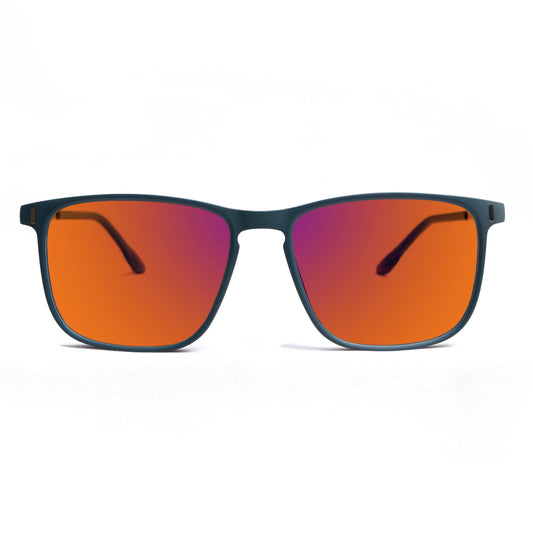
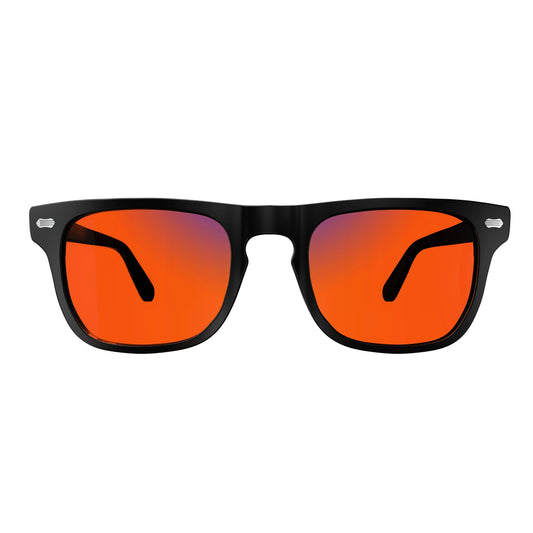
Sleepaxa's FL-41 glasses use a technology called NeuroCalm FLX+™ which is an advancement over the original FL-41. Here's what's different:The original FL-41 blocks one band of light (480-520 nm). That's the blue-cyan band that activates ipRGC cells. But a 2016 study found that amber light (585-600 nm) also makes migraines worse through a completely separate mechanism involving the cone cells in your retina.NeuroCalm FLX+™ blocks both bands simultaneously:
- Band 1 (460-490 nm): The melanopsin/ipRGC trigger band
- Band 2 (585-600 nm): The cone-driven pain band
While preserving the green band (520-560 nm) that research shows reduces pain.This dual-band approach is patented (Indian Patent IN 587746, all 10 claims approved). It's the first FL-41 technology to address both pain pathways at once.Available with prescription: CR-39, MR-8, high-index 1.67 and 1.74. UV400, anti-reflective, anti-scratch coatings included.
Frequently Asked Questions
What does FL-41 look like? A gentle rose-pink tint. Not as dark as sunglasses. Comfortable for all-day indoor wear.Can I wear FL-41 at work? Absolutely. FL-41 is designed for indoor environments — offices, schools, hospitals, anywhere with fluorescent or LED lighting.Do I need a prescription? FL-41 is available in both zero power and with your prescription at Sleepaxa.Will FL-41 cure my migraines? No. FL-41 glasses are comfort eyewear they help manage light sensitivity, not cure migraines. Think of them as a tool that reduces one of your triggers.How is this different from the blue light glasses I already have? Your blue light glasses likely target 400-450 nm. FL-41 targets 480-520 nm the actual migraine-trigger wavelength. Different target, different result.Where can I buy FL-41 glasses in India? Sleepaxa FL-41 glasses (powered by NeuroCalm FLX+™) are available at sleepaxa.in, Amazon India, and partner optometrist stores in 7+ cities.
References
- Good PA, Taylor RH, Mortimer MJ. The use of tinted spectacles in childhood migraine. Cephalalgia. 1991.
- Noseda R, et al. A neural mechanism for exacerbation of headache by light. Nature Neuroscience. 2010.
- Noseda R, et al. Migraine photophobia originating in cone-driven retinal pathways. Brain. 2016.
- Berson DM, et al. Phototransduction by retinal ganglion cells that set the circadian clock. Science. 2002.
- Digre KB, Brennan KC. Shedding light on photophobia. J Neuro-Ophthalmology. 2012.
Author - Suraj Dubey is the Founder & Head of R&D at Sleepaxa (sleepaxa.in) — India's first photobiological eyewear company. ORCID: 0009-0003-7510-9254
Tags:
Previous
Photobiological Eyewear ? How It Differs from Traditional Eyewear
Next
Why Your Phone Wrecks Your Sleep — And the Simple Fix Most People Don't Know About