

Why Your Phone Wrecks Your Sleep — And the Simple Fix Most People Don't Know About
You've heard it a hundred times: "Don't use your phone before bed." But has anyone actually explained why? Not vaguely but the exact biological mechanism that makes your phone screen a sleep-destroying machine?
Here's what's actually happening inside your brain every evening when you pick up your phone. And here's the surprisingly simple fix that doesn't require you to give up your screen time.
Your Brain Has a Hidden Light Sensor
You know about rods and cones the cells in your retina that help you see. But in 2002, scientists discovered a third type of light-detecting cell that nobody knew existed. They're called ipRGCs (intrinsically photosensitive retinal ganglion cells).
These cells don't help you see at all. Instead, they detect the colour of ambient light and send that information to a tiny region deep in your brain called the SCN (suprachiasmatic nucleus) your body's master clock.
During the day, sunlight (which contains lots of blue wavelengths) hits these ipRGC cells, and they tell your brain: "It's daytime. Stay awake. Don't make melatonin yet."
After sunset in a world without artificial light these cells stop firing. Your brain registers "nighttime." Your pineal gland starts producing melatonin. You get sleepy within 2-3 hours.
Now here's the problem: your phone screen emits light with a peak at 450-490 nm the exact wavelength range that activates these ipRGC cells. When you look at your phone at 11 PM, your brain receives a signal saying "it's still noon." Melatonin production is suppressed. Your body clock is confused. Sleep doesn't come.
How Bad Is It? The Numbers Are Shocking
A landmark study by Gooley et al. (2011) at Harvard measured exactly how much evening light suppresses melatonin:
- Normal room lighting (~200 lux, typical living room) suppressed melatonin by 85%
- Melatonin onset was delayed by 90 minutes
- Total melatonin production was shortened by 90 minutes
That's not from staring at a bright spotlight. That's from sitting in a normally lit room. Now add a phone screen 30cm from your face, emitting blue light directly at your ipRGCs, and the suppression is even stronger.
An estimated 93 million Indians suffer from clinically significant sleep disorders. India has over 750 million smartphone users, most using their devices within the hour before sleep. The connection is not subtle.
"Blue Light Glasses" Don't Actually Fix This
If you've bought clear "blue light blocking" glasses and they didn't help your sleep — here's why:
Most blue light glasses block 10-30% of light in the 400-450 nm range. But the melanopsin peak — the wavelength that actually suppresses melatonin — is at 480 nm. Your glasses are blocking the wrong colour.
It's like putting a lock on your front door while leaving the back door wide open.
What Actually Works: Amber Lenses
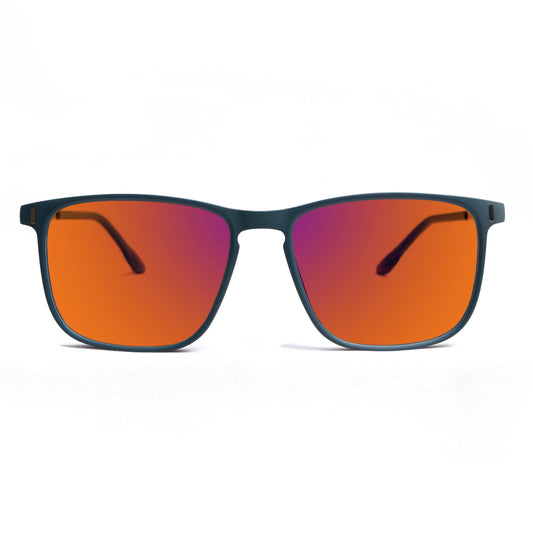
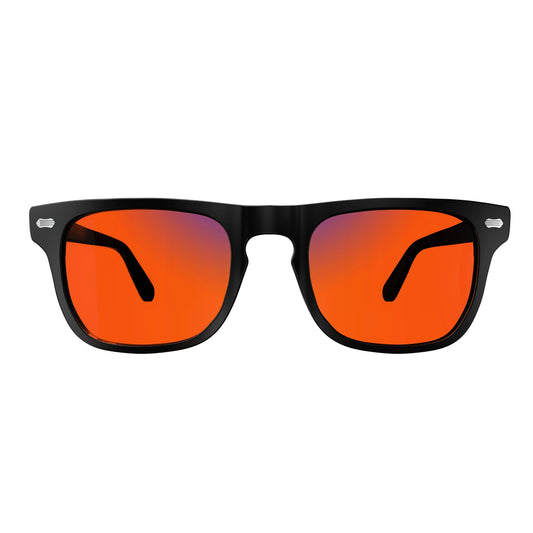
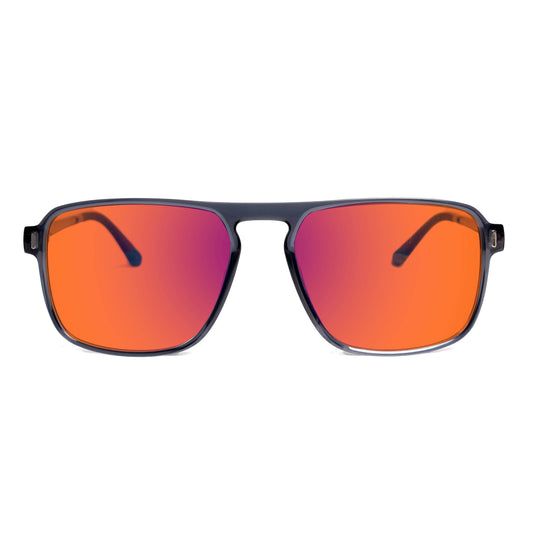
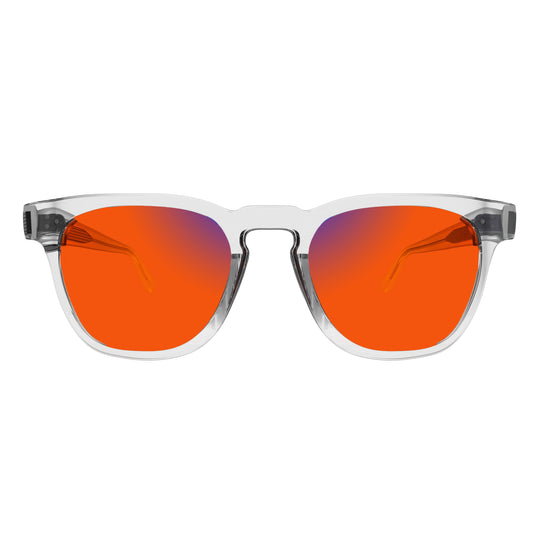
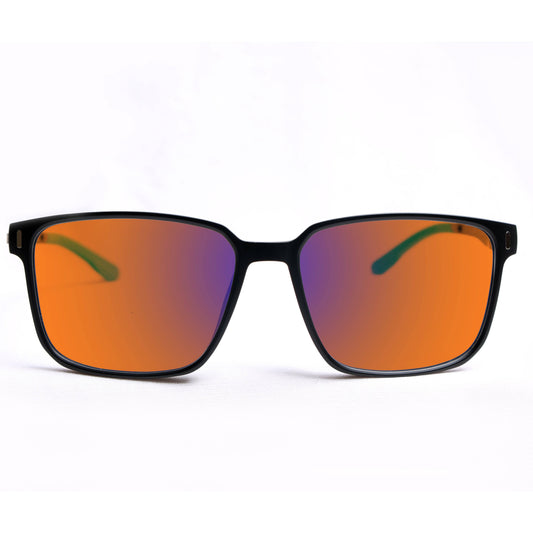
The solution backed by clinical trials isn't clear coatings — it's amber-tinted lenses worn in the evening.
Amber lenses block the entire melanopsin-activating range, from the deep blue end all the way up to approximately 560 nm — the upper boundary of the melanopsin sensitivity curve. By filtering these wavelengths, they allow your brain to register "nighttime" even while you're using screens.
The evidence:
- Burkhart & Phelps (2009) — Randomised trial: amber lenses improved sleep quality and mood over 3 weeks
- Shechter et al. (2018) — Randomised controlled trial: amber lenses improved sleep in insomnia patients
- van der Lely et al. (2015) — Amber lenses reduced the alerting effect of evening LED screens in teenagers
Why 560 nm Is the Magic Number
Not all amber lenses are created equal. Many generic orange-tinted glasses block "some" blue light across an undefined range. They don't publish spectral data. You have no idea what they're actually filtering.
The melanopsin photopigment — the molecule in ipRGC cells that detects blue light — has sensitivity extending all the way to approximately 560 nm. A lens that blocks up to 560 nm provides the most comprehensive melatonin protection. A lens that only blocks to 450 nm or 500 nm leaves the extended sensitivity range exposed.
This is why Sleepaxa's Circadian560™ technology (Patent Granted IN 597482) was named after this wavelength. It blocks 100% of blue light at peak, with blocking extending to the 560 nm boundary.
The Right Lens for the Right Time
This is where most people get confused. Here's the simple rule:
Morning and daytime → Yellow-tinted lenses (DayActive 1.0) These filter harsh HEV blue-violet light while keeping enough blue light through for daytime alertness. Your brain NEEDS blue light during the day to stay alert and keep your circadian clock on schedule. Blocking it during daytime is counterproductive.
Evening (2-3 hours before bedtime) → Amber lenses (Circadian560™) These block the full melanopsin activation range up to 560 nm. Wear them during evening screen time to let your natural melatonin production proceed normally.
Why not just one lens for everything? Because your brain needs OPPOSITE things at different times. Daytime = blue light for alertness. Evening = no blue light for sleep. One lens can't do both.
The Evening Protocol
Based on the published chronobiology research, here's how to use amber lenses most effectively:
- Start wearing 2-3 hours before your intended bedtime. This matches the natural melatonin onset window.
- Keep them on during ALL evening screen use. Even a few minutes of unfiltered phone light can partially reset melatonin suppression.
- Dim your room lights too. Combine amber lenses with reduced room lighting for maximum effect.
- Remove when you get into bed in the dark. The lenses have done their job once you're in darkness.
Frequently Asked Questions
Does blue light damage my eyes? No. The American Academy of Ophthalmology says there is no evidence of eye damage from screen blue light. The concern is circadian disruption (sleep), not tissue damage.
Why amber and not clear? Clear blue light glasses block 10-30% at 400-450 nm. The melatonin-suppressing wavelength peaks at 480 nm. Amber lenses block across the full melanopsin range. Different tools for different jobs.
Can I wear amber glasses all day? Not recommended. Blocking blue light during the day removes the alertness signal your brain needs. Use amber only in the evening. For daytime, use DayActive 1.0 (yellow tint).
What is Circadian560™? Sleepaxa's patented technology (IN 597482) that blocks 100% of blue light at the melanopsin peak, extending to 560 nm. It powers Sleepaxa Amber Sleep Glasses.
Where can I buy these? sleepaxa, Amazon India, and partner optometrist stores in 7+ Indian cities. Available with prescription.
References
- Gooley JJ, et al. (2011) — Room light suppresses melatonin by 85%. J Clin Endocrinol Metab.
- Burkhart K, Phelps JR. (2009) — Amber lenses improve sleep (RCT). Chronobiol Int.
- Shechter A, et al. (2018) — Amber lenses for insomnia (RCT). J Psychiatr Res.
- van der Lely S, et al. (2015) — Amber lenses reduce LED screen alerting in teens. J Adolesc Health.
- Berson DM, et al. (2002) — ipRGC discovery. Science.
- Brainard GC, et al. (2001) — Melatonin suppression action spectrum peaks at 460-480 nm. J Neurosci.
Suraj Dubey is the Founder of Sleepaxa (sleepaxa.in) — India's first photobiological eyewear company. ORCID: 0009-0003-7510-9254
Tags:
Previous
What Are FL-41 Glasses? A Simple Guide to the Migraine Lens Most People Have Never Heard Of
Next
The Hidden Light Sensors in Your Eyes That Control Migraines, Sleep, and Mood - What Science Discovered in 2002