

Are Blue Light Glasses a Scam? The Honest Truth (2026)
By Suraj Dubey — Senior Optometrist, Founder & Head of R&D, Sleepaxa Private Limited · Last updated: July 2026
Disclaimer: Educational content only, not medical advice. Sleepaxa lenses are designed for visual comfort and evening light management, not as a treatment, cure or prevention for any disease. Persistent migraine, sleep or metabolic concerns should be discussed with a qualified clinician.
Reviewed by: Dr. Monica Chaudhry — former AIIMS faculty, senior optometry academic (Clinical Advisor, Sleepaxa).
The Honest Answer
No — blue-light glasses are not a "scam." But the criticism ophthalmologists make is fair: most clear "blue-cut" lenses filter the wrong part of the spectrum (400–450 nm) and show limited clinical benefit for sleep or eye strain. The wavelength that actually drives melatonin suppression, migraine photophobia and circadian disruption is the ~480 nm melanopsin peak — and a truly transparent lens physically cannot block it without a visible amber tint. That single fact explains both the skepticism and the real solution.
Why Ophthalmologists Are Skeptical (and Right)
In 2023 the Cochrane Collaboration — the gold standard of medical evidence — reviewed 17 randomised controlled trials and concluded there is limited, low-certainty evidence that blue-light-filtering lenses reduce digital eye strain or improve sleep compared with ordinary lenses. The American Academy of Ophthalmology (AAO) similarly does not recommend special blue-light glasses for routine computer use, pointing instead to screen habits, blink rate and viewing distance.
Key evidence
Singh S, et al. (2023). Blue-light filtering spectacle lenses for visual performance, sleep and macular health. Cochrane Database Syst Rev, CD013244. — plus AAO guidance on computer eyewear (2024).
Singh S, et al. (2023). Blue-light filtering spectacle lenses for visual performance, sleep and macular health. Cochrane Database Syst Rev, CD013244. — plus AAO guidance on computer eyewear (2024).
So the skeptics have a point. But here's what the headlines miss: the studies tested clear lenses that filter 400–450 nm. They did not test whether blocking the biologically active 480 nm band helps. Absence of evidence for one design is not evidence against the whole idea.
Blue Light at the Wrong Time Is a Real Problem
Filtering blue light poorly does not mean blue light is harmless. Decades of circadian research — and new large-scale data — show that evening blue light genuinely disrupts human biology:
1. It suppresses melatonin and delays sleep
Harvard researchers showed ordinary room light before bed can suppress melatonin and shorten its duration (Gooley et al., 2011), and evening screen light delays the body clock and next-morning alertness (Chang et al., 2015). The sensor responsible peaks at ~480 nm.
2. It worsens migraine and light sensitivity
Migraine photophobia is driven by intrinsically photosensitive retinal ganglion cells (ipRGCs) and a separate cone pathway (Noseda et al., 2010; 2016). Blue-cyan light around 480–520 nm amplifies pain; this is why FL-41 tints — not clear lenses — are used clinically.
3. New evidence links night light to metabolic risk
A 2024 study in The Lancet Regional Health – Europe analysed roughly 13 million hours of personal light-sensor data across ~85,000 people and found that brighter light at night and circadian-disrupting light patterns were associated with a higher incidence of type 2 diabetes, independent of genetics and lifestyle. The authors noted that avoiding light at night could be a simple, low-cost risk-reduction step.
New research
Personal light exposure patterns and incidence of type 2 diabetes (2024). The Lancet Regional Health – Europe. ~85,000 participants; ~13 million hours of light data; ~670,000 person-years. Association study — not proof that glasses prevent diabetes, but strong evidence that evening light matters.
Personal light exposure patterns and incidence of type 2 diabetes (2024). The Lancet Regional Health – Europe. ~85,000 participants; ~13 million hours of light data; ~670,000 person-years. Association study — not proof that glasses prevent diabetes, but strong evidence that evening light matters.
Important: this is an association, and no eyewear prevents or treats diabetes. The takeaway is simpler — evening light exposure is biologically meaningful, so how you manage it matters.
The Core Limitation of Clear "Transparent" Blue-Light Glasses
This is the part almost no brand explains honestly. Colour is physics. To block a wavelength, a lens must absorb it — and absorbing blue light (450–500 nm) removes blue from what passes through, which makes the lens look yellow or amber. There is no way around it:
The transparency trade-off
A lens that looks perfectly clear is, by definition, letting almost all visible blue through — including the ~480 nm melanopsin peak. Clear "blue-cut" coatings mostly trim 400–430 nm violet (which is a small slice) and reflect a little blue. They cannot block the 460–500 nm band that drives melatonin suppression without taking on a visible tint.
So clear blue-light glasses aren't fake — they do filter some high-energy violet and can cut glare/reflections for screen comfort. They just can't do the circadian job people buy them for. That job requires a tint.
Why Amber & Orange Lenses Are the Real Fix for Sleep
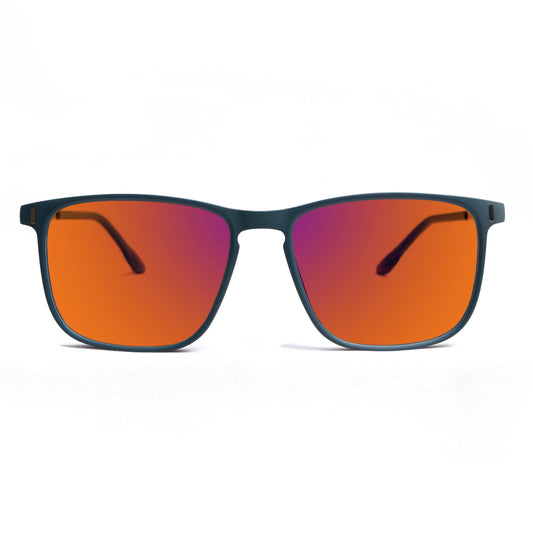
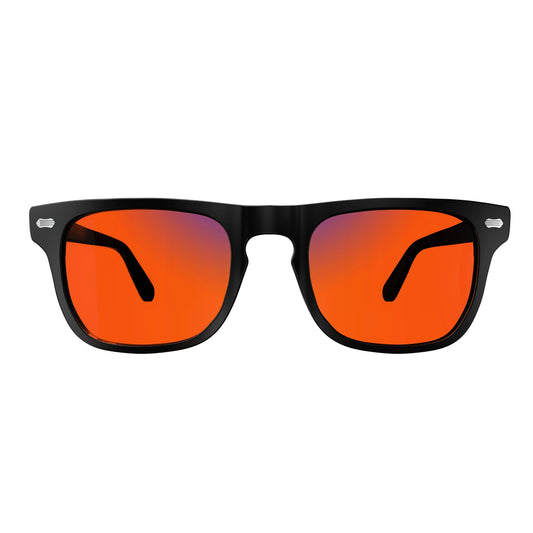
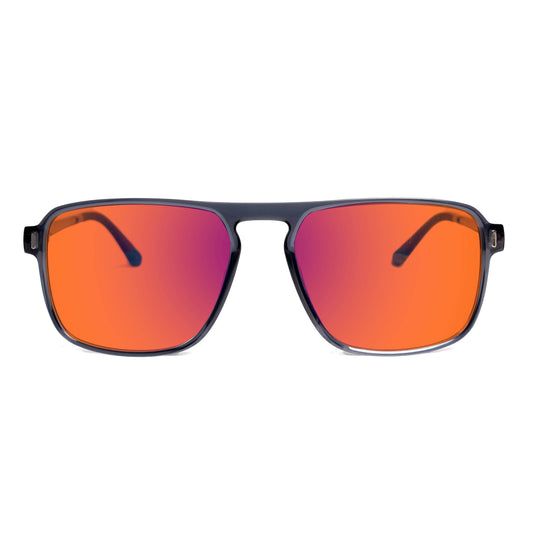
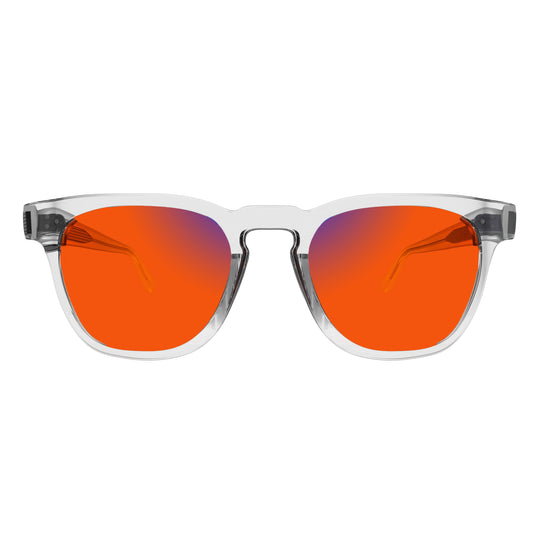
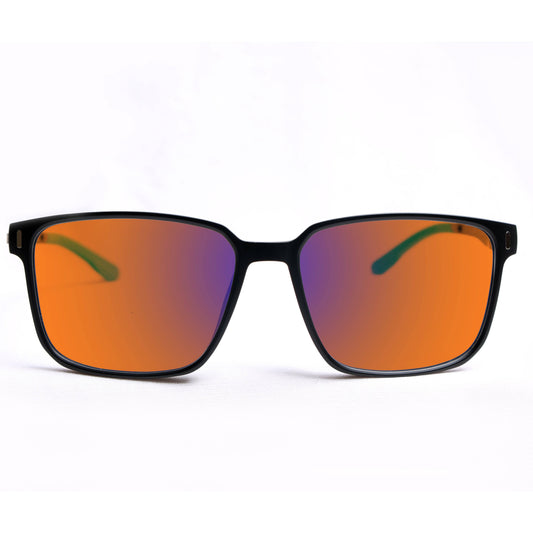
Amber and orange lenses absorb the blue-green band, so they can block the melanopsin peak. The clinical signal is much stronger here:
Burkhart & Phelps (2009) found amber lenses worn before bed improved sleep quality, and Shechter et al. (2018) found blue-blocking (amber) glasses improved sleep in people with insomnia. These trials used tinted lenses — not clear ones.
Sleepaxa's sleep lenses are engineered and independently lab-tested to this exact target (ISO 12312-1 / ANSI Z80.3 reports):
| Lens | Blue signal 380–500 nm (Tsb) | What it means | Best for |
|---|---|---|---|
| Amber Evening Sleep | 0.13% | ~100% block to ~500 nm (incl. 480 nm peak); keeps green/amber for colour balance | Everyday evening, indoor + outdoor |
| Circadian560 (Patent Granted IN 597482) | 0.00% | 100% block right up to ~560 nm — maximum circadian protection | Advanced / biohacker, indoor evening |
| Red Sleep | 0.00% | Deep block below ~560 nm, VLT ~15% — the darkest, red-tinted deep-sleep option | Deep pre-sleep wind-down, indoor only |
| Generic clear "blue-cut" | Mostly 400–430 nm only | Leaves the 460–500 nm melanopsin band largely intact | Light screen glare comfort |
Blue Light by Problem: What Actually Helps
| Concern | Wavelength that matters | What works | What doesn't |
|---|---|---|---|
| Sleep / melatonin | ~480 nm (melanopsin) | Amber / Circadian560 (tinted) | Clear blue-cut |
| Migraine / photophobia | 480–520 nm + 585–600 nm | FL-41 / dual-band NeuroCalm FLX+ | Clear blue-cut; dark sunglasses indoors |
| Circadian / metabolic hygiene | Evening light load | Evening amber + darkness habits | Bright evening screens, clear lenses |
| Daytime screen strain | Multifactorial (blink, distance, breaks) | Breaks + a light HEV filter (yellow) is enough | You do not need dark lenses by day |
The honest verdict
Blue-light glasses are not a scam — but "a clear lens will protect my sleep" is the myth. Match the lens to the job: a light yellow HEV filter for daytime comfort, and a genuine amber tint when you want circadian and sleep benefit.
Get the Right Lens for the Right Job
India's first photobiological eyewear company · 9 published research works · 6 patents (2 granted) · lab-tested lenses · zero-power & prescription.
Amber & Circadian560 Sleep Glasses FL-41 Migraine Glasses DayActive Daytime GlassesFrequently Asked Questions
Are blue light glasses a scam?
No, but clear "blue-cut" lenses are widely over-sold. A 2023 Cochrane review of 17 trials found only limited, low-certainty evidence that clear blue-light lenses reduce eye strain or improve sleep, because they filter 400–450 nm while the biologically active melanopsin peak is at ~480 nm. Tinted amber lenses, which can block that peak, have stronger sleep evidence.
Do clear blue-light glasses help you sleep?
Generally no. A transparent lens, by definition, lets most visible blue (including ~480 nm) pass through, so it cannot meaningfully block the wavelength that suppresses melatonin. For sleep, an amber or orange tint is needed — clear lenses simply cannot do the circadian job.
Why do ophthalmologists say blue light glasses don't work?
They are referring to clear blue-cut lenses for digital eye strain, where the evidence is weak (Cochrane 2023; AAO guidance). Digital eye strain is mostly caused by reduced blinking, viewing distance and screen time. This criticism is valid for clear lenses, but does not apply to tinted amber lenses used for evening circadian protection or FL-41 lenses used for migraine photophobia.
Does blue light at night cause diabetes?
Blue light does not directly "cause" diabetes, but a large 2024 study in The Lancet Regional Health – Europe (~85,000 people, ~13 million hours of light data) found that greater light exposure at night was associated with higher incidence of type 2 diabetes, likely through circadian disruption. It suggests managing evening light is a sensible health habit — no eyewear treats or prevents diabetes.
Are amber glasses better than clear blue blockers?
For sleep and circadian protection, yes. Amber and orange lenses absorb the 460–500 nm blue-green band and can block the melanopsin peak — which is why amber lenses (not clear ones) were used in the positive sleep trials (Burkhart & Phelps 2009; Shechter 2018). For daytime screen comfort, a light yellow filter or simply taking breaks is enough.
Do I need blue light glasses during the day?
You do not need dark or amber lenses during the day — daytime blue light around 460–490 nm actually supports alertness and a healthy body clock. If bright screens feel harsh, a light yellow HEV filter (like Sleepaxa DayActive) trims the harsh violet-blue while preserving daytime clarity and traffic-signal recognition. Save amber for the evening.
What is the melanopsin peak and why does it matter?
Melanopsin is a light-sensitive protein in ipRGC retinal cells that sets your body clock and influences migraine pain. It is most sensitive at about 480 nm. Because that wavelength sits in the visible blue-cyan range, blocking it requires a lens that absorbs blue — i.e., a visible amber tint — which is why clear lenses fall short.
How is Sleepaxa different from generic blue-cut brands?
Sleepaxa builds wavelength-specific, lab-tested lenses instead of generic clear "blue-cut" coatings: amber and Circadian560 for evening/sleep, FL-41 and dual-band NeuroCalm FLX+ for migraine, and DayActive for daytime. Each is backed by published research (9 DOI-linked works) and patents (6; 2 granted — Patent Nos. 587746 & 597482), designed by an optometrist with clinical advisory input.
References
1. Singh S, et al. (2023) Blue-light filtering spectacle lenses. Cochrane Database Syst Rev. CD013244.
2. American Academy of Ophthalmology (2024) Guidance on computer/blue-light eyewear.
3. Gooley JJ, et al. (2011) Room light before bedtime suppresses melatonin. JCEM. 96:E463–E472.
4. Chang AM, et al. (2015) Evening use of light-emitting eReaders. PNAS. 112:1232–1237.
5. Shechter A, et al. (2018) Blocking nocturnal blue light for insomnia: a randomized trial. J Psychiatr Res. 96:196–202.
6. Burkhart K, Phelps JR (2009) Amber lenses to block blue light and improve sleep. Chronobiol Int. 26:1602–1612.
7. Noseda R, et al. (2010) Neural mechanism for exacerbation of headache by light. Nat Neurosci. 13:239–245.
8. Noseda R, et al. (2016) Migraine photophobia from cone-driven retinal pathways. Brain. 139:1971–1986.
9. Personal light exposure patterns and incidence of type 2 diabetes (2024). The Lancet Regional Health – Europe.
10. Good PA, et al. (1991) Tinted spectacles in childhood migraine. Cephalalgia.
Suraj Dubey is Founder & Head of R&D at Sleepaxa Private Limited, India's first photobiological eyewear company. Inventor of NeuroCalm FLX+™ and Circadian560™. ORCID: 0009-0003-7510-9254.
Tags:
Previous
India's Most Innovative Eyewear Company 2026: 6 Patents, 9 Papers
Next
Amber vs Red vs Circadian560 Sleep Glasses: Which to Choose