

The Hidden Light Sensors in Your Eyes That Control Migraines, Sleep, and Mood - What Science Discovered in 2002
This article is based on our published research:
Dubey S, Chaudhry M (2026). Intrinsically Photosensitive Retinal Ganglion Cells (ipRGCs): Subtypes, Signalling Pathways, and Implications for Photobiological Eyewear Design.
Zenodo (DOI): 10.5281/zenodo.19500137
Academia.edu: Read on Academia
Earlier paper: 10.5281/zenodo.19422123
What if I told you that your eyes contain a secret set of light sensors that have nothing to do with seeing? That these sensors directly control your sleep, amplify your migraine pain, and even affect your mood - and that scientists didn't even know they existed until 2002?
These cells are called ipRGCs (intrinsically photosensitive retinal ganglion cells), and their discovery has completely changed how we understand the relationship between light and the human brain. More importantly, it has changed how we design eyewear.
This article breaks down what ipRGCs are, what they do, and why they matter for anyone who suffers from migraines, light sensitivity, or poor sleep.
Your Eyes Have 3 Types of Light Sensors, Not 2
In school, you learned about two types of cells in your retina:
Rods - about 120 million per eye. They help you see in dim light. They don't detect colour.
Cones - about 6 million per eye. Three types (S, M, L) that detect blue, green, and red light. They give you colour vision.
For over a century, scientists believed these were the only light-detecting cells in the human eye. Then in 2002, two research teams publishing in the journal Science discovered something extraordinary: a third type of photoreceptor that nobody knew existed.
These cells - ipRGCs - number only about 5,000 per eye. They contain a unique light-sensitive protein called melanopsin. And unlike rods and cones, they have absolutely nothing to do with helping you see images.
Instead, they measure the colour and intensity of ambient light and send that information directly to parts of your brain that control:
- Your body clock (sleep-wake cycle)
- Pain processing (migraine photophobia)
- Pupil size
- Mood and alertness
What Makes These Cells Special?
ipRGCs are different from rods and cones in three critical ways:
1. They detect a very specific colour of light
Melanopsin - the photopigment in ipRGCs - is most sensitive to light at exactly 480 nanometres (blue-cyan light). This is different from what rods detect (498 nm) and what cones detect (420, 530, 560 nm). This specific wavelength sensitivity is why certain colours of light affect your brain differently.
2. They don't adapt to light
When you walk from a dark room into sunlight, your eyes adjust within seconds - that's rod and cone adaptation. But ipRGCs don't adapt. Once activated by 480 nm light, they keep firing steadily for as long as the light is present. Minutes, hours - they don't stop. This makes them perfect for measuring sustained ambient light levels, which is exactly what your body clock needs.
3. They don't help you see
ipRGCs send their signals to completely different parts of the brain than rods and cones. Rods and cones send information to the visual cortex (for seeing). ipRGCs send information to the SCN (body clock), the posterior thalamus (pain centre), and other non-visual brain regions.
This is why some completely blind people - with zero rod and cone function - still have normal sleep-wake cycles. Their ipRGCs still work.
The 5 Subtypes: Not All ipRGCs Are the Same
Research has identified five types of ipRGCs, labelled M1 through M5:
| Type | Melanopsin Level | Main Job | Why It Matters |
|---|---|---|---|
| M1 | Highest | Controls body clock + pupil reflex | PRIMARY target for sleep glasses |
| M2 | Moderate | Body clock + some vision | Secondary target |
| M3 | Moderate | Body clock + pupil | Secondary target |
| M4 | Low | Brightness perception | Less relevant for eyewear |
| M5 | Low | Colour discrimination | Less relevant for eyewear |
M1 cells are the most important for photobiology. They have the most melanopsin, respond strongest to light, and project directly to your body clock (SCN). When we design sleep glasses, M1 cells are the primary target.
How ipRGCs Control Your Sleep
Here's the chain of events:
Step 1: Blue-cyan light (460-490 nm) from screens, LEDs, or sunlight hits the ipRGC cells in your retina.
Step 2: Melanopsin absorbs the light and activates the cell. The cell starts firing electrical signals.
Step 3: These signals travel through a dedicated pathway called the retinohypothalamic tract (RHT) directly to your SCN - the master clock in your brain.
Step 4: The SCN interprets this signal as "it's daytime" and suppresses melatonin production from the pineal gland.
Step 5: Without melatonin, your body doesn't get the "prepare for sleep" signal. You stay awake.
A Harvard study (Gooley et al., 2011) measured exactly how powerful this effect is: normal room lighting (~200 lux) suppressed melatonin production by 85% and delayed sleep onset by 90 minutes.
This is why your phone screen at midnight tells your brain it's noon. The 450-490 nm blue peak from the LED screen directly activates your ipRGC melanopsin, which tells your SCN "daytime!", which blocks melatonin. Your body has no idea it's actually midnight.
How ipRGCs Make Migraines Worse
In 2010, Dr. Rodrigo Noseda at Harvard published a groundbreaking study in Nature Neuroscience. He discovered that ipRGCs don't just connect to the body clock - they also connect to the brain's pain centre.
Specifically, ipRGC signals arrive at neurons in the posterior thalamus that ALSO receive pain signals from the trigeminal nerve (the nerve that carries headache pain from the membranes around your brain).
The result: when light activates your ipRGCs during a migraine, the light signal literally adds to the pain signal at the same neurons. Light amplifies your headache. This is why 80-90% of migraine patients are photophobic (light-sensitive) during attacks.
The pathway: LIGHT (480 nm) hits ipRGCs in retina → signals travel to posterior thalamus → converge with HEADACHE PAIN signals from trigeminal nerve → amplified pain reaches cortex → worse headache.
This is exactly why FL-41 lenses work - they filter 480-520 nm light before it reaches your ipRGCs, reducing the light signal that amplifies your pain.
The 2016 Discovery: It's Not Just Blue Light
Noseda published again in 2016 in the journal Brain with an even more important finding:
| Wavelength | Colour | Effect on Migraine | Mechanism |
|---|---|---|---|
| ~480 nm | Blue | Makes it WORSE | ipRGC / melanopsin pathway |
| ~590 nm | Amber | Makes it WORSE | Cone-driven pathway (different!) |
| ~530 nm | Green | REDUCES pain | Only colour that helps |
This means a migraine lens that only blocks blue light is only doing half the job. The ideal lens needs to:
- Block blue-cyan (460-490 nm) - the ipRGC trigger
- Block amber (585-600 nm) - the cone-driven trigger
- PRESERVE green (520-560 nm) - the pain-reducing band
This is exactly what Sleepaxa's NeuroCalm FLX+ technology does - dual-band filtration targeting both pain pathways while preserving the beneficial green band. Patent granted: IN 587746.
The Melanopsin Sensitivity Chart
Every lens design decision comes down to this chart:
| Wavelength | Melanopsin Sensitivity | What It Means |
|---|---|---|
| 420 nm | ~30% | Some activation |
| 460 nm | ~80% | High - sleep lens blocking should start here |
| 480 nm | ~100% (PEAK) | Maximum - most important wavelength in photobiology |
| 500 nm | ~80% | FL-41 filtration zone |
| 520 nm | ~50% | FL-41 upper boundary |
| 540 nm | ~25% | Green comfort zone - PRESERVE this |
| 560 nm | ~10% | Upper boundary - Circadian560 target |
| 580+ nm | <5% | Negligible melanopsin activation |
This is why Sleepaxa's Circadian560 technology (Patent Granted IN 597482) blocks up to the 560 nm boundary - because melanopsin sensitivity extends that far. Generic blue light glasses that only block 400-450 nm miss the entire peak zone.
What This Means for Your Glasses
Based on the complete ipRGC science:
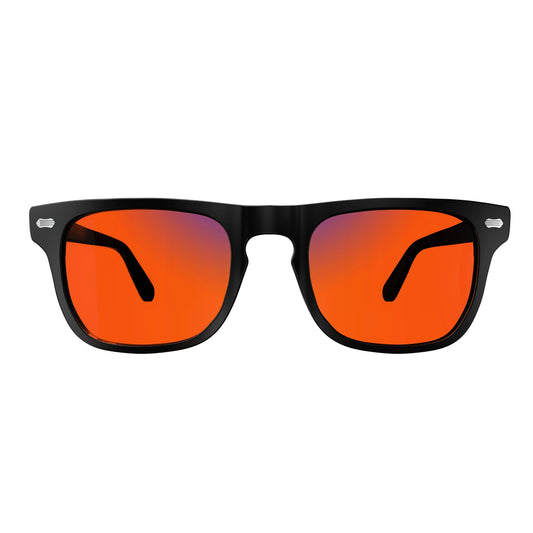
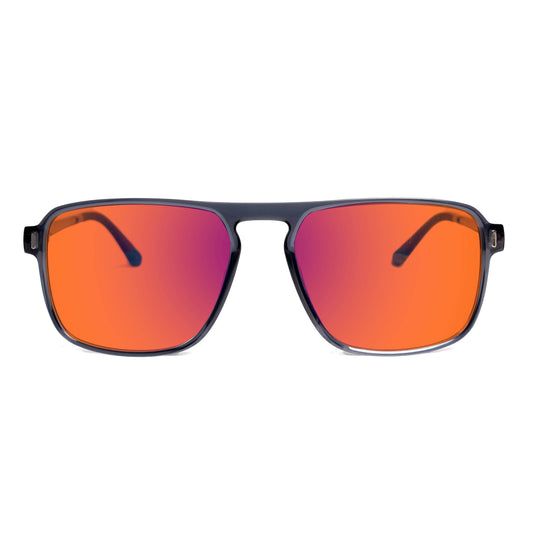
For migraine and photophobia: You need FL-41 filtering at 480-520 nm (plus 585-600 nm for the cone pathway). This is what NeuroCalm FLX+ does. Sleepaxa FL-41 Migraine Glasses.
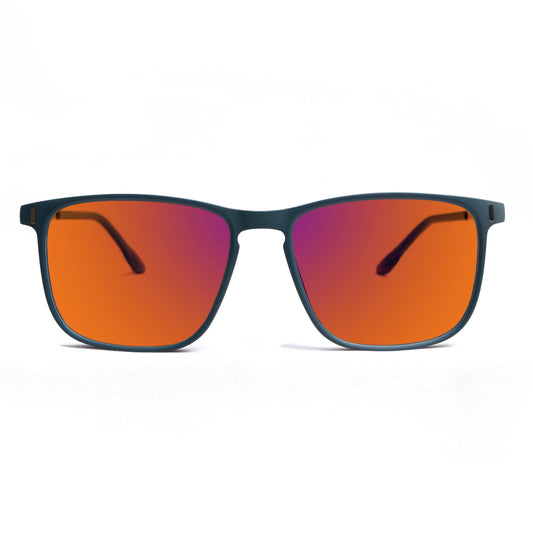
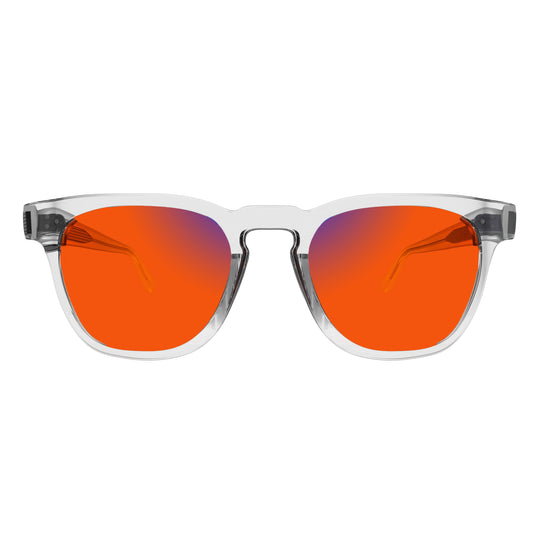
For sleep protection: You need amber lenses blocking the full melanopsin range up to 560 nm, worn 2-3 hours before bedtime. This is what Circadian560 does. Sleepaxa Amber Sleep Glasses.
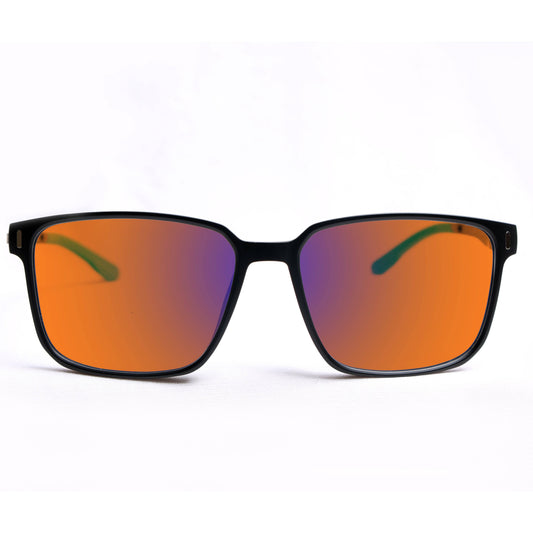
For daytime screen use: You need yellow lenses that filter harsh blue-violet while preserving alerting blue light. This is DayActive 1.0. Sleepaxa DayActive 1.0.
Three different problems. Three different wavelength solutions. Because ipRGC science tells us that one lens cannot solve all three.
Read the Full Research
Paper 1: Wavelength-Selective Filtration in Photobiological Eyewear
https://doi.org/10.5281/zenodo.19422123
Paper 2: ipRGCs: Subtypes, Signalling Pathways, and Implications for Photobiological Eyewear Design
https://doi.org/10.5281/zenodo.19500137
Academia.edu:
Read on Academia.edu
Both papers are open-access and free to download.
Frequently Asked Questions
What are ipRGCs in simple terms?
They are a third type of light sensor in your eyes, discovered in 2002. Unlike rods and cones (which help you see), ipRGCs measure ambient light colour and control your body clock, pain sensitivity, and mood.
Why do my migraines get worse in bright light?
Because ipRGCs in your retina send light signals to the same brain neurons that process headache pain. Light literally amplifies the pain signal. This was proven by Harvard researcher Noseda in 2010.
Why doesn't my blue light glasses help with migraines?
Most blue light glasses block 400-450 nm. The migraine-triggering wavelength is 480 nm (melanopsin peak). Plus, amber light (590 nm) also worsens migraine through a separate pathway. Generic glasses miss both.
What is melanopsin?
The light-sensitive protein inside ipRGC cells. It responds most strongly to 480 nm (blue-cyan) light. It controls melatonin suppression and pain pathway activation.
Why can't I sleep after using my phone?
Your phone's LED screen peaks at 450-490 nm - right at the melanopsin activation zone. Your ipRGCs detect this and tell your brain "it's daytime." Melatonin is suppressed by up to 85%.
What is the 560 nm boundary?
It's the approximate upper limit of melanopsin sensitivity. A sleep lens that blocks up to 560 nm provides the most comprehensive melatonin protection. This is why Circadian560 is named after this wavelength.
References
- Berson DM, et al. (2002) Science - ipRGC discovery
- Hattar S, et al. (2002) Science - Melanopsin + SCN projection
- Noseda R, et al. (2010) Nature Neuroscience - Light amplifies migraine pain
- Noseda R, et al. (2016) Brain - Wavelength-dependent pain modulation
- Schmidt TM, et al. (2011) Trends in Neurosciences - M1-M5 subtypes
- Gooley JJ, et al. (2011) JCEM - Melatonin suppression by 85%
- Do MTH, Yau KW (2010) Physiological Reviews - ipRGC comprehensive review
- Brainard GC, et al. (2001) J Neuroscience - Melatonin suppression action spectrum
Suraj Dubey is the Founder & Head of R&D at Sleepaxa (sleepaxa.in) - India's first photobiological eyewear company. ORCID: 0009-0003-7510-9254
Tags:
Previous
Why Your Phone Wrecks Your Sleep — And the Simple Fix Most People Don't Know About
Next
Why Blocking Blue Light Isn't Enough for Migraines | Sleepaxa